
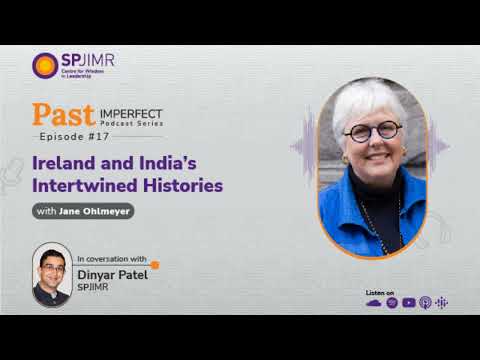
This blog post delves into the complex historical connections between Ireland and India, highlighting the shared colonial experiences, influential figures, and the impact of Irish nationalism on Indian independence movements. It discusses the role of Irish individuals in the British Empire, the cultural exchanges between the two nations, and the ongoing legacies of colonialism in both societies.
In this episode of Past Imperfect, we explore the fascinating and often overlooked connections between Ireland and India, two countries that, on the surface, seem vastly different. Our guest, Jane Ohlmeyer, a professor of history at Trinity College Dublin and author of "Making Empire," sheds light on the shared colonial experiences that have shaped the histories of both nations.
Ireland and India, while distinct in many ways, share a common history of colonization. Ireland was England's oldest colony, while India was its largest. This shared experience has led to significant interactions between the two countries, particularly during the colonial period. Ohlmeyer emphasizes that many Irish individuals served as officials, bureaucrats, and soldiers in colonial India, creating a complex web of connections.
Researching the intertwined histories of Ireland and India presents challenges, particularly regarding the availability of archives. Historians often rely on English-language records, which can obscure the voices of indigenous populations. Ohlmeyer notes that while there are extensive archives related to the British Empire, much of the material is fragmented and requires careful interpretation to uncover the stories of marginalized groups.
One notable figure in this narrative is Gerald Ainger, the second governor of Bombay, who played a crucial role in shaping the city during the late 17th century. Ainger, an Irishman from Dublin, drew on his heritage to foster a diverse and prosperous community in Bombay, promoting religious tolerance and economic development.
Ainger's tenure as governor saw significant growth in Bombay's population and infrastructure. He encouraged various communities to settle in the city, including Indian merchants and Armenians, and established legal and economic frameworks that laid the foundation for Bombay's future success. His legacy is still evident today, with street names and institutions in Mumbai reflecting his influence.
The nationalist movements in Ireland and India were contemporaneous and often drew inspiration from one another. Figures like Charles Stewart Parnell and Annie Besant became symbols of collaboration between the two movements. Ohlmeyer highlights how Irish nationalists recognized the parallels between their struggles and those of Indian nationalists, particularly in terms of poverty and exploitation under British rule.
Irish nationalism provided a framework for Indian leaders like Mahatma Gandhi and Bal Gangadhar Tilak, who adopted strategies of peaceful protest and agrarian resistance. The connections between the two movements were not just ideological; they also involved personal relationships and exchanges of ideas that shaped the course of both nations' struggles for independence.
Today, both Ireland and India grapple with the legacies of colonialism. In India, the impact of British rule is a frequent topic of political discourse, while in Ireland, there has been a growing interest in acknowledging the complexities of its colonial past. Ohlmeyer notes that while Ireland has made strides in confronting its history, the legacy of colonialism remains a contentious issue, particularly in Northern Ireland.
The way both countries remember and reflect on their colonial pasts varies significantly. In Ireland, there has been a shift towards recognizing the contributions of Irish individuals to the British Empire, while in India, the focus often remains on the injustices of colonial rule. Ohlmeyer emphasizes the importance of using history as a tool for understanding and reconciliation rather than division.
The intertwined histories of Ireland and India reveal a rich tapestry of shared experiences, struggles, and legacies. As both nations continue to navigate their post-colonial identities, the connections forged during the colonial era remain relevant. Understanding these histories not only enriches our knowledge of the past but also informs the ongoing dialogues about identity, nationalism, and the legacies of empire in both countries.



















