
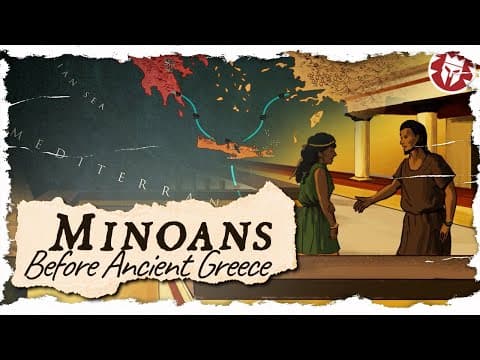
The Minoan civilization of ancient Crete, flourishing during the Bronze Age, was a complex and prosperous society distinct from later Greek culture. Known for its palatial architecture, vibrant trade networks, undeciphered scripts, and rich artistic traditions, the Minoans influenced the wider Aegean region. Despite myths surrounding King Minos and the labyrinth, archaeological evidence reveals a sophisticated culture with unique social, religious, and economic structures.
Emerging from the clear blue waters of the Mediterranean, the island of Crete is renowned for its lush mountains and pristine beaches. While today it is part of modern Greece, Crete has always maintained a distinct history and identity, markedly different from the rest of Greece. This uniqueness is reflected in Greek mythology, which portrays Crete as a distant, mysterious land ruled by the mythical King Minos, home to the labyrinth and the minotaur.
The most famous chapter in Cretan history is the ancient Bronze Age Minoan civilization, which thrived before the arrival of Greek culture and language on the island. Early 20th-century archaeologists associated this civilization with the legendary King Minos. However, the actual connection between the Minoans and the mythic labyrinth-building monarch remains uncertain.
The Minoans existed on Crete for nearly two millennia, producing remarkable culture and architecture. They engaged in extensive mercantile activities throughout the Aegean and as far east as Egypt. This article explores the labyrinthine history of Minoan Crete, revealing the reality behind the myths.
The term "Minoan" was coined by archaeologist Arthur Evans, who excavated the ancient palace of Knossos in the early 1900s. He derived the name from the myth of King Minos, who was said to rule the seas and whose minotaur was slain by Theseus, the founder hero of Athens.
Despite Evans' pioneering work, much about the Minoans remains a mystery. We do not know what they called themselves or the exact nature of their ethnic identity. The Minoans used at least two writing systems: an earlier hieroglyphic script (seen on artifacts like the Phaistos Disc) and the later Linear A script. Neither has been deciphered, but Linear A does not appear to correspond to the Greek language, suggesting the Minoans were not Greek speakers.
Some historians propose that Crete was home to multiple ethnolinguistic groups during the Bronze Age, further complicating our understanding.
Minoan culture dates back over 5,000 years, around the end of the 4th millennium BC, contemporaneous with the early dynastic period of Egypt and the emergence of the Indus Valley civilization. Neolithic settlements on Crete began to coalesce into larger communities, marked by a shift from unpainted to painted ceramics.
This period, known as the Prepalatial period, lasted about a millennium and is divided into phases: Early Minoan 1, 2, and 3, and Middle Minoan 1. Early Minoan 1 saw the growth of settlements but little evidence of trade or social stratification. By Early Minoan 2 (2900–2650 BC), settlements grew larger, and the first Minoan seals appeared, indicating the start of trade with the wider Mediterranean.
Elite tombs emerged during Early Minoan 3 (2300–2000 BC), signaling increasing social stratification. This millennium laid the foundation for Crete's rise as an industrial and mercantile hub.
The Prepalatial period ended with Middle Minoan 1 (2100–1900 BC), when the first palatial complexes appeared at sites like Knossos, Phaistos, Malia, and Zakros. These palaces likely served as administrative centers managing agriculture and trade.
Contrary to popular images of colorful palaces with red pillars, these reconstructions by Evans may distort the reality. The palaces featured large courtyards, collapsible roofs for summer ventilation, and bathhouses with flushable toilets.
Smaller settlements and shrines in mountain peaks and caves also increased. Industries such as obsidian working and weaving developed within the palaces, controlled by elites.
Trade relations intensified with the Near East, Egypt, Asia Minor, and mainland Greece. The Middle Minoan 2 period (1875–1800 BC) saw further centralization, with palaces producing weaving, pottery, and metallurgical goods.
The need for managing agricultural surplus and goods led to the creation of the hieroglyphic and Linear A scripts, used for logistics and possibly religious texts. Linear A survived until around 1450 BC and influenced the Cypro-Minoan script of Cyprus.
Minoan culture spread across the Aegean, reaching islands like Thera (Santorini) and mainland sites near the Peloponnese. Early scholars described Minoan society as a thalassocracy—a naval empire controlling the Aegean Sea. However, recent research suggests there was no centralized state ruling over the sea; rather, elites across the region emulated Crete's prestigious culture.
Crete became a center of trade and culture, exporting elegant art, jewelry, and pottery. Minoan traders appear in ancient Egyptian temple records, and Minoan-style frescoes have been found in Egyptian villas dating to 1450 BC.
Imagine a Minoan trader setting off from Kastelli near modern Heraklion, Crete, with a ship laden with obsidian and pottery. He visits the island of Kea, praying at the only known Minoan sanctuary outside Crete, then sails to Thera to see the ruins of its settlement. Next, he travels to a city in Asia Minor where Minoans and locals trade goods. After acquiring raw materials, he returns home, singing to the wind, bringing wealth and goods to his family.
This journey illustrates the extensive trade networks and cultural exchanges that defined Minoan prosperity.
Minoan society has been subject to many interpretations, often influenced by their magnificent art. For example, signet rings depict women in gardens with others prostrating before them, possibly representing priestesses or goddesses, though this remains speculative.
Minoan art is characterized by naturalistic motifs, from squids on pottery to flowers in frescoes. Famous frescoes include the "Lady in Blue" and the "Prince of the Lilies," though the social status of these figures is unclear.
Processions featuring gifts like bull heads appear in palatial art, possibly representing public celebrations. The "Toreador Fresco" shows youths leaping over bulls, a mysterious practice that may have religious significance.
Minoan religion emphasized natural elements, with frequent depictions of bulls and bowls. Cave and mountain peak sanctuaries reveal offerings of bronze weapons and terracotta figurines. Some evidence suggests human sacrifice, though its extent is debated.
Statues hint at worship of a mother or snake goddess and a youthful male deity. Some Greek deities, such as the sea goddess Diktynna and childbirth goddess Eileithyia, may have Minoan origins. Minoans buried their dead in house tombs or tholos tombs, varying by region.
The Postpalatial period (Late Minoan 2 and 3, c. 1470–1000 BC) saw the arrival of Mycenaean Greeks from the Peloponnese. Inspired by Minoan culture, the Mycenaeans developed their own elite practices and signet rings but spoke Greek.
Palaces shrank but remained economic and cultural centers. Linear A script fell out of use, replaced by Linear B tablets, which are Greek. Interestingly, more Linear B tablets have been found in Crete than mainland Greece.
It is unclear whether the Mycenaeans conquered Crete or settled peacefully. Some Minoans may have joined the "Sea Peoples," raiders mentioned in Near Eastern records.
The gradual decline of palatial complexes led to the Geometric period (1100–800 BC), when Greek city-states solidified their presence on Crete. Homer mentions various peoples living on the island alongside Greeks, indicating continued multiculturalism.
By Homer's time, the Minoan palatial era was a distant memory, preserved only in myths of Minos, the Minotaur, Daedalus, and the labyrinth. However, their influence persisted in Greek culture, especially in religion.
Throughout their civilization, the Minoans achieved cultural, architectural, and artistic heights admired from Santorini to Egypt. Early 20th-century archaeological reconstructions have shaped modern perceptions, but the true Minoan story is one of industrious people thriving in vibrant trade and cultural networks.
Visitors to Knossos should look beyond fanciful reconstructions to appreciate the real archaeological sites and the magnificent Bronze Age culture they represent.
The Minoan civilization of Crete was a remarkable Bronze Age society with a rich cultural heritage distinct from later Greek culture. Their achievements in architecture, art, trade, and administration laid the groundwork for the civilizations that followed. While myths have colored their story, archaeological research continues to uncover the fascinating reality of this ancient people.
More explorations of ancient Bronze Age societies will continue to shed light on the complex tapestry of human history in the Mediterranean and beyond.



















