The Malaysian Ringgit is more than just currency; it reflects the country's culture, history, and natural wonders through its unique designs and security features. This blog post delves into the various denominations, their significance, and the largest banknote in the world, showcasing Malaysia's vibrant identity.
Banknotes are objects that pass through our hands every day, yet they hold much more significance than mere pieces of paper or plastic. They serve as a country's business card, encapsulating its culture and history in a colorful and accessible format. The Malaysian Ringgit is a prime example of this phenomenon, self-described as distinctively Malaysian. In this blog post, we will explore the culture, traditions, history, and natural wonders represented in the Malaysian Ringgit, as well as the intriguing fact that it includes the largest banknote in the world.
The Malaysian Ringgit is available in six denominations, ranging from the 1 Ringgit (approximately 18 pence or 24 US cents) to the 100 Ringgit (about 18 pounds or 24 US dollars). Each note is characterized by its vivid color, but the front designs are fairly uniform. They feature the portrait of Abdul Rahman, the country's first supreme head of state or King, alongside Malaysia's national flower, the Hibiscus. Each note also showcases a different pattern of songket, a traditional Malay fabric, adding to the intricate beauty of the designs.
One of the notable aspects of the Malaysian Ringgit is its security features, which are designed to prevent counterfeiting. Each note includes a see-through register security feature, where half an image is printed on the front and the other half on the back. When held up to the light, the image completes, making it difficult for counterfeiters to replicate accurately. Additionally, micro printing is incorporated into the main numbers on each note, consisting of hundreds of smaller numbers that are nearly impossible to see with the naked eye.
All notes also feature a braille-like raised line to assist the visually impaired in distinguishing between denominations, with the exception of the 50 Ringgit note, which has two raised diamonds instead. The 1 and 5 Ringgit notes are made of polymer, while the others are printed on paper. This choice likely reflects the durability and lifespan of polymer, especially for lower-value notes that experience more wear and tear.
An intriguing aspect of the 50 Ringgit note is the presence of the word "void" at the top and bottom of a box on the left side. This inclusion raises questions about its purpose, as it seems contradictory to feature the word on a circulating banknote. Speculations abound, and the mystery remains unsolved.
The reverse side of the Malaysian Ringgit notes is where they truly shine with unique designs:
All designs incorporate the central bank's logo and Jawi script, a traditional alphabet used for the Malay language, which is increasingly falling out of use. The notes also glow under UV light, revealing additional security features.
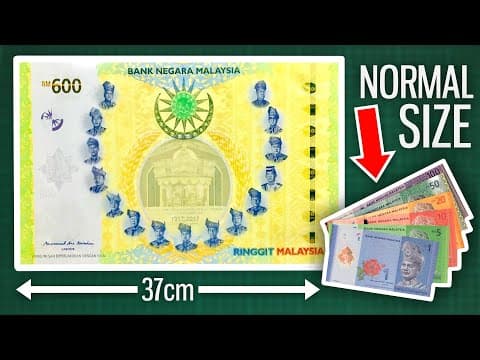
In 2017, Malaysia released two unusual banknote designs to commemorate the country's 60th anniversary. The 60 Ringgit note, an uncommon denomination, is now sold online for about 15 times its face value. However, the most remarkable release was the 600 Ringgit note, which is the largest legal tender banknote in the world, measuring an impressive 37 by 22 centimeters. This note is highly sought after by collectors and can sell for several thousand dollars.
The 600 Ringgit note features the Royal Throne encircled by the 15 Supreme heads, including Abdul Rahman, while the reverse portrays the signing of the independence agreement. Unfortunately, acquiring a real one for display is challenging, as they are often held by dedicated collectors.
The Malaysian Ringgit is a colorful and fascinating representation of Malaysia's rich culture, history, and natural beauty. Each denomination tells a story, from the intricate designs to the unique security features, making the Ringgit not just a medium of exchange but a reflection of the nation's identity. As we explore these banknotes, we gain insight into the marvelous country of Malaysia and its vibrant heritage. A special thanks to those who contributed banknotes for this exploration, enriching our understanding of this remarkable currency.