
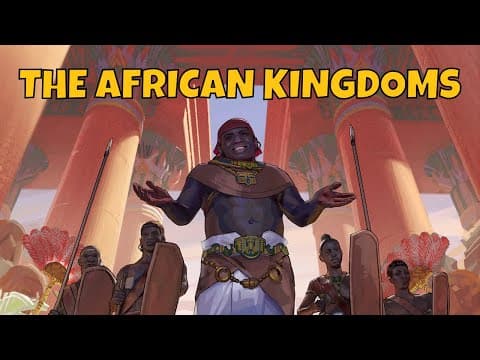
This blog post provides a comprehensive overview of the ancient and medieval kingdoms of Africa, highlighting the diverse cultures, significant civilizations, and historical developments that shaped the continent from the Nile Valley to the Kingdom of Aksum and beyond.
Africa is a continent rich in history, diversity, and culture, often overlooked in global narratives. As the second-largest continent, it boasts a variety of terrains and climates, from the Mediterranean coast to the vast Sahara Desert, and from the lush rainforests of the Congo Basin to the arid landscapes of southern Africa. This post delves into the ancient and medieval kingdoms of Africa, exploring their development, cultural exchanges, and significant contributions to world history.
Africa's geography plays a crucial role in its historical development. The continent is divided into several regions:
Agriculture in Africa likely began around 7,000 years ago in the Sahel, a region that was once more fertile than it is today. As the Sahara became drier, populations migrated southward, spreading farming techniques and diversifying crops. The Nile River Valley emerged as a cradle of civilization, leading to the formation of ancient Egypt, which, despite its connections to the Mediterranean, is fundamentally an African civilization.
While Egypt often dominates historical narratives, Nubia, located to the south, developed its own rich civilization. Around 2500 BCE, the Kerma Culture arose in Upper Nubia, characterized by impressive mud-brick structures known as de fufas. Despite being underestimated by Egypt, Nubia had a significant military presence and cultural exchanges with its northern neighbor. The Kingdom of Kush, established around 1070 BCE, marked a golden age for Nubia, culminating in the conquest of Egypt by King Piye in 745 BCE, establishing the 25th Dynasty.
To the southeast, the Kingdom of Aksum emerged by the first century CE, claiming descent from the Kingdom of Saba. Aksum became a major trading power, exporting ivory, perfumes, and slaves while importing metalworks and wine. The kingdom's conversion to Christianity in the mid-300s CE marked a significant cultural shift, with Aksum maintaining close ties to the Church of Alexandria.
In West Africa, the introduction of the camel revolutionized trade across the Sahara, leading to the rise of powerful empires. The Ghana Empire, founded by the Soninka people, became known as the land of gold due to its rich resources. Following its decline, the Mali Empire emerged, with Mansa Musa becoming one of the wealthiest individuals in history. Under his reign, Timbuktu flourished as a cultural and educational center.
The spread of Islam in Africa began with trade and military conquests, leading to a syncretic blend of African and Islamic cultures. While the Kingdom of Aksum declined, the Zagwe dynasty in Ethiopia centralized power and spread Christianity. The coastal cities of East Africa became vibrant trading hubs, influenced by Arab settlers and the Swahili culture that emerged from intermarriage and trade.
African societies were characterized by rich oral traditions, artistic expressions, and unique architectural styles. From the pyramids of Nubia to the stone structures of Aksum and the mud-brick buildings of West Africa, architecture reflected the cultural values and resources of each region. Music and dance played vital roles in community life, with instruments like the balafun and talking drums facilitating storytelling and cultural expression.
The history of ancient and medieval Africa is complex and diverse, encompassing thousands of distinct societies, languages, and cultures. Despite the challenges posed by colonial narratives and the lack of written records, modern historians continue to uncover the rich tapestry of African history. Understanding this history is essential for appreciating the continent's contributions to global civilization and recognizing its diverse cultural heritage.



















