
This blog post delves into the complex relationship between transatlantic slavery and the rise of Western hegemony. It examines historical perspectives, critiques of the slavery hypothesis, and the broader implications for understanding capitalism and imperialism.
The question of how the West achieved hegemonic power over the rest of the world has long intrigued historians. Why were Europeans able to conquer vast territories across the globe? What factors contributed to the might of Europe and its settler states? While numerous theories have been proposed, none have provided a definitive answer. This blog post explores the controversial yet significant role of transatlantic slavery in the rise of Western power, examining various historical interpretations and critiques.
One common assertion in discussions about Western dominance is that Europeans were inherently more violent or aggressive. Such claims are not only simplistic but also ignore the complexities of human history. Instead, a more nuanced interpretation suggests that transatlantic slavery played a crucial role in shaping the economic and social structures that underpinned Western hegemony.
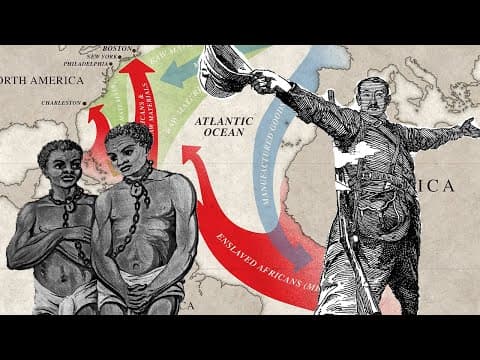
Eric Williams, in his seminal 1944 work "Slavery and Capitalism," argued that transatlantic slavery provided a unique form of labor that was entirely alienated from the land. This created a clear underclass defined by race, making escape nearly impossible. The social construction of race as a labor hierarchy allowed plantations in the Americas to specialize in cash crops like sugar, tobacco, and cotton. This specialization facilitated a triangle trade: slaves were sold in Africa, which fed colonies in the Americas, producing cash crops that were then sent to Europe for manufacturing. This cycle not only enriched Europe but also deprived Africa of manpower, making it vulnerable to conquest.
The triangle trade was a complex system that involved multiple empires competing for control over trade routes and resources. Each empire sought to prevent its constituents from trading outside its influence, resulting in several interconnected triangle trades rather than a single unified system. The innovation of capitalism allowed for greater market competition, which was essential for the rise of Western economic power.
Sydney Mintz's 1985 book "Sweetness and Power" introduced the concept of commodity history, examining how specific goods, like sugar, influenced human experiences and power dynamics. Mintz argued that the rise of sugar consumption in Britain paralleled the changing power dynamics of the time. As sugar became a dietary staple for the English proletariat, it stimulated the industrial revolution and the accumulation of capital. The processing of sugar and its derivatives, such as rum, further entrenched the economic benefits derived from slavery.
Even after the abolition of slavery in the 19th century, the economic gains from slave labor continued to shape Western economies. Hajun Chang's 2008 work "Bad Samaritans" posits that the capitalist system, rooted in slavery, evolved into a structure that perpetuated the exploitation of third-world countries. The argument suggests that the economic order established by slavery continues to influence global trade dynamics today.
While the connection between slavery and capitalism is compelling, it is essential to recognize the limitations of the slavery hypothesis. Critics argue that attributing Western hegemony solely to slavery oversimplifies the complexities of historical economics. For instance, Joseph Inicory contends that slavery was not the sole driver of industrial capitalism but rather one of many factors that contributed to economic transformation.
Recent scholarship has sought to complicate the slavery hypothesis. Scholars like David Eltis and Stanley L. Engerman argue that while slavery had significant economic implications, it did not singularly cause the British industrial revolution. This perspective highlights the need for a more comprehensive understanding of the various factors that contributed to Western dominance.
The relationship between transatlantic slavery and Western hegemony is a complex and multifaceted issue. While slavery undoubtedly played a significant role in shaping the economic foundations of capitalism, it is crucial to consider the broader historical context and the interplay of various factors. As historians continue to grapple with these complexities, it becomes clear that no single explanation can fully account for the rise of Western power. Future explorations into this topic may yield new insights and perspectives, further enriching our understanding of history.
As we continue to explore the intricate narratives of history, it is essential to engage with these discussions critically. What are your thoughts on the role of slavery in shaping Western hegemony? Share your insights in the comments below, and let’s continue this important conversation.



















