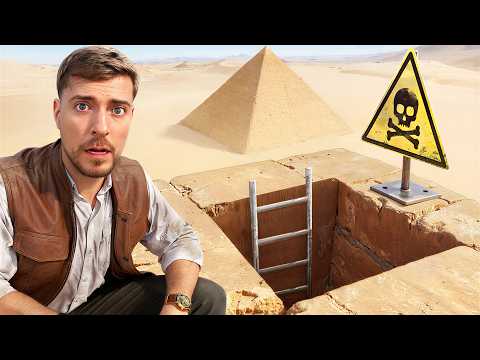
Join us as we delve into the mysteries of the Great Pyramids of Egypt, exploring ancient tombs, uncovering hidden chambers, and discovering the truth behind their construction—all within an exhilarating 100-hour adventure.
I somehow have unrestricted access to all of the Great Pyramids of Egypt! This is the coolest thing I've ever seen. We will be going into the tombs of ancient pharaohs, places that are literally illegal to enter because they're incredibly dangerous. What if we fall? Oh, yeah, you'll definitely die. We’ll even be swimming to a secret underground tomb beneath the pyramids. Oh my God! We've only been granted 100 hours to explore, and we're gonna start right now!
As we entered the pyramid, we were greeted by the stunning architecture that dates back approximately 4,500 years. The passageway we were in leads to what Egyptologists say is King Khufu's tomb—the pharaoh who may have ordered the pyramids to be built. This room is called the Grand Gallery.
In the next room, we found what is believed to be the king's final resting spot. Holy crap! This chamber may have contained the king's mummified body. This is where the pharaoh was buried. But how do we know for sure? I suspect there might be another chamber inside this pyramid that we have not found yet, which could hold the body of the king. In this video, we're going to find it because we will literally be exploring from hundreds of feet below the pyramids up to the highest point in the largest ancient pyramid on Earth.
Before we explored the other giant pyramids, I wanted to show you guys our base camp. We set up a dinner table, some tents to sleep in, and even brought lights to see the pyramids from camp. This is the pyramid we're going to explore tomorrow, and I want to start at 5 a.m.
These pyramids were so technologically advanced for their time that some credit them to a pre-Egyptian civilization, while others point to even crazier theories like aliens. However, Egyptologists are sure that they were built by the first Egyptians as tombs for their kings.
The next pyramid on our list was the Pyramid of Khafre. Rami led us nearly 100 feet below the Earth's surface, deep into Khafre’s pyramid. This is a place where hardly anyone in the modern world has ever been. We believed that this was the burial chamber for King Khafre for the longest time, but now they're using it to store tools for restoration. Rami took us to the real resting place thought to have once held the body of King Khafre.
The king's tomb didn't really answer many of our questions. However, the portal to the underworld deep beneath the pyramids could have everything we were looking for. This is the tomb of the god Osiris, where very few humans have ever been. As we descended deeper underground, we encountered a 3,000-year-old human skull. The air was thin, and we had to be cautious as we approached the sarcophagus of God Osiris, which is allegedly the portal to the underworld.
After our adventure in the underworld, we rode camels to the Pyramid of Menkaure. The director of the entire Giza Plateau joined us for this exploration. The Pyramid of Menkaure is known for its complex passageways, and we discovered the first chamber in ancient Egyptian history to have decorative carvings.
As we ventured deeper, we reached the burial chamber, which had a vaulted ceiling designed to relieve the weight. We learned that Menkaure had three small pyramids for his queens, which were their tombs.
Our next stop was the workman's tomb, where the builders of the pyramids were buried over 4,600 years ago. Unlike the grand tombs of the pharaohs, these tombs were simple, reflecting the lives of the workers. We even found a skull in situ, confirming that these were indeed the remains of the pyramid builders.
With only a few hours left, we prepared to ascend to the highest point inside the Great Pyramid. This was a rare opportunity, as less than 50 people in modern history have been up there. The climb was challenging, but we finally reached the top, where we discovered ancient graffiti that confirmed the Egyptians were the builders of these magnificent structures.
Throughout this adventure, we uncovered the truth about the pyramids, from the workman's tomb to the skeletons buried nearby, which had all been affected by manual labor. We explored under the Sphinx for secret rooms and treasure, and the evidence we found solidified the belief that ancient Egyptians built these pyramids as tombs for their pharaohs.
This journey through the Great Pyramids of Egypt was not only thrilling but also enlightening, and I am eternally grateful for the opportunity to explore these ancient wonders.
Escribe for MrBeast!