
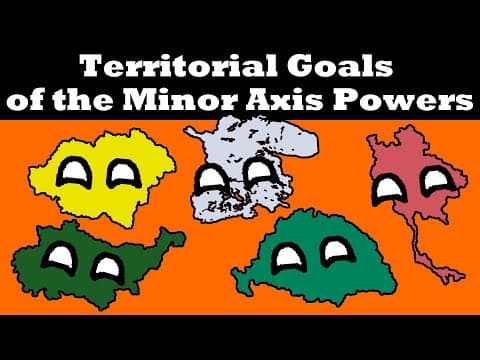
This blog post delves into the territorial goals of the minor Axis powers during World War II, including Hungary, Romania, Bulgaria, Finland, and Thailand. Each nation's ambitions were shaped by historical grievances and geopolitical shifts, leading to varying degrees of success and failure in achieving their goals during and after the war.
World War II is often characterized by the grand ambitions of the major Axis powers: Germany's quest for continental hegemony, Italy's aspirations for a Neo-Roman Empire, and Japan's vision of a co-prosperity sphere in Asia and the Pacific. However, the territorial goals of the minor powers allied with the Axis are less frequently discussed. This blog post aims to explore the motivations and ambitions of these nations, which were influenced by a complex interplay of political, military, diplomatic, and economic factors.
Hungary's primary territorial goal during World War II was the restoration of its pre-World War I borders, often referred to as the restoration of St. Stephen's Crown. Following World War I, Hungary lost significant territories, including Transylvania to Romania, parts of Croatia to Yugoslavia, and Carpatho-Ukraine to Czechoslovakia. The Hungarian government sought to reclaim these lands, although many were not predominantly Hungarian.
Hungary prioritized territories with Hungarian majorities, such as Southern Slovakia and parts of Transylvania, over more distant regions like Croatia. The geopolitical landscape shifted dramatically after Germany annexed Austria, which diminished Hungary's hopes for reclaiming Burgenland. As Hungary became economically dependent on Germany, aspirations for Burgenland faded.
With the collapse of Czechoslovakia, Hungary successfully annexed Southern Slovakia and Carpatho-Ukraine, marking significant territorial gains. However, the establishment of a Slovak state under German support limited further ambitions to the north. Hungary's pressure on Romania for Transylvania led to a joint German-Italian intervention, resulting in Hungary regaining parts of Transylvania that had significant Hungarian populations.
The Axis invasion of Yugoslavia allowed Hungary to annex parts of Bosnia and Slovakia, unifying many Hungarians into a single state. However, further territorial ambitions were thwarted by the establishment of a Croatian puppet state and the retention of Banat by Serbia.
Ultimately, Hungary's borders returned to their pre-war state after World War II, despite the temporary gains made during the conflict.
Romania's territorial ambitions were more complex, as they had achieved most of their desired borders after World War I, known as Greater Romania. However, the geopolitical landscape shifted dramatically after 1938, leaving Romania feeling isolated and vulnerable.
Romania's main motivation during World War II was the reclamation of territories lost to Hungary, the Soviet Union, and Bulgaria. The invasion of the Soviet Union allowed Romania to regain territories such as Moldova and Bukovina, while the Germans compensated Romania with Transnistria for the loss of Northern Transylvania.
Despite these gains, Romania's aspirations for Northern Transylvania remained unfulfilled, as Germany had no plans to return the territory. Romania's participation in the war was driven more by the desire to secure a favorable position in a German-dominated Eastern Europe than by expansionist ambitions.
After the war, Romania faced significant territorial losses, including those previously reclaimed from the Soviets and Bulgarians, although Northern Transylvania was returned.
Bulgaria's aspirations were shaped by a history of territorial losses and a desire for reclamation. Following World War I, Bulgaria lost significant territories, and by the lead-up to World War II, they sought expansion in three main directions: the Aegean coast, Southern Dobruja, and Macedonia.
Initially, Bulgaria aimed to play the Axis and the Soviets against each other for its benefit. They achieved some territorial gains, including Southern Dobruja, but were forced into the Axis alliance as Italy faltered in Greece. Bulgaria's ambitions were largely satisfied with the annexation of territories in Macedonia and parts of Serbia, although further expansion was curtailed by German and Italian occupations.
Despite their losses, Bulgaria managed to retain some territories post-war, particularly Southern Dobruja, which was confirmed as part of their territory.
Finland's involvement in World War II was primarily motivated by the desire to reclaim territories lost to the Soviet Union during the Winter War. Finland sought to restore its borders and integrate East Karelia, which had historical ties to the Finnish people.
During the war, Finland successfully reclaimed lost territories and occupied much of Eastern Karelia. However, the tide of the war shifted with the Soviet victory at Stalingrad, leading Finland to negotiate a surrender in 1944. Ultimately, Finland lost the territories it had gained during the conflict.
Thailand's territorial ambitions were focused on reclaiming lands lost to British and French colonial powers. Their goals included territories in the south, west, and parts of Indochina.
After the fall of France, Thailand sought to reclaim its borders without engaging in a grand conflict. They successfully invaded Indochina with Japanese support, regaining some immediate border claims. However, Japan's intentions limited Thailand's further territorial ambitions.
Thailand achieved some territorial gains during the war, but after Japan's defeat, they were forced to return to their pre-war borders.
The territorial ambitions of the minor Axis powers during World War II were shaped by historical grievances and shifting geopolitical landscapes. While some nations achieved temporary gains, most returned to their pre-war borders after the conflict. Understanding these ambitions provides a more nuanced view of the complexities of World War II beyond the major powers' narratives.



















