
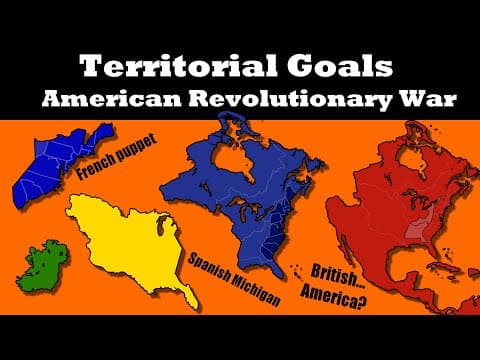
The American Revolutionary War was a complex global conflict involving major powers like Britain, France, Spain, and the emerging United States. Each had distinct territorial ambitions, with the US seeking independence and expansion, while France and Spain aimed to weaken Britain and regain lost territories. Ultimately, the US emerged as the primary victor, achieving independence and significant territorial gains, while France faced substantial losses and debt, leading to its own revolution.
The American War of Independence is often perceived as a local conflict between a global empire and its rebellious colony. However, this view overlooks the war's broader implications and the involvement of major powers like France and Spain. This article delves into the territorial ambitions of the four principal participants: Britain, America, France, and Spain, highlighting how their goals shaped the conflict and its outcomes.
The primary goal of the American revolutionaries was to gain independence from British rule. However, their aspirations extended beyond mere autonomy. Initially, there was a consideration for a federal union with Britain, where the colonies would maintain political independence while remaining economically tied to the empire. As the war progressed and British resistance intensified, the focus shifted entirely to achieving full independence.
One of the early military objectives for the Americans was Canada. Control over this territory would disrupt British supply routes and push the conflict away from populous cities like New York and Boston. The Americans believed that if they could conquer Canada, they could eliminate the British threat and secure their northern border. Diplomatic efforts were made to persuade Canadians, particularly in Quebec, to join the revolution, promising to respect their rights. However, these efforts were largely unsuccessful, and military attempts to invade Canada faltered.
The alliance with France marked a significant turning point for the Americans. Initially wary of Catholic France, the need for military support outweighed previous prejudices. In 1776, the Americans proposed a treaty that expected France and Spain to relinquish all claims to British territories in North America, including Bermuda and the Bahamas. However, as the war progressed and American military performance faltered, these ambitious goals were tempered.
The Americans had to consider what their allies would find acceptable. France, while supportive, preferred to keep Canada under British control to ensure ongoing conflict between the US and Britain. Spain, on the other hand, was cautious about American expansion, fearing it would threaten their own territories. The Americans ultimately had to adjust their expectations, focusing on securing independence and territorial gains that were realistic given the shifting dynamics of the war.
Contrary to popular belief, France's ambitions during the war were not solely driven by a desire for revenge against Britain. Instead, French leaders adopted a pragmatic approach, recognizing that a weakened Britain was preferable to a destroyed one, which could lead to France becoming the next target of aggression.
France aimed to regain some of its lost territories, particularly in the West Indies and Newfoundland, where lucrative fishing rights were at stake. They also sought to restore their influence in India. However, France's primary goal was to maintain a balance of power, ensuring that the US remained dependent on French support while keeping Britain in check.
Despite their ambitions, France struggled to achieve naval superiority during the war. While they played a crucial role in supporting the American revolutionaries, their own territorial goals largely went unmet due to military setbacks and the inability to secure decisive victories outside North America.
Spain's involvement in the war was marked by a desire to weaken Britain while simultaneously safeguarding its own empire. Unlike France, Spain did not sign an official alliance with the US, viewing the Americans as a potential threat to their territorial integrity.
Spain aimed to reclaim territories such as Gibraltar and Minorca, which were vital for their power projection in the Mediterranean. They also sought to regain control over Florida and other Caribbean territories to reestablish their dominance in the region. However, their military efforts were hampered by a lack of resources and coordination with the Americans.
While Spain did manage to regain Florida, their broader ambitions were largely unfulfilled. The failure to capture Gibraltar and expand their territories east of the Mississippi highlighted the limitations of their military strategy during the conflict.
From the outset, Britain's primary goal was to reconquer its lost colonies. They viewed the rebellion as an upstart movement that could be quelled with decisive military action. However, as the war progressed, their objectives evolved in response to the changing dynamics of the conflict.
Britain's strategy shifted towards securing key territories, such as New York and the southern colonies, which were economically vital. They also considered broader imperial ambitions, including potential conquests in the Caribbean and even plans to weaken Spain's influence in the Americas.
The entry of France and Spain transformed the conflict into a global war for Britain. Despite their initial confidence, the British military found itself overstretched, struggling to maintain control over multiple fronts. Ultimately, they faced significant losses, including the recognition of American independence and the cession of Florida to Spain.
The American Revolutionary War was far more than a local conflict; it was a global struggle involving multiple powers with distinct territorial ambitions. In the end, the United States emerged as the primary victor, achieving independence and significant territorial expansion. Spain, while failing in some of its grander ambitions, managed to recover some prestige and territory. Britain, despite losing the war, retained its status as a powerful empire, while France faced substantial losses and debt, leading to its own revolution shortly thereafter.
This complex interplay of goals and outcomes illustrates the multifaceted nature of the American Revolutionary War, highlighting its significance as a pivotal moment in global history.



















