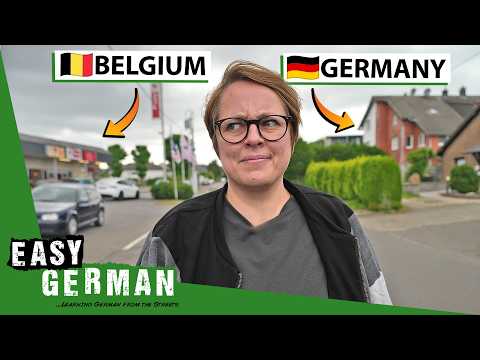
This blog post delves into the fascinating dynamics of living near the German border, highlighting the experiences of residents in border towns, the impact of EU policies on daily life, and the historical context of border changes.
The border regions have always intrigued me. Here, people are neighbors yet live in different countries. What does it mean for individuals living near a border? Are there advantages to being just ten minutes away from another country, or are there disadvantages? To explore this, we traveled to the western border of Germany, where we discovered the unique characteristics of this fascinating border region.
We began our journey at the tripoint where Germany, Belgium, and the Netherlands meet. Standing on the border, we observed Janusch in Germany and Manuel in Belgium, playfully hopping between the two countries. This area, known as the Dreiländereck, showcases how borders can be more fluid than we often imagine.
When we think of borders, we often envision police controls and physical barriers. However, in this region, there are none. All three countries are part of the European Union and the Schengen Agreement, which abolished border controls nearly 30 years ago. This has transformed the daily lives of residents, allowing them to move freely across borders without much thought.
To gain a deeper understanding of life at the border, we spoke with Roland Wolf from the Egio Mars Rehein, an institution aimed at improving cross-border cooperation. He noted that for locals, borders play a minimal role in their daily lives. People frequently cross into neighboring countries for family visits, shopping, or leisure activities without considering the borders.
Residents in Eupen, a German-speaking city in Belgium, shared their experiences. Many commute to Germany for work and enjoy shopping in both Belgium and the Netherlands due to price differences. One resident mentioned that shopping in the Netherlands or Germany is often cheaper, making it a regular activity at least once a week.
As we continued our exploration, we found ourselves on a street that straddles the border between Germany and Belgium. On one side, there was a Belgian supermarket, and on the other, a German establishment. This peculiar situation illustrates how borders can be arbitrary and sometimes nonsensical.
The complexity of borders in this region can be traced back to historical events, particularly after World War I when territories were reallocated. For instance, an old railway line that once connected Germany and Belgium now serves as a bike path, illustrating how borders can change yet leave remnants of their past.
In Röttchen, a community of about 9,000 residents, the border seems to have little impact on daily life. Locals expressed that the only noticeable difference is the language, with dialects varying just a few hundred meters apart. One resident humorously noted that the border is a normal part of life, akin to a vacation when venturing further into Belgium.
Despite the ease of crossing borders, some bureaucratic hurdles remain, particularly for commuters and students. These challenges highlight that while physical barriers may be absent, administrative ones still exist.
We also met Renata, who grew up in the area when physical borders and customs checks were prevalent. She reminisced about the strict controls and the thrill of smuggling small items across the border as a child. Today, she reflects on how arbitrary borders can be, emphasizing that they are often drawn without regard to the people living there.
Renata took us to see remnants of a military defense line built during the 1930s, a stark reminder of the past. These structures, intended to prevent invasions, now stand as historical markers, illustrating the evolution of borders and their significance over time.
Our journey through the German border regions revealed a complex tapestry of daily life, historical context, and the fluidity of borders. While the absence of physical barriers has fostered a sense of community and ease of movement, the remnants of history and bureaucratic challenges remind us that borders are not merely lines on a map but are deeply intertwined with the lives of those who inhabit these regions.
As we conclude our exploration, we invite readers to reflect on their own experiences with borders. How do borders shape your daily life? What unique stories do you have from living near a border?