
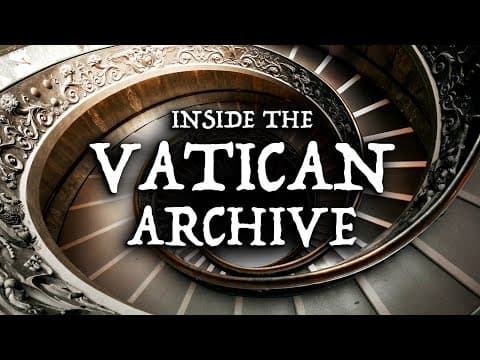
The Vatican Apostolic Archive, formerly known as the Vatican Secret Archive, is a vast repository of historical documents spanning centuries. Located beneath Vatican City, it houses papal letters, state papers, and rare manuscripts including records on the Knights Templar, Galileo's trial, and the excommunication of Martin Luther. Though access is restricted, the archive offers invaluable insights into world history and the Catholic Church's past.
Beneath the world's smallest sovereign state, Vatican City, lies one of the most mysterious and historically significant archives in the world: the Vatican Apostolic Archive. Formerly known as the Vatican Secret Archive, this vast collection has long been shrouded in secrecy and speculation. In recent years, however, the Vatican has granted exclusive access to researchers, revealing the true contents of this legendary repository.
The Apostolic Archive is situated adjacent to the Vatican Library, just a short walk from the Sistine Chapel and St. Peter's Basilica. Most of the archive is housed in a purpose-built subterranean facility, a sprawling maze of storage rooms spread across two underground levels. The shelves, if lined up end to end, would stretch over 53 miles — roughly the distance from London to Oxford.
At the center of the archive lies a highly restricted area known as the bunker, a climate-controlled vault safeguarding the most delicate possessions. The archive is essentially a vast network of shelves and storage rooms, containing hundreds of thousands of individual items.
For much of its history, the collection was known in English as the Vatican Secret Archive, a name that naturally fueled speculation and conspiracy theories. In 2019, Pope Francis renamed it the Vatican Apostolic Archive to dispel the notion that the Church was hiding something.
Contrary to popular belief, the archive has been open to researchers for over 100 years. Since the late 19th century, parts of the archive have been accessible to historians who meet strict requirements, including holding a master's degree in a relevant field, providing a letter of recommendation, and specifying the documents they wish to view. Despite these conditions, access remains highly selective.
Among the many rumors surrounding the Vatican archives is the story of the Chronovisor, a device allegedly built by Father Pellegrino Ernetti, a Benedictine monk and former physicist. This machine was said to be a television capable of viewing historical events as if they were happening live — essentially a time-traveling television.
Ernetti claimed to have used the Chronovisor to witness scenes from ancient history, including a photograph of Jesus and his disciples. However, these claims are widely regarded as dubious and outside the bounds of accepted physics. Skeptics believe the story to be a fabrication, yet Ernetti maintained his assertions until his death in 1994.
The reality of the Vatican Apostolic Archive is far from the sensationalized portrayals in popular culture. There are no booby traps or secret chambers filled with forbidden knowledge. Instead, the archive is a massive warehouse of papal bureaucracy and historical documents.
The contents broadly fall into four main categories:
While much of this may sound like mundane paperwork, the archive holds secrets and documents that have shaped world history.
One of the most fascinating discoveries is the Shenon parchment, a long-lost document uncovered in 2001. It details a secret investigation by the Church into the Knights Templar, a powerful medieval military order.
The Templars were accused of heresy and devil worship by King Philip IV of France in 1307, leading to their arrest and execution, including the burning of their Grandmaster, Jacques de Molay, in 1314. The Shenon parchment reveals that the Church found the Templars innocent and that Pope Clement V secretly absolved them. However, this pardon was never made public due to political pressure from King Philip IV, who sought to erase his debts to the order by dismantling it.
The archive houses original records from the infamous 1633 trial of Galileo Galilei. Galileo, a pioneering astronomer, supported heliocentrism — the idea that the Earth revolves around the Sun — which contradicted the Church's geocentric doctrine.
The documents include Galileo's handwritten defense, where he argued that his scientific views did not contradict Christian faith. Despite his efforts, he was forced to recant and spent the last nine years of his life under house arrest. It was only in modern times that the Church formally acknowledged its mistake and pardoned Galileo. Today, the Vatican even operates its own telescope in Arizona, embracing science.
Among the more unusual items in the archive are blueprints for the Pasarola, a concept for a flying machine designed by Portuguese priest Tomo de Gazmau. The drawings depict an aircraft shaped like a bird with a large central sail and wings on either side. Although the Pasarola never flew, it is an inventive example of early human imagination about flight, preserved by the Church for safekeeping.
The archive also contains letters from notable historical figures, such as Michelangelo. One letter reveals a payment dispute where Michelangelo complained that Vatican workers had not been paid for three months and threatened to abandon their work on the Sistine Chapel and St. Peter's Basilica.
A pivotal document in Christian history is the papal bull signed by Pope Leo X, officially excommunicating Martin Luther. Luther's 1517 criticisms of Church corruption sparked the Protestant Reformation, fracturing Christianity into multiple denominations.
This document marked the formal break between Catholicism and Protestantism. The archive also holds King Henry VIII's letter requesting an annulment of his marriage, which the Pope rejected, leading Henry to establish the Church of England.
The Vatican Apostolic Archive is one of the most impressive historical collections globally. While it may not contain earth-shattering revelations akin to those in popular fiction, it offers an extraordinary glimpse into the epicenter of world history.
In recent years, the Vatican has moved towards greater transparency, allowing qualified researchers access to its treasures. However, visitors must request specific documents in advance, creating a paradox: how can one request documents without knowing they exist?
This leaves open the possibility that some items remain hidden and off-limits, preserving an aura of mystery around the archive.
The Vatican Apostolic Archive is a historian's playground, a vast repository of documents that chronicle centuries of religious, political, and cultural history. From secret pardons and scientific trials to early aviation concepts and pivotal religious decrees, the archive offers invaluable insights into the past.
While myths like the Chronovisor capture the imagination, the true treasures lie in the authentic records that have shaped the course of history. For those who meet the stringent requirements, the archive remains a gateway to understanding the complex legacy of the Catholic Church and its role in world affairs.
The Vatican Apostolic Archive stands as a testament to the enduring power of history and the ongoing quest for knowledge beneath the heart of Vatican City.
Thank you for reading this exploration of one of the world's most fascinating archives. If you are intrigued by history and the mysteries it holds, the Vatican Apostolic Archive offers a unique window into the past.



















