
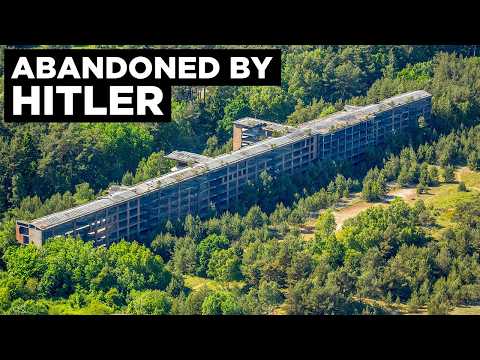
The Colossus of Prora, a Nazi-era megastructure in northern Germany, has been transformed from a symbol of oppression into luxury apartments, sparking debate about how to reconcile its dark past with its new identity as a tourist destination.
In northern Germany, a controversial transformation is taking place at the Colossus of Prora, a massive structure built during the Nazi regime. Originally conceived as a seaside resort for National Socialist tourism in the 1930s, Prora has now been redeveloped into luxury flats. This shift has ignited a debate about how to handle the site's dark history while embracing its future.
Prora is located on Rügen, an idyllic holiday island that became a popular destination for wealthy Prussians in the 19th century. The Nazi party established a travel agency called Strength Through Joy in 1933, which aimed to provide package holidays infused with political indoctrination. In 1935, Robert Ley, the agency's chief, commissioned the construction of Prora, an enormous holiday resort designed to accommodate tens of thousands of visitors.
Designed by architect Clemens Klotz, Prora stretched over 4.5 kilometers and consisted of eight identical residential blocks, housing 10,000 rooms for 20,000 holidaymakers. Each block was connected to a service tower with communal bathrooms and showers. At the center of the complex was a large festival hall for concerts and political lectures, along with a pier for cruise ships, an observation tower, swimming pool, cafes, and a cinema. The scale of Prora was intended to convey the power of the Nazi regime, dwarfing the individual.
Construction began in May 1936, employing around 9,000 workers, many of whom were forced laborers. The project cost an estimated USD 900 million in today’s currency. However, with the outbreak of World War II in 1939, construction halted, leaving half of the residential blocks incomplete. After the war, Prora fell into Soviet hands, ending its intended purpose as a holiday resort.
Following WWII, Rügen became part of East Germany, and Prora was repurposed as a secret military facility. The site was largely erased from maps, and it wasn't until German reunification in 1990 that the question of its future arose. With the local economy in dire straits, authorities sought to redevelop Rügen as a holiday destination, and Prora's prime real estate became a focal point.
Local politician Udo Knapp advocated for demolishing Prora, calling it a "Nazi monstrosity." However, the Red Army's attempts to destroy the site after WWII were largely unsuccessful. In 1994, Prora was granted protected status, which mandated that any future development must consider its historical significance. This protection also provided tax incentives for developers.
In 1996, Dieter Reinhardt, the mayor of Binz, proposed a redevelopment plan that included hotels, restaurants, and a water park, suggesting that Prora's history could attract visitors similarly to Alcatraz prison. However, this plan did not materialize due to the risks associated with such a large project.
In 2004, the council began selling the site block by block, leading to the first significant redevelopment in 2006 when Seebad Prora acquired two blocks. They transformed these into the luxury hotel Prora Solitaire and private residences. The renovation process was complex, as the original rooms were small and designed for communal living. The developers created modern apartments while maintaining the building's historical integrity.
Today, Prora features cafes, restaurants, hotels, private apartments, and a youth hostel, thriving as a tourist destination. However, the transformation has not been without criticism.
The tension between Prora's past and its future remains a contentious issue. Katja Lucke, chief historian at the Dokumentationszentrum Prora, expressed concern over the extent of tourism developments, arguing that more space should be allocated for cultural and educational purposes. The original protection order emphasized a mixed-use approach, balancing tourism with cultural and educational functions.
Ulrich Busch, who led the Prora Solitaire development, believes that the building's use is what defines its legacy. By transforming it into a space for enjoyment, he argues, the site gains a sense of humanity. This perspective highlights the broader implications of how society interacts with its historical structures.
The case of Prora raises important questions about how we engage with our past. Similar debates have emerged around other historical sites, such as the Berlin Olympiastadion, which underwent renovations in the 1990s and continues to host major events today. While the origins of these structures are acknowledged, their futures are shaped by contemporary needs and values.
The transformation of Prora from a Nazi-era megastructure to luxury apartments illustrates the complex relationship between history and modernity. Striking a balance between remembering the past and creating a vibrant future is challenging but essential. As Prora evolves, it has the potential not only to serve as a reminder of its dark history but also to foster healing and joy in the present.



















