
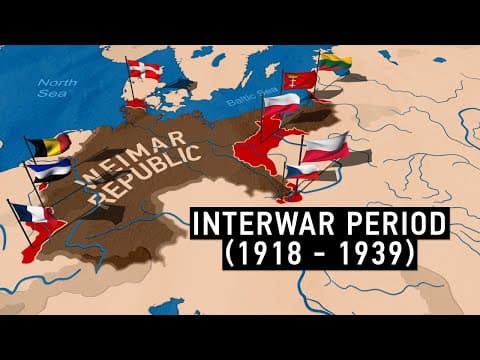
The transition from World War I to World War II was marked by unresolved tensions, economic turmoil, and the rise of totalitarian regimes. The Treaty of Versailles, the failure of the League of Nations, and the socio-political upheavals in Europe set the stage for the second global conflict, highlighting the fragility of peace and the consequences of unresolved grievances.
In the early morning hours of November 11, 1918, the German command was forced to sign a surrender in a train car, marking the end of World War I. The world was hopeful that this would be the last war, coining the phrase "the war to end all wars." However, while the United States celebrated, Germany faced devastation and ruin.
The Paris Peace Conference began in January 1919, where the British delegation at Versailles discussed U.S. President Woodrow Wilson's proposal for a League of Nations aimed at ensuring collective security, promoting disarmament, and fostering international cooperation. However, the leaders faced numerous challenges:
The Allied Forces maintained a presence along the Rhine until the summer of 1919, establishing deep bridgeheads into a defeated, disarmed, and starved Germany, which was deemed the main culprit of the war.
The French population, significantly smaller than Germany's, was anxious about the future. France had suffered the loss of 1.5 million soldiers, and the leadership recalled past threats of war. Supreme Allied Commander Marshall Ferdinand Foch insisted on extending France's borders along the Rhine to ensure peace. However, British and American politicians opposed this, believing it contradicted the principles of the peace treaty.
Ultimately, the Allies, with the support of French President Georges Clemenceau, agreed to a demilitarized zone and the complete disarmament of Germany. Germany lost all its colonies and was limited to an army of 100,000, forced to surrender vast amounts of military equipment. Despite protests, the Treaty of Versailles was signed, with Foch famously stating it was not peace but merely a 20-year truce.
The French leadership sought to create an independent German state under their control, but this plan failed. In 1923, Franco-Belgian troops invaded the Ruhr region, leading to outrage among Germans and Allies alike. Under pressure, these troops withdrew the following year.
Although World War II officially began in 1939, it was the result of numerous local conflicts in Europe. The collapse of the Austro-Hungarian Empire after the Treaty of Saint-Germain and the Treaty of Trianon led to significant territorial losses for Austria and Hungary, creating instability in the region.
The League of Nations faced a severe blow when the Republicans took power in the U.S. in 1920, abandoning Wilson's internationalist policies. The situation worsened with the rise of communism in Russia, leading to conflicts such as the Polish-Soviet War. The Red Army aimed to spread socialism, resulting in significant casualties.
In 1921, the Treaty of Riga ended hostilities, but the Bolshevik victory in the Russian Civil War resulted in millions of deaths. Meanwhile, the League of Nations struggled to maintain peace, as the U.S. and Britain began disarming while France maintained its military strength.
The economic landscape in Europe was dire, with hyperinflation in Germany leading to extreme currency devaluation. Adolf Hitler capitalized on this chaos, rallying support against communists and Jews. His failed coup in 1923, known as the Beer Hall Putsch, led to his imprisonment, during which he wrote "Mein Kampf."
The Great Depression further exacerbated economic issues, leading to widespread unemployment and unrest. The Soviet Union's policies in Ukraine resulted in a man-made famine, with millions perishing as the regime sought to suppress national identity.
In the Pacific, Japan sought to expand its territory, refusing to return Manchuria to China and eventually launching the Sino-Japanese War. Japan's withdrawal from the League of Nations highlighted the organization's ineffectiveness in maintaining collective security.
Italy, under Mussolini, invaded Ethiopia, leading to a lack of meaningful intervention from the League of Nations. The Spanish Civil War erupted in 1936, fueled by the rise of fascism and communism, resulting in significant casualties and refugees.
In 1938, Hitler's annexation of Austria and subsequent occupation of the Sudetenland marked a significant escalation. The world began to prepare for another conflict as dictators like Hitler, Mussolini, and Stalin rose to power, revealing the fragility of peace.
The Molotov-Ribbentrop Pact between Nazi Germany and the USSR set the stage for the invasion of Poland, officially starting World War II. The war would change the world forever, leading to the establishment of the United Nations and a global commitment to prevent such conflicts in the future.
The transition from World War I to World War II was marked by unresolved tensions, economic turmoil, and the rise of totalitarian regimes. The Treaty of Versailles, the failure of the League of Nations, and the socio-political upheavals in Europe set the stage for the second global conflict, highlighting the fragility of peace and the consequences of unresolved grievances. The scars left by World War II continue to remind us of the importance of vigilance in maintaining global peace.



















