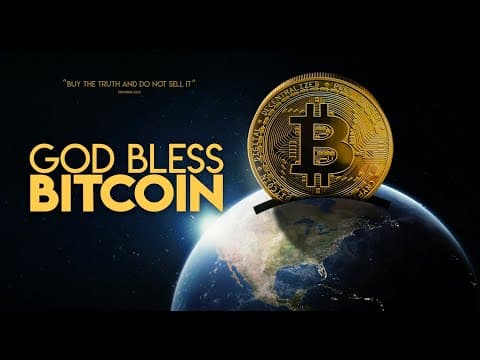
This blog post explores the arguments presented in the documentary 'God Bless Bitcoin,' highlighting the flaws of fiat currency, the impact of inflation, and the transformative potential of Bitcoin as a decentralized, sound form of money that empowers individuals and promotes financial freedom.
In the documentary "God Bless Bitcoin," the narrative unfolds around the historical context of money, the flaws of the current fiat system, and the transformative potential of Bitcoin. The film argues that Bitcoin is not just a digital currency but a revolutionary tool that can restore financial integrity and empower individuals.
The documentary begins by reflecting on a time when a single income could support a family, contrasting it with today's economic struggles. The pivotal moment discussed is President Nixon's decision in 1971 to decouple the dollar from gold, allowing for unlimited money printing. This decision, aimed at financing the Vietnam War, set the stage for the inflationary policies that have eroded the purchasing power of the dollar.
The film highlights the detrimental effects of fiat currency, where a single politician's ability to print money can lead to economic chaos. Inflation, often misunderstood, is presented as a tool for wealth redistribution that disproportionately affects the working class. The documentary argues that inflation is not merely a natural economic phenomenon but a deliberate act that benefits the elite at the expense of the average citizen.
The documentary distinguishes between two types of inflation:
The latter is identified as the primary driver of inflation, leading to a decrease in purchasing power and an increase in economic inequality. The average American now finds it increasingly difficult to meet basic needs, with wages failing to keep pace with the rising cost of living.
The film posits that Bitcoin offers a solution to the problems created by fiat currency. Here are some key arguments made in favor of Bitcoin:
Bitcoin's capped supply of 21 million coins ensures that it cannot be devalued through excessive printing, unlike fiat currencies. This scarcity is likened to precious metals, providing a more stable store of value.
Bitcoin operates on a decentralized network, meaning no single entity can control or manipulate it. This characteristic empowers individuals, allowing them to be their own banks and control their financial destiny.
Bitcoin transcends borders and can be accessed by anyone with an internet connection. This inclusivity is particularly beneficial for those in developing countries or under oppressive regimes, where traditional banking systems may be inaccessible or corrupt.
The documentary emphasizes Bitcoin's potential to protect individuals from government surveillance and control. Unlike Central Bank Digital Currencies (CBDCs), which can be monitored and restricted by governments, Bitcoin transactions are private and secure.
The film argues that Bitcoin embodies a moral choice for individuals seeking financial freedom. It is presented as a means to combat systemic injustices perpetuated by fiat currency systems, which often favor the wealthy and powerful.
Bitcoin provides individuals with the ability to store and transfer wealth without the interference of banks or governments. This empowerment is crucial for fostering economic independence and resilience.
The documentary highlights real-world examples where Bitcoin has been used to support humanitarian efforts, such as providing aid during crises or enabling financial transactions in war-torn regions. This illustrates Bitcoin's potential as a force for good in society.
The documentary concludes with a hopeful vision for the future, suggesting that Bitcoin could lead to a more equitable and just financial system. It posits that as more people adopt Bitcoin, we may witness a shift away from fiat currencies and a reduction in government control over money.
The film envisions a world where Bitcoin serves as a universal currency, promoting peace and cooperation rather than conflict. By removing the ability to print money at will, governments would be held accountable to their citizens.
The documentary encourages viewers to educate themselves about Bitcoin and consider its implications for their financial futures. It advocates for a collective movement towards adopting Bitcoin as a means of achieving financial freedom and social justice.
"God Bless Bitcoin" presents a compelling case for Bitcoin as a transformative force in the world of finance. By addressing the flaws of the current monetary system and highlighting the benefits of Bitcoin, the documentary invites viewers to rethink their understanding of money and consider the potential of a decentralized financial future. As we navigate the complexities of modern economics, Bitcoin emerges as a beacon of hope for a more equitable and just society.