
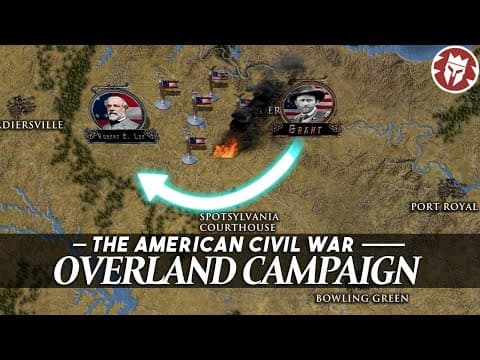
The Overland Campaign marked a pivotal moment in the American Civil War, showcasing the strategic brilliance of Ulysses S. Grant against Robert E. Lee. As Grant took command, he implemented a strategy focused on attrition and simultaneous attacks to dismantle the Confederate forces. The campaign was characterized by brutal battles, including the Wilderness and Spotsylvania, leading to significant casualties on both sides. Ultimately, Grant's relentless approach set the stage for the Union's path
By December of 1863, the American Civil War was well into its final act as Union troops pierced deep into the heart of the Confederacy. While Sherman and Johnston elegantly fenced in Georgia, Ulysses S. Grant and Robert E. Lee were exchanging hammer blows in Virginia. Grant intended to swiftly confront and destroy Lee in battle while crushing the Confederacy from all fronts. When Lee refused to give him that battle, Grant switched tactics and began grinding him down. This strategy did put Lincoln’s reelection in jeopardy, but through determination and superior strategic vision, Grant was ultimately successful. Welcome to our exploration of the bloodiest conflict ever fought on American soil, where the two greatest generals of the Civil War jousted in the bloody and fiery Overland Campaign.
As 1864 dawned, Grant’s Military Division of the Mississippi found itself without a clear target. The only strategic objective remaining between Kansas and the Appalachians was Mobile, Alabama, which was under the Navy's purview. Grant was still responsible for destroying the Army of Tennessee, but it had fled his jurisdiction to defend Atlanta. Having previously faced criticism for leaving his military district, Grant was cautious about repeating that mistake. He knew that President Lincoln and General-in-Chief Henry Halleck would approve his march into Georgia, but he needed to present a well-structured plan first.
In a surprising turn, Lincoln telegraphed Grant at the end of February, informing him that he had been made General-in-Chief, with Halleck reassigned to Chief of Staff. To prevent conflicts over seniority, Grant was promoted to Lieutenant General, the first American to hold this office since George Washington. Upon arriving in Washington D.C. on March 8th, Grant accepted his promotion with the condition that Lincoln and Secretary of War Stanton would not interfere with his upcoming campaigns. Grant aimed to bring the war to a swift conclusion, fully aware of the potential for extreme bloodshed.
Grant’s strategy was straightforward: the Confederacy was held together by the Army of Northern Virginia and the Army of Tennessee. If these armies were destroyed, the Confederacy would collapse. To achieve this, Union armies would launch the simultaneous attacks that McClellan had envisioned but never executed. William T. Sherman was tasked with destroying the Army of Tennessee and capturing Atlanta, while smaller departments were to strike the Carolina coast and Florida. The main focus, however, was Virginia.
Grant intended for the Army of the Potomac to quickly destroy the Army of Northern Virginia in battle south of The Wilderness. However, he recognized that Lee would not fall easily. Therefore, Benjamin Butler’s Army of the James would advance from Fort Monroe to threaten Lee’s rear and take Richmond, while Franz Sigel’s Army of the Shenandoah would cut Lee’s supply base in the Shenandoah Valley. Union forces in West Virginia were also to move south to destroy railways and lead mines before joining Sigel. With nearly 200,000 Federals against 90,000 Confederates in Virginia, the pressure would eventually overwhelm Lee.
George Meade, who expected to be relieved of command of the Army of the Potomac, was retained by Grant. Grant believed it would be irresponsible to oversee the entire war while managing the day-to-day operations of an army. He attached his headquarters to Meade’s, directing strategic movements while allowing Meade to handle tactical decisions. Grant respected Meade’s abilities and maintained the chain of command, delivering orders to Meade’s headquarters rather than directly to unit commanders.
As soon as the roads dried, Meade was to move out and destroy Lee with superior numbers. However, challenges arose, including the vulnerability of the Orange and Alexandria Railroad to Jeb Stuart’s cavalry raids and the risk of passing through The Wilderness, which could lead to another Chancellorsville. Grant addressed these concerns by planning around river logistics and acknowledging the risks involved. Additionally, the army needed reorganization due to the depletion of veteran units, which were below half-strength. Grant consolidated the army into three infantry and one cavalry corps, with Ambrose Burnside’s 9th Corps accompanying Meade but remaining outside his command.
By May 3rd, the roads were dry, and on May 4th, Grant’s 120,000 troops crossed the Rapidan at Germanna and Ely’s Fords. The cavalry drove away Confederate pickets, screening the infantry’s advance. Grant hoped to push through the Wilderness quickly, but the army’s size and narrow roads caused delays. Lee anticipated the movement and positioned A.P. Hill and Richard Ewell’s corps to intercept Grant.
On May 5th, Union cavalrymen began patrolling down Orange Plank Road, quickly discovering Hill’s advancing corps. Meade directed the 5th Corps to engage, believing they faced only a division. However, Ewell was holding back, waiting for Longstreet to arrive. The Union attack was repulsed with heavy casualties, and the fighting devolved into chaos as both sides struggled for control amidst the dense vegetation.
The following day, Grant ordered Meade to attack at 05:00, but Ewell struck first, keeping Grant pinned until Longstreet arrived. The fighting continued throughout the day, with both sides suffering heavy losses. By nightfall, the Union front stabilized, but the battle had taken a devastating toll.
Morale was low in the Army of the Potomac on May 7th, as soldiers feared they would retreat behind a river to regroup. However, orders to march south reignited their spirits, and they sang on the march. On May 8th, as cavalry forces clashed at Todd’s Tavern, Union troops attempted to break through Confederate defenses at Spotsylvania. Despite initial successes, they faced fierce resistance and were forced to retreat.
As both armies extended their trench lines, General Sedgwick was fatally shot while reassuring his men. Grant recognized that Lee was shifting his lines and ordered Hancock’s 2nd Corps to attack. However, miscommunication and delays hindered the Union’s efforts, leading to further stalemates.
On May 10th, Grant realized that Lee had fixed his positions and ordered a general attack. Despite heavy artillery support, the assaults were repulsed, with only one notable success from Colonel Emery Upton’s innovative tactics. Grant recognized the need for fresh strategies as the fighting continued.
The Overland Campaign was brutal, with historians noting significant discrepancies in casualty counts. Grant suffered between 38,691 and 65,000 casualties, while Lee faced 20,000 to 40,000. Despite the losses, Grant’s army swelled back toward 120,000 as new recruits replaced fallen soldiers. Although he had initially sought to avoid a war of attrition, it had arrived, and Grant was determined to win, despite the political ramifications for Lincoln.
As the campaign progressed, Lee’s army dwindled, confined to siege lines, and the Confederacy tilted toward collapse. The stage was set for increasingly desperate offensives from the Confederacy as they sought to reverse their crumbling fortunes.
Join us next time as we delve deeper into the consequences of the Overland Campaign and the unfolding events that would shape the remainder of the Civil War.



















