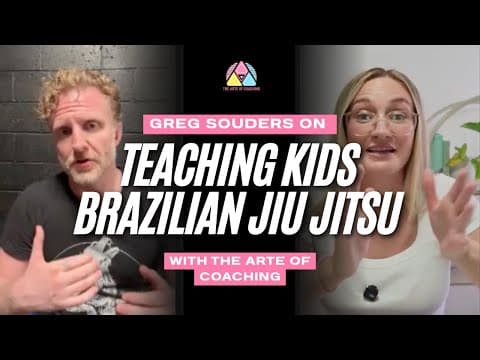
In this insightful conversation, Greg Souders shares his extensive experience in coaching kids in Brazilian Jiu-Jitsu (BJJ) and Constraint-Led Approach (CLA). He emphasizes the importance of understanding children's unique learning styles, the role of parents in shaping their experiences, and the significance of creating a fun, engaging environment. Souders also discusses the challenges of competition and the need for a balanced approach to training that prioritizes play and exploration over win
In a recent conversation, Greg Souders shared his insights on coaching children in Brazilian Jiu-Jitsu (BJJ) and the Constraint-Led Approach (CLA). With years of experience in teaching kids, Souders emphasizes the importance of understanding how children learn and the unique challenges that come with coaching them.
Souders began his journey in coaching kids back in 2006 when he was asked to start a program for 5 to 7-year-olds at a local gym. Despite being a blue belt at the time, he embraced the challenge and quickly learned the intricacies of teaching children. His initial experience was chaotic, but it laid the foundation for his understanding of how to engage kids effectively.
One of the key takeaways from Souders' experience is that children approach learning differently than adults. Kids primarily come to classes to socialize and play, rather than to focus on technical skills. Souders notes that many BJJ gyms prioritize adult training, often neglecting the kids' programs. He believes that understanding the children's perspective is crucial for creating a successful learning environment.
Souders advocates for using games as a teaching tool, a concept he first encountered in Taekwondo seminars. He adopted the Teaching Games for Understanding (TGFU) approach, which emphasizes learning through play. This method allows children to engage with the material in a fun and interactive way, making it easier for them to grasp complex concepts.
One of the most significant challenges Souders faced was managing parental expectations. Parents often project their desires onto their children, which can create a toxic environment. Souders emphasizes the need for coaches to establish boundaries and communicate clearly with parents about the goals of the program. He shares that he implemented rules to limit parental involvement during classes, allowing kids to learn without external pressures.
Souders discusses the complexities of competition in kids' sports. He believes that competition should be framed as a fun experience rather than a high-pressure situation. He encourages a culture where winning is not the sole focus, and emphasizes the importance of celebrating effort and participation. Souders shares a poignant story about a young girl in his program who experienced severe pressure from her parents, which ultimately influenced his decision to step back from teaching kids.
Souders structured his kids' classes to maximize engagement and learning. He typically held classes four days a week, alternating between gi and no-gi sessions. Each class began with games to establish expectations and ended with fun activities, creating a balanced experience. He kept sessions short, recognizing that kids have limited attention spans and need frequent breaks.
Souders emphasizes the importance of monitoring mental fatigue in children. He found that keeping classes around 30 minutes for younger kids was optimal, as their focus tends to wane after that time. He also highlights the need for coaches to be adaptable, responding to the children's energy levels and engagement throughout the class.
Creating a positive and supportive environment is crucial for children's development. Souders encourages coaches to praise effort and celebrate small victories, fostering a culture of encouragement. He believes that children should learn to navigate emotions related to winning and losing, and that these experiences are essential for their social development.
Greg Souders' insights into coaching kids in BJJ and CLA highlight the importance of understanding children's unique learning styles and the challenges that come with parental expectations. By creating a fun, engaging, and supportive environment, coaches can help children develop not only their skills in martial arts but also their social and emotional resilience. Souders' approach serves as a valuable guide for anyone involved in coaching young athletes, emphasizing that the ultimate goal is to foster a love for the sport and a positive experience for all participants.