
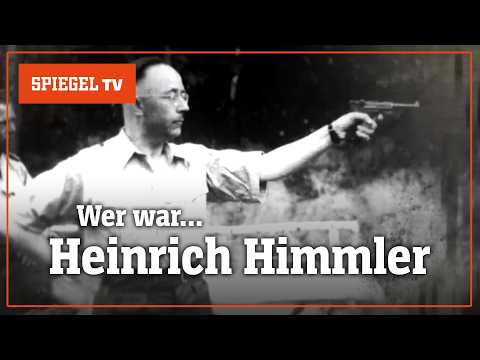
Heinrich Himmler, the feared leader of the SS, played a crucial role in the Nazi regime's oppressive machinery and the Holocaust. His radical ideologies and ruthless actions made him one of history's most notorious figures, responsible for the systematic extermination of millions.
Heinrich Himmler is often regarded as one of the most feared figures in Nazi Germany, second only to Adolf Hitler himself. As the head of the SS (Schutzstaffel), he was a relentless driver of death and destruction, organizing the brutal persecution of political opponents and overseeing the entire German police force from 1936 onwards. Himmler was responsible for the oppressive apparatus of the Nazi regime and played a central role in the machinery of mass murder that characterized the Holocaust.
Born in October 1900 in Munich, Heinrich Himmler came from a well-to-do Catholic family. He was the middle child of three sons and enjoyed a largely carefree childhood. His father was a respected educator, even serving as a tutor to Prince Heinrich of Bavaria. Despite this stable upbringing, Himmler harbored ambitions of becoming a soldier, a desire that was deeply ingrained in the militaristic culture of his time.
During World War I, Himmler volunteered for military service in 1917, aiming to join the navy. However, he was rejected due to his poor eyesight. Instead, he served as an officer candidate in a Bavarian infantry regiment but never saw combat. This lack of battlefield experience left a mark on him, fueling a desire to prove himself in a militaristic role.
The aftermath of World War I brought economic hardship and political instability to Germany, leading to the rise of radical right-wing groups. In 1923, Himmler joined the NSDAP (Nazi Party) as member number 42404, aligning himself with Adolf Hitler's vision for Germany. He participated in the failed Beer Hall Putsch that same year, which solidified his status as a committed party soldier.
Following the failed coup, Himmler quickly rose through the ranks of the Nazi Party, becoming a key figure in the SS, which initially served as a small protection squad for the party. By 1927, he was appointed deputy chief of the SS and began organizing Nazi rallies. His dedication and organizational skills helped him gain significant influence within the party.
Under Himmler's leadership, the SS transformed from a small group into a powerful paramilitary organization. He envisioned the SS as a racially elite force, and membership was restricted to those who met his strict criteria for appearance and background. By 1933, after the Nazis came to power, the SS played a crucial role in consolidating Hitler's regime.
Himmler was instrumental in establishing the concentration camp system, starting with Dachau in 1933. These camps were designed to imprison political opponents and suppress dissent. Over time, the camps expanded to include racial and social outcasts, with Himmler overseeing the brutal treatment and extermination of countless individuals.
Himmler was not only a key enforcer of Nazi policies but also a fervent believer in the ideology of racial purity. He sought to create a new Aryan race through selective breeding and the extermination of those he deemed inferior. His vision included the establishment of a Germanic cult and the expansion of German territory in the East, which he believed was necessary for the survival of the Aryan race.
Himmler’s radical beliefs were reflected in his orders for the SS to carry out mass killings, particularly during the invasion of Poland and later in the Soviet Union. He viewed the extermination of Jews and other groups as a patriotic duty, and he was deeply involved in the planning and execution of these atrocities.
As World War II progressed, Himmler played a central role in the implementation of the Holocaust. He oversaw the Einsatzgruppen, mobile killing units responsible for mass shootings of Jews and other perceived enemies. By the time of the invasion of the Soviet Union in 1941, these units had already killed hundreds of thousands.
Himmler’s involvement in the Holocaust was not limited to overseeing killings; he also sought to improve the efficiency of the murder process. He was present at the establishment of extermination camps like Auschwitz, where gas chambers were used to kill large numbers of people quickly and systematically.
In a speech to SS leaders in 1943, Himmler acknowledged the mass murder of Jews, referring to it as a necessary task that should remain unspoken in public. His chilling rationalization of these crimes demonstrated his complete detachment from the moral implications of his actions.
As the war drew to a close, Himmler’s power began to wane. He attempted to negotiate with Allied forces and even tried to disguise himself to escape capture. However, he was apprehended by British troops and ultimately committed suicide on May 23, 1945, when his identity was confirmed.
Heinrich Himmler remains one of the most notorious figures in history, a key architect of the Holocaust and a symbol of the atrocities committed during the Nazi regime. His actions and ideologies contributed significantly to the systematic extermination of millions, marking him as one of the greatest criminals of the 20th century. His legacy serves as a stark reminder of the depths of human cruelty and the dangers of unchecked power and radical ideology.



















