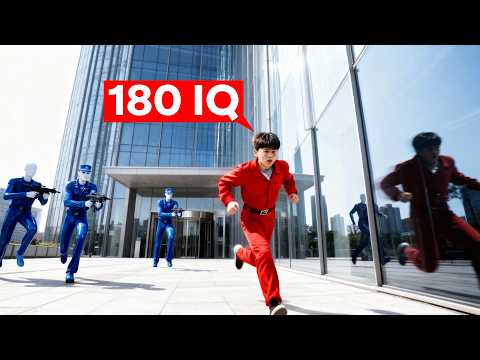
Ri Jong Yol, a North Korean math prodigy and four-time International Mathematical Olympiad silver medalist, defected during the 2016 competition in Hong Kong to escape forced recruitment into North Korea's cyber warfare unit. After a tense escape and diplomatic standoff, he secured asylum in South Korea, where he rebuilt his life and pursued higher education, highlighting the personal costs and geopolitical complexities of defection from North Korea.
On July 17th, 2016, in Hong Kong, an 18-year-old North Korean teenager named Ri Jong Yol faced a life-or-death moment. Knocking on the door of the South Korean consulate at midnight, he whispered, "I'm from North Korea. I want to defect." If the door opened, he would live; if not, he would be dead by morning.
Just 24 hours earlier, Ri had stood on stage accepting his fourth consecutive silver medal for North Korea at the International Mathematical Olympiad (IMO). Now, he was a fugitive—not running from prison, but from forced recruitment into North Korea's top hackers unit, where he would have been trapped in a lifetime of cyber warfare and nuclear weapons research.
Born in 1998 under the watchful gaze of Kim Jong-il's portrait in a city north of Pyongyang, Ri showed extraordinary mathematical talent from a young age. By seven, he had mastered his entire elementary math curriculum, impressing teachers with his mechanical computation skills.
In North Korea, exceptional talent is not celebrated but weaponized. Ri's brilliance earned him admission to Pyongyang's elite school for gifted youth—a pipeline to state service where every class, friendship, and thought was monitored for loyalty. By 15, he dominated local math competitions; by 16, he was on the national team for the IMO.
Ri competed internationally for four years—in Thailand, South Africa, Colombia, and Hong Kong—winning silver medals each time. While these trips brought prestige to North Korea, they also increased scrutiny. After his third Olympiad in 2015, North Korean officials began interrogating his friends, relatives, and teachers, signaling that Ri had been "selected" for a classified government unit.
The regime planned to funnel his mathematical talent into cyber warfare, potentially forcing him to hack foreign banks to fund missile programs or work on nuclear weapons research in isolation. For Ri, who had glimpsed freedom abroad, this future was a premature burial.
Faced with conscription into North Korea's shadow apparatus, Ri decided to escape. The 2016 IMO in Hong Kong presented a rare opportunity: a foreign city with a South Korean consulate on Chinese soil, his last eligible year to compete.
Before leaving, Ri confided in his father, a mathematics teacher, who, despite the risks of collective punishment, gave him $200 in foreign currency to aid his escape. With only clothes, books, and this money, Ri boarded the plane to Hong Kong, carrying one shot at freedom.
At the Hong Kong University of Science and Technology, Ri competed under strict surveillance: no passports, no smartphones, constant monitoring by government-appointed handlers. The regime's security was based on intimidation and routine, lacking weapons or handcuffs.
Ri observed cracks in the surveillance and planned his escape carefully. After the competition ended and the closing banquet relaxed the minders, he slipped out of the dormitory around 2 a.m., evaded a dozing security guard, and hailed a taxi to the Hong Kong International Airport.
At the bustling airport, Ri approached the Korean Air check-in counter, nervously requesting help to go to South Korea. Revealing he was from North Korea, he quickly gained the attention of staff who contacted the South Korean consulate.
The consulate, initially skeptical, confirmed his story and urged him to reach their office independently, as sending an escort could violate laws or provoke China and North Korea. Armed with the consulate's address, Ri took another taxi through Hong Kong's streets, constantly checking for pursuers.
Arriving at the Far East Finance Center, Ri found the South Korean consulate on the fifth floor. Despite initial hesitation from security guards, he declared his need for asylum and was ushered inside.
Inside, consular officers were astonished but quickly provided shelter. Ri was physically on South Korean territory by diplomatic law, safe from North Korean reach. However, he was still on Chinese soil, and the geopolitical battle over his fate was just beginning.
News of Ri's defection spread to Hong Kong and Beijing authorities, who stationed plainclothes officers around the consulate to prevent unauthorized access. The consulate went into lockdown, and Ri was confined to a small, windowless room.
Negotiations between South Korea, China, and North Korea ensued. China faced a dilemma: deporting Ri would be a public relations disaster, but allowing him to reach Seoul risked angering Pyongyang. Ri spent weeks in limbo, isolated and anxious about his family's fate back home.
After roughly 70 days, China agreed to let Ri travel to South Korea. South Korea issued him a passport under a pseudonym, Lee Jong-Ho, and Hong Kong granted a temporary visa.
Escorted by South Korean officials, Ri traveled to the airport and boarded a flight to Seoul. The moment the plane lifted off, he exhaled the breath he had held for months—he was free.
Upon arrival, Ri underwent a special arrivals process and was enrolled in an intensive program for North Korean defectors. He faced culture shock but embraced his freedom, learning new social norms and exploring a world previously forbidden.
Within a year, Ri passed entrance exams and was admitted to Seoul National University to study mathematics, a remarkable achievement for someone raised without internet or academic freedom.
Ri has not seen or heard from his family since his defection, likely never will unless North Korea collapses. He downplays his father's help publicly to protect his family from punishment.
His defection humiliated the North Korean regime, which froze its IMO program for two years and implemented stricter surveillance upon resuming.
Ri's story is a rare success among defectors, highlighting the personal sacrifices and geopolitical complexities involved. His first act in South Korea was to search for information about North Korea online, a simple freedom denied to him for years.
Ri Jong Yol's journey from a math prodigy under a repressive regime to a free student in South Korea is a powerful testament to courage and the human desire for freedom. His story raises a poignant question: how many other brilliant minds remain trapped in North Korea, calculating their own desperate equations for freedom?