
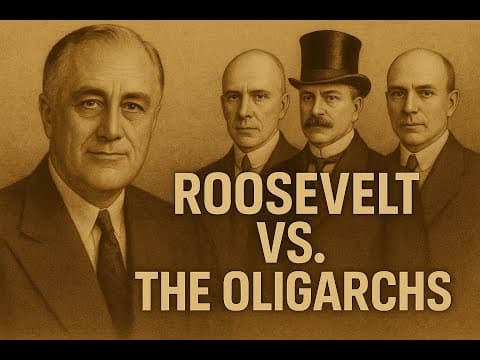
The Great Depression was a crisis engineered by financial elites that devastated the working class. Franklin D. Roosevelt's New Deal, supported by a progressive Congress, implemented reforms to protect workers, regulate Wall Street, and rebuild the economy. Despite fierce opposition from billionaires and attempts to overthrow the government, the New Deal empowered the middle class and labor, shaping modern America. However, later decades saw a reversal driven by corporate interests.
The Great Depression was not a natural disaster but a crisis engineered by a financial elite whose unchecked greed and speculation in the 1920s led to the collapse of the economy. When the stock market plummeted in 1929, it exposed the fragility and inequality of an economy dominated by the top 0.1% who controlled as much wealth as the bottom 42% of Americans.
The 1920s are often remembered for jazz, flappers, and excess, but for Wall Street, it was a decade marked by deregulation and rampant speculation. Workers were disregarded, and the economy was a house of cards built on inequality. When the market crashed, more than one-third of US banks failed, small businesses closed, and unemployment soared to nearly 25%. The working class lost their savings, homes, and assets, often selling them back to the very financiers who caused the disaster.
In 1932, Franklin Delano Roosevelt was elected president with a landslide victory, promising a "New Deal" that would put government power on the side of the people. His Democratic Congress, filled with progressives like Senator Robert Wagner and Hugo Black, was crucial in passing landmark legislation.
FDR famously declared, "The only thing we have to fear is fear itself," restoring hope to 140 million Americans. His administration aimed not to return to the past but to create a new economic order that protected workers and regulated Wall Street.
These reforms empowered labor, protected workers' rights, and rebuilt the economy from the ground up.
The business elite, including families like the Duponts, and moguls such as J.P. Morgan and John D. Rockefeller, vehemently opposed FDR. They labeled him a socialist and launched relentless propaganda campaigns through newspapers and right-wing radio to stir fear of communism and class warfare.
In 1934, Wall Street financiers even plotted a fascist military coup to overthrow the government, led by retired Marine General Smedley Butler. Butler refused to participate and testified before Congress, exposing the conspiracy. Although no prosecutions followed, the attempt underscored the lengths to which the elite would go to stop reforms.
The New Deal marked a turning point where the government sided with workers rather than business owners. When the United Auto Workers struck General Motors in 1937, FDR urged GM to recognize the union, leading to a historic victory for labor.
This era saw the rise of the strongest middle class in US history, supported by government programs and labor protections.
Despite the New Deal's successes, the wealthy class never ceased their efforts to regain control. Starting in 1971, corporate interests launched a long-term campaign to dismantle the gains made by FDR's policies. A secret memo by Lewis Powell, a corporate lawyer and future Supreme Court justice, called for a disciplined takeover of institutions to protect business interests.
Over decades, billionaires took over media, funded think tanks, influenced politicians, and rolled back social programs. The repeal of Glass-Steagall in 1999 under President Bill Clinton paved the way for the 2008 financial crisis.
Franklin Roosevelt demonstrated that government could work for the people, not just the wealthy. However, the fight continues today in voting booths, picket lines, and public discourse about the kind of country America should be.
The question remains: what kind of nation do we want, and who should it serve?
The New Deal was a transformative period in American history that confronted the billionaire class and reshaped the economy to protect workers and the middle class. Despite fierce opposition and ongoing challenges, it remains a powerful example of how government can act in the public interest. Understanding this history is crucial as we face contemporary debates about economic justice and democracy.
As we look back, we see both how far we've come and how far we still have to go.
Testimony of General Smedley Butler on the attempted fascist coup:
"I appeared before the congressional committee... to tell what I knew of activities which I believe might lead to an attempt to set up a fascist dictatorship... I want to retain the right to vote by the right to speak freely and the right to write. If we maintain these basic principles, our democracy is safe. No dictatorship can exist with suffrage, freedom of speech, and press."



















