
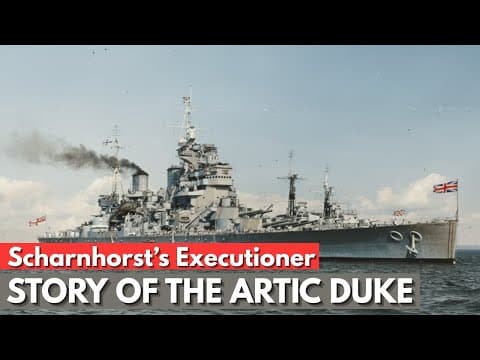
On December 26, 1943, HMS Duke of York engaged and sank the German battleship Scharnhorst in the Arctic, marking the last major battleship duel in naval history. Despite treaty limitations, Duke of York's advanced radar, firepower, and armor proved decisive in protecting Arctic convoys and ending Germany's surface threat in the region.
On the afternoon of December 26th, 1943, in the harsh Arctic conditions off the North Cape of Norway, HMS Duke of York detected a surface contact at nearly 30,000 yards. This contact was the German battleship Scharnhorst, which was attempting to intercept an Arctic convoy bound for Russia. Unaware of Duke of York's approach, Scharnhorst was caught off guard, leading to the last major battleship duel in naval history.
HMS Duke of York was a King George V-class battleship, designed and built under the constraints of the Washington Naval Treaty, which limited battleships to 35,000 tons and 14-inch guns. While other nations like Japan and Italy abandoned these treaties, Britain honored them, resulting in battleships that were heavily armored but carried smaller guns compared to their contemporaries. Duke of York carried ten 14-inch guns arranged in a unique turret configuration.
Laid down in 1937 and commissioned in 1941, Duke of York joined the Home Fleet at a critical time when Britain needed modern battleships to counter German surface raiders and protect vital Arctic convoys supplying the Soviet Union.
After commissioning, Duke of York's first mission was diplomatic, transporting Winston Churchill to the United States in December 1941. Subsequently, she operated primarily in Arctic waters, escorting convoys carrying tanks, aircraft, ammunition, and supplies to the Soviet Union. These convoys faced constant threats from German aircraft, submarines, and surface ships, including the battleship Tirpitz.
Duke of York participated in several convoy escorts and operations, including:
German naval intelligence detected convoy JW55B leaving Scotland on December 22, 1943. Scharnhorst, armed with nine 11-inch guns and capable of over 30 knots, was ordered to intercept and destroy the convoy. The Royal Navy anticipated this and assigned two forces:
On the morning of December 26, Force One made contact with Scharnhorst, resulting in brief engagements that damaged the cruiser Norfolk's radar. Scharnhorst attempted to attack the convoy but was driven off, eventually turning south to return to Norway.
Admiral Bruce Fraser, commanding Force Two, maneuvered Duke of York to intercept Scharnhorst's retreat. Utilizing superior radar technology and the cover of Arctic darkness, Duke of York detected Scharnhorst at 4:32 p.m. and closed in undetected due to Scharnhorst's damaged radar.
At 4:47 p.m., cruiser Belfast fired star shells to illuminate Scharnhorst but missed. Duke of York fired her own star shell, which burst directly over Scharnhorst, revealing the German battleship unprepared with main turrets trained away from battle stations.
At 4:50 p.m., Duke of York opened fire with a full 10-gun broadside from 12,000 yards. The first salvo hit Scharnhorst, causing alarm and forcing the crew to man battle stations. Despite returning fire, Scharnhorst suffered significant damage:
For 90 minutes, the two ships exchanged fire while racing southeast through the Arctic darkness. Duke of York fired 52 broadsides, totaling 520 rounds, while Scharnhorst's return fire was limited due to damage and smoke.
As Scharnhorst attempted to escape, a 14-inch shell penetrated her number one boiler room, reducing speed drastically. British destroyers overtook her and launched torpedo attacks, scoring multiple hits. Duke of York and cruiser Jamaica resumed firing, further battering Scharnhorst.
By 7:45 p.m., Scharnhorst was heavily listing and sank, with over 1,700 men lost and only 36 survivors rescued from the freezing waters.
The Battle of the North Cape marked the end of Germany's surface threat to Arctic convoys. Tirpitz remained in Norwegian fjords but was eventually sunk by RAF bombers in 1944. With the German heavy units neutralized, the Royal Navy's need for powerful battleships in home waters diminished.
Duke of York continued convoy escort duties and supported carrier air strikes until the end of the war. In 1945, she sailed to the Pacific, arriving too late for significant action but was present at the Japanese surrender in Tokyo Bay.
Post-war, Duke of York served as flagship of the Home Fleet until 1949 and was scrapped in 1957.
The Battle of the North Cape was the Royal Navy's last great surface action against a German capital ship and symbolized the twilight of the battleship era. The advent of aircraft carriers and the atomic age soon rendered battleship engagements obsolete.
Duke of York, built under treaty restrictions and armed with smaller guns than her contemporaries, demonstrated the effectiveness of modern technology such as radar and fire control systems. The battle showcased the power of coordinated naval forces and the importance of surprise and determination.
Admiral Fraser's reflection on the battle emphasized the skill and command displayed, even against a formidable opponent. The sinking of Scharnhorst closed a chapter in naval history, marking the last major gun duel between battleships and the transition to modern naval warfare.
On December 26, 1943, HMS Duke of York achieved a decisive victory against the German battleship Scharnhorst in the Arctic darkness. This battle not only protected vital supply convoys to the Soviet Union but also marked the final great battleship engagement in history. The legacy of Duke of York and the Battle of the North Cape endures as a testament to naval strategy, technology, and the changing face of warfare in the 20th century.



















