
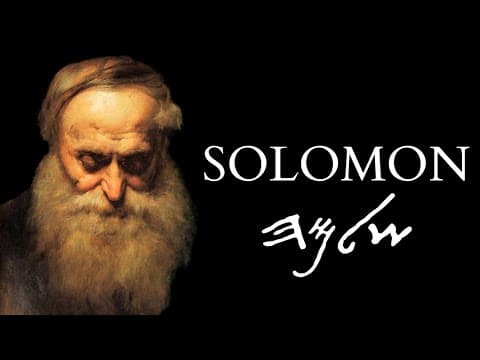
King Solomon, the third king of Israel, is renowned not only for his wisdom and political acumen but also for his legendary association with demons and esoteric magic. This article explores Solomon's biblical origins, his divine wisdom, the evolution of his image in esoteric traditions, and how he became a central figure in occult lore and magical grimoires.
The image of King Solomon surrounded by demons as he builds the temple for the Israelite God is striking and has fascinated people for centuries. Solomon, the third king of Israel, is not only remembered for his wisdom and political leadership but also for his legendary control over demons and diabolical magic. This article delves into how Solomon came to be associated with the arcane and occult, tracing his story from the Hebrew Bible to early modern magical texts.
Solomon first appears in biblical history as the third king of the ancient kingdom of Israel, succeeding his father King David. His rise to power involved political maneuvering, including marrying the daughter of the Egyptian pharaoh to solidify his position. One of the most significant moments early in his reign is his encounter with the Israelite God, Yahweh, at Gibeon.
At Gibeon, Solomon performs sacrifices and undergoes a ritual incubation—a practice where one sleeps in a holy place to receive divine communication through dreams. In this dream, Solomon admits his lack of knowledge about how to govern effectively and asks God for a "listening heart" to discern good from evil and rule justly. Pleased with this request, Yahweh grants Solomon profound wisdom, along with promises of riches, glory, and a long life, contingent on his obedience.
This divine wisdom, known as Hocmat Elohim, becomes the foundation of Solomon's legendary status. It is famously demonstrated in the biblical story where Solomon adjudicates a dispute between two women claiming to be the mother of a child, showcasing his ability to discern truth and justice.
Beyond his wisdom, Solomon is credited with extensive knowledge of nature, including trees, animals, birds, reptiles, and fish. This comprehensive understanding symbolizes his mastery over the natural world and the elements—air, fire, water, and earth. His reputation for wisdom and knowledge extends beyond Israel, making him a world-renowned king.
Solomon's reign culminates in the construction of the House of Yahweh, the temple in Jerusalem. While later legends emphasize Solomon's use of demonic aid to build the temple, the Hebrew Bible itself does not contain any such stories. Instead, the biblical narrative focuses on Solomon's wisdom, political achievements, and eventual downfall due to idolatry influenced by his foreign wives.
The biblical editors, particularly the Deuteronomist, frame Solomon's decline as a consequence of his apostasy, which leads to the division of the Israelite monarchy after his death. The Chronicler, writing later, emphasizes Solomon's role as a builder and downplays his wisdom and moral failings, likely as part of a broader agenda to promote Davidic legitimacy.
Several biblical texts are attributed to Solomon, including Psalms 72 and 127, the Book of Proverbs (Mishle), the Song of Songs (Shir Hashirim), and Ecclesiastes (Kohelet). While these works highlight Solomon's wisdom, they do not explicitly contribute to the esoteric or occult aspects of his legend. Notably, the Song of Songs later becomes a mystical allegory in Jewish and Christian traditions.
It is important to note that many of these texts were likely composed centuries after Solomon's reign, indicating that the historical Solomon probably did not author them. Proverbs, for example, is a compilation of Israelite and Egyptian sayings.
The transformation of Solomon's image from a wise king to a master of demons and magic is a complex process influenced by various cultural and religious traditions. By the time of early printed texts like Yaqob-de-Tauramos Consolatio Peccatorum (also known as the Book of Belial), Solomon is depicted presiding over a supernatural trial involving demons.
First printed in 1473, this controversial and sometimes forbidden text describes a lawsuit launched by Satan against Jesus Christ for trespassing into hell. Solomon acts as the judge, overseeing demons testifying in the trial. The vivid woodcut illustrations of demons before Solomon helped cement his reputation as a figure deeply familiar with diabolical magic.
For centuries, handbooks of black magic circulated under Solomon's name, further establishing him as the archetypal occult king. The widespread dissemination of such texts contributed to the enduring legend of Solomon as a master of esoteric knowledge and demonology.
Solomon's story embodies a duality: he is both a figure of divine wisdom and a morally ambiguous character whose desire for power leads to transgression. This combination of supernatural insight and ethical complexity makes Solomon a compelling figure in literature and occult traditions.
His wisdom and power, coupled with his moral failings, provide fertile ground for endless reinterpretation and myth-making. Solomon becomes an Israelite Faust or Casanova, whose story warns of the dangers of overreaching ambition and the allure of forbidden knowledge.
Starting in the third century BCE, during the Hellenistic period, Solomon's image underwent further transformation. Greek and later Western esoteric traditions expanded on his legend, incorporating him into grimoires such as the Lesser Key of Solomon, a famous early modern handbook of magic.
These texts portray Solomon as a magician who commands demons to perform tasks, especially in the construction of the temple. This portrayal is a significant departure from the biblical narrative and reflects the syncretism of Jewish, Christian, and pagan magical traditions.
King Solomon's journey from a biblical monarch known for his divine wisdom to the master of demons in occult lore is a fascinating example of how historical figures can be reimagined across cultures and eras. His story illustrates the interplay between religion, mythology, and esotericism, showing how legends evolve to meet the spiritual and cultural needs of different communities.
Solomon remains a powerful symbol of wisdom, power, and the complex relationship between knowledge and morality. His legacy continues to inspire art, religion, and occult practices, making him one of the most enduring figures in the history of esotericism.
This exploration is part of a series examining the arcane dimensions of historical figures and their impact on esoteric traditions. Stay tuned for further insights into the mystical and magical legacies that shape our understanding of history and spirituality.



















