
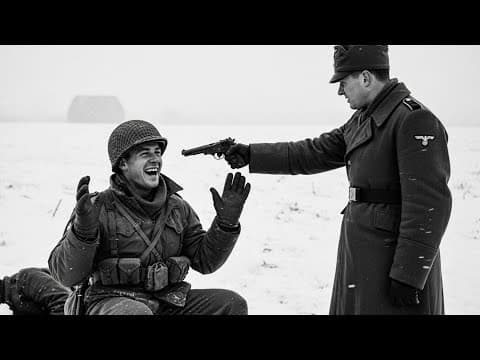
On January 29, 1945, 1st Sergeant Leonard Funk faced 90 German soldiers alone in Holtzheim, Belgium. Despite being outnumbered and threatened at gunpoint, Funk's unexpected laughter confused the enemy, allowing him to take down 21 soldiers in under a minute and force the rest to surrender. His extraordinary bravery earned him the Medal of Honor and cemented his legacy as a remarkable WWII hero.
On January 29th, 1945, at 2:47 PM in Holtzheim, Belgium, 1st Sergeant Leonard Funk found himself in an extraordinary and perilous situation. Around the corner of a farmhouse, he was confronted by 90 German soldiers. Half of these soldiers were armed, while the others were hastily picking up rifles from a pile on the ground. Just 20 minutes earlier, these Germans had been prisoners captured by Funk's company during an assault on the village. Guarded by only four men, these prisoners had now freed themselves, armed, and were organizing to attack Company C from the rear.
A German officer stepped forward, pressing an MP 40 submachine gun into Funk's stomach and shouting commands in German, a language neither Funk nor his men understood. Instead of showing fear, Funk looked at the overwhelming number of Germans, then at his four disarmed soldiers, and then at the gun pressed against him—and started laughing. This unexpected reaction confused and enraged the German officer, who screamed louder, but Funk's laughter only grew.
What followed was a remarkable act of combat that lasted less than a minute. Leonard Funk managed to kill 21 German soldiers, and the remaining soldiers surrendered. This incredible feat earned him the Medal of Honor and became one of the most insane and heroic acts of World War II.
Leonard Alfred Funk Jr. was born on August 27th, 1916, in Braddock Township, Pennsylvania, a steel town near Pittsburgh. Growing up during the Great Depression, Funk learned responsibility early, taking care of his younger brother. After graduating high school in 1934, jobs were scarce, and college was a distant dream.
In June 1941, with war raging across Europe and Asia, the U.S. Congress extended the draft. Funk was inducted at age 24. Despite his modest stature—5 feet 5 inches tall and 140 pounds—and the army's initial impression that he might be suited for clerical work, Funk volunteered for the paratroopers.
At the time, American airborne forces were a new concept. The idea of jumping out of aircraft behind enemy lines to fight surrounded was considered suicidal by many. The training was brutal, designed to break candidates through five weeks of intense physical conditioning, jump towers, and actual aircraft jumps.
Funk earned his jump wings and was assigned to Company C, 1st Battalion, 508th Parachute Infantry Regiment at Camp Blanding, Florida. The 508th shipped to England in late 1943 and joined the 82nd Airborne Division, veterans of Sicily and Italy. Funk, at 27, was older than most of his squad mates but brought maturity and steadiness that inspired confidence.
On June 6th, 1944, during the Normandy invasion, Funk was part of the airborne operation involving 13,000 paratroopers. Their mission was to land behind the beaches, secure bridges and crossroads, and prevent German reinforcements from reaching the coast. The operation was chaotic; formations were scattered, many landed in flooded fields, and some died before freeing themselves from their harnesses.
Funk landed hard, twisting his ankle badly, but he could still walk and fight. Despite being 40 miles from his drop zone and alone in enemy territory, he gathered a group of 18 lost paratroopers from different units and led them through German-held territory for 10 days, traveling by night and hiding by day.
By January 1945, Funk had risen to acting company executive officer. The confrontation at Holtzheim was a testament to his leadership and courage. Facing 90 armed Germans, including those recently captured by his company, Funk's laughter in the face of danger disoriented the enemy. His quick thinking and combat skills allowed him to kill 21 soldiers and force the rest to surrender, preventing an attack on his company from the rear.
Leonard Funk's actions at Holtzheim exemplify extraordinary bravery and presence of mind under extreme pressure. His Medal of Honor citation commemorates one of the most remarkable single-handed combat feats of World War II. Funk's story is a powerful reminder of the courage and resilience of soldiers who faced overwhelming odds during the war.
The story of Leonard Funk is not just about a soldier's bravery but also about the unexpected ways courage can manifest. His laughter, a simple human reaction, became a weapon that confused and defeated a much larger enemy force. Funk's legacy continues to inspire, illustrating that sometimes, the most extraordinary acts come from the most unexpected moments.



















