
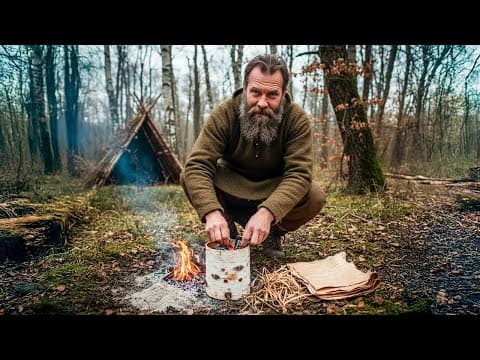
This article explores 25 medieval survival techniques that sustained peasants during crises like the Great Famine and contrasts them with modern system failures. It reveals how medieval knowledge of firewood storage, camouflage, heat retention, water purification, and more were essential for survival, why such knowledge was banned for control, and how these ancient methods remain relevant today.
In 1315 A.D., Europe was devastated by the Great Famine. A mysterious plague wiped out eighty percent of the cattle, leaving ten million people facing starvation. Medieval peasants survived by turning to the forest and employing ingenious survival techniques such as processing tree bark into flour, preserving embers for 48 hours without matches, and purifying water using heated stones. These methods kept entire villages alive through years of crop failure.
Fast forward to February 2021, when the Texas power grid failed, plunging modern homes into freezing temperatures within six hours. Families huddled in cars, running out of gas, facing a complete system collapse. This stark contrast highlights the resilience of medieval survival skills compared to modern infrastructure.
In 1184, the English crown passed forest laws that made basic survival knowledge illegal. This was not a moral decision but a means of control. If peasants could feed themselves from the forest, they would not need the nobility. Knowledge became a crime because knowledge was power. Today, scientists validate what medieval people knew: these 25 techniques require no supply chains or permission, work when modern systems fail, and were banned then and remain restricted in some forms now.
In regions like Germany, Switzerland, Austria, and Scandinavia, farmers built housebarns—combined structures where living spaces were attached directly to animal housing, grain storage, and firewood storage. Archaeological evidence from sites such as Flixborough in England (8th-9th century) shows residential structures with attached storage areas, including firewood stacked right against the house.
Residual Heat: Even poorly insulated medieval cottages generated warmth that radiated through shared walls into attached storage areas, reducing wood moisture content significantly.
Protection and Ventilation: The attached sheds had three walls with the house as the back wall, wooden plank side walls with gaps for airflow, and an open front under a slanted roof. This design protected wood from rain and snow while allowing air circulation.
In Norway, where winters reach minus 30°C, firewood was stacked vertically against the house wall, leaning inward to create natural airflow channels. Only the top was covered, leaving sides and front exposed to air. Experiments at Aarhus University showed wood stored this way reached optimal dryness (18% moisture) in 6.5 months, compared to over 12 months outdoors.
In parts of Germany, the Holtzhausen method involved stacking wood in concentric rings forming a free-standing cylinder with a chimney effect to pull air through the stack. The outer ring was capped with bark arranged as a natural thatched roof. This method could hold enough wood for a winter and maximized airflow while protecting from rain.
Modern camouflage patterns were invented in World War I, but medieval outlaws, hunted criminals who would be killed on sight, developed superior concealment techniques documented in the 1370 hunting manual Le Livre de Chasse du roy Modus et de la royne Ratio.
Medieval cottages were engineered for heat retention with thick thatched roofs (16 inches of wet straw) providing insulation better than many modern attics. Stone walls absorbed and radiated heat slowly. Families used heated river stones wrapped in wool rags placed in bedding to radiate heat for hours.
Bringing livestock inside added continuous heat (a sheep produces about 150 watts), making the difference between survival and frostbite despite discomfort and poor hygiene.
At Kenilworth Castle in 1389, Lord Edmund’s bed was a precision-engineered thermal chamber. The bed frame stood on a raised platform creating an air gap from the cold stone floor. Heavy wool curtains with wool batting and linen interlining surrounded the bed, creating insulation equivalent to modern fiberglass.
The curtains blocked radiant heat loss, reflecting body heat back to the sleeper. Before bed, a chambermaid warmed the bed using a copper pan filled with red-hot charcoal, sliding it between sheets to warm the mattress without scorching.
Medieval peasants mastered water purification to avoid deadly diseases like dysentery and cholera. They harvested rainwater using thatched roofs as filters and channeled runoff into barrels. When using riskier sources, they layered methods:
Medieval peasants were not primitive but skilled engineers and survivalists who developed techniques tested over generations to survive brutal conditions. Their knowledge of firewood storage, camouflage, heat retention, and water purification allowed them to endure famines, plagues, and harsh winters.
These skills were banned historically to maintain social control but remain relevant today, especially when modern infrastructure fails. Understanding and reviving these forgotten techniques can provide resilience in times of crisis.
Note: Some details about edible plants and foraging were clarified to ensure accuracy and transparency.
If you found this exploration of medieval survival skills insightful, consider sharing it to help others discover these powerful, time-tested techniques.



















