
This blog post explores the transformation of the Capitoline Hill and the Roman Forum through Michelangelo's architectural vision during the Renaissance, highlighting the historical significance of these sites and their connection to both ancient and modern Rome.
In Ancient Rome, the Roman Forum served as the most important part of the city. It was not only a commercial hub but also a center for social interaction and religious activities. The Forum housed several significant structures, including the Curia, the senate house, and various basilicas that played crucial roles in governance. Overall, the Roman Forum was the epicenter of Roman life, where citizens engaged in public and civic activities.
Overlooking the Forum was the Capitolium, a hill that held great significance in the city’s life. At its summit stood the Temple of Jupiter Optimus Maximus, the greatest temple in Rome. This temple was where new consuls took their vows and where victorious generals celebrated their triumphs. The buildings on Capitolium faced the Forum, symbolizing Rome’s divine favor, military might, and political power.
Following the fall of Rome, the city experienced a decline in population and importance. Over the centuries, the area that once thrived became wild and uncultivated, filled with ancient ruins and grazing cattle. By the 14th century, Rome was in disrepair, with the papacy residing in France. Despite this, it remained a significant pilgrimage destination, housing important relics and tombs, including that of St. Peter.
By the 15th century, as the popes returned to Rome, interest in ancient Roman ruins began to resurface. The Italian Renaissance was underway, and artists and architects, including renowned figures like Brunelleschi and Alberti, flocked to Rome to study its ancient structures. The popes also developed a passion for collecting ancient marble sculptures, which were displayed on Capitolium. The Capitoline Museums, founded in 1471, became one of the oldest public museums in the world, offering Renaissance artists invaluable opportunities to study these masterpieces.
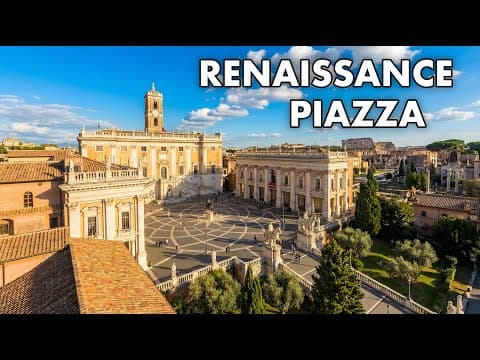
In 1537, Pope Paul III commissioned Michelangelo to create a square on Capitolium, as the area was becoming increasingly public. At that time, two significant buildings were already present: the Palazzo Senatorio and the Palazzo dei Conservatori. Michelangelo's design not only transformed the appearance of these buildings but also reoriented the piazza towards St. Peter’s Basilica, symbolically turning away from the Roman Forum and the remnants of pagan antiquity.
The name of the hill evolved from "Capitolium" in Latin to "Campidoglio" in Italian, leading to the creation of the "Piazza del Campidoglio" or the "Square of the Capitol." This name has influenced many modern countries, including the United States, which named their government buildings after this historic site.
The first step in the Piazza del Campidoglio project occurred in 1538, with the placement of the statue of Marcus Aurelius at the center of the piazza. However, progress on Michelangelo’s plans stalled, and they were not published until 1550, when he was 75 years old. During his final years, Michelangelo was preoccupied with designing the dome of St. Peter’s Basilica, resulting in little advancement on the piazza before his death in 1564.
After Michelangelo's passing, architect Giacomo della Porta, who had collaborated with him, took over the unfinished projects, ensuring that Michelangelo’s original plans were faithfully executed, including the Piazza del Campidoglio.
Michelangelo drew inspiration for the shape of the piazza from the earlier Piazza Pio II in Pienza, designed by Bernardo Rosselino. This trapezoidal design opened the corners of the piazza, allowing views of the surrounding landscape, including the Roman Forum, creating an illusion of greater space.
Michelangelo refined the Palazzo Senatorio, removing its medieval characteristics and introducing classical elements such as columns and pediments. He also redesigned the Palazzo dei Conservatori to match the new aesthetic. To enhance the piazza's Renaissance character, he proposed constructing a new palace opposite the axis created by the tower and the statue of Marcus Aurelius, creating a more enclosed space.
To ensure the piazza's grandeur, Michelangelo introduced the Colossal Order in the facades of the buildings, giving them the appearance of Roman temples from a distance. A majestic staircase was created to provide a grand entrance to the piazza, reinforcing the statue of Marcus Aurelius as the focal point. The pavement design featured an oval-shaped star that expanded into diamonds, enhancing the sense of unity and coherence in the design.
Strategically placed ancient Roman statues throughout the square further emphasized its historical significance. Statues of Castor and Pollux framed the access, while the facade of the Palazzo Senatorio displayed representations of the Nile and Tiber rivers, along with Dea Roma, the city's patron goddess. A statue of the she-wolf suckling Romulus and Remus served as a reminder of Rome's mythical foundation.
The statues in the piazza not only symbolize Ancient Rome but also represent actual works from that era, creating a sense of continuity between ancient and Renaissance Rome. Michelangelo’s pedestal for the equestrian statue bore a Latin inscription honoring the five good emperors of ancient Rome, further linking the two periods.
From the Capitoline Museums, visitors can enjoy one of the best views of the Roman Forum, constructed over the ancient Tabularium. The site allows for close appreciation of the columns from the Temples of Saturn and Vespasian, the Arch of Septimius Severus, and the Curia, alongside the Arch of Titus in the distance.
Overlooking the Piazza del Campidoglio is the Church of Santa Maria in Aracoeli, a medieval basilica built in the 13th century on the site of an ancient Roman temple. Michelangelo respected the church's independence while designing the new civic space, ensuring a harmonious integration of the old and new.
Michelangelo’s project for the Capitoline Hill represents one of the most coherently planned architectural groups of the 16th century, providing an appropriate setting for the traditional heart of Rome. His work not only revived the historical significance of the area but also established a lasting legacy that continues to resonate in modern Rome.
This transformation of the Capitoline Hill and the Roman Forum illustrates the profound impact of the Renaissance on the city, bridging the gap between ancient glory and contemporary significance.



















