
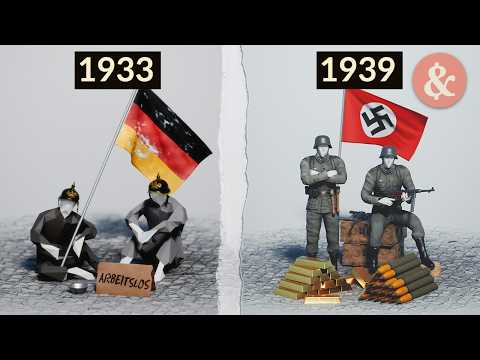
This article explores how Nazi Germany, under Hjalmar Schacht's leadership, engineered an economic recovery from the Great Depression to build a massive military force by 1939. It details the economic challenges faced by Weimar Germany, Schacht's unconventional financial tools, and the eventual militarization and control of the economy that led to war and devastation.
In 1933, Berlin was deeply affected by the Great Depression, with unemployment reaching 30% among the working-age population. Soup kitchens were common, reflecting widespread poverty. By 1939, on Hitler's birthday, unemployment was nearly zero, soup kitchens had vanished, and Germany showcased a formidable new army equipped with thousands of tanks, artillery, trucks, and modern aircraft. This rapid transformation, often called an economic miracle, was orchestrated by Hjalmar Schacht, a man known as the Dark Wizard of International Finance for his unconventional economic strategies.
This article delves into how Schacht rebuilt the German economy, the economic and political context preceding this transformation, the tools he used, and the consequences of this economic miracle.
The story begins in early 20th century Europe, where Imperial Germany, formed in 1871, was emerging as a major power challenging the British Empire. Hjalmar Schacht, born in 1877, was an intelligent economist who rose through the ranks of Germany's Dresdner Bank and served briefly as a financial consultant during World War I.
Germany faced severe resource shortages during the war due to an Allied naval blockade, leading to food shortages and public unrest. In 1918, the German Kaiser was overthrown, ending Imperial Germany and ushering in the Weimar Republic.
Schacht returned to banking and politics, co-founding the center-left German Democratic Party. The Weimar Republic is often remembered for the hyperinflation crisis of 1923, where the German currency became nearly worthless due to excessive money printing.
The hyperinflation was not due to ignorance but a consequence of two major problems:
Balance of Payments Crisis: Germany lacked sufficient foreign currency reserves due to reduced exports, increased imports, and reparations payments mandated by the Treaty of Versailles.
Massive War Debt: The government owed large debts to its citizens from war financing.
Conventional solutions like increasing exports or defaulting on reparations were impractical. The government resorted to printing money to pay debts and reparations, which led to hyperinflation. While hyperinflation destroyed savings and pensions, it kept unemployment low and inflated away war debts.
In 1923, Schacht was brought in to stabilize the economy. He introduced a new currency and negotiated the Dawes Plan, which reduced reparations payments temporarily. This stabilized inflation and attracted foreign investment, leading to the Golden Age of Weimar.
However, the 1929 Great Depression hit Germany hard. Foreign loans stopped, exports collapsed, and the balance of payments crisis returned. The government imposed austerity measures, leading to massive unemployment and poverty, fueling political extremism.
In 1933, the Nazis came to power, and Schacht was appointed Reichsbank president and Economy Minister. He faced three challenges:
Despite limited natural resources and reparations debts, Schacht achieved remarkable economic recovery.
Hidden Deficit Spending: Schacht introduced the Neuer Plan, similar to Roosevelt's New Deal, using government borrowing to fund public works and military spending. To hide military spending, he created a shell company issuing "Mefo Bills" as payment, which the Reichsbank guaranteed.
Dual Wage Controls: Labor unions were banned and replaced by the German Labor Front, which prevented wage increases, keeping wages stagnant despite economic growth.
Price Controls: Gradual introduction of price controls prevented inflation but led to shortages in goods like textiles and seafood.
Quotas: Bureaucrats allocated scarce resources like steel and coal, prioritizing military needs over civilian sectors.
Selective Debt Default: In 1934, Germany defaulted on debts owed to the US, UK, Netherlands, and Switzerland, which led to sanctions but was partially mitigated by trade deals with some countries.
Capital Controls: Importers had to get approval from the Reichsbank to access foreign currency, controlling imports tightly.
Exporter Subsidies: To maintain export competitiveness without devaluing the Reichsmark, the government subsidized exporters.
Personal Capital Controls: Jews and others wishing to emigrate were limited in the amount of assets they could take abroad, preventing a drain on foreign currency reserves.
These policies eliminated unemployment and built a powerful military but at the cost of economic freedom. Wages remained stagnant, shortages appeared, and the government controlled prices, wages, imports, and resource allocation. Businesses remained privately owned but were forced to comply with Nazi-controlled associations.
In 1935, the Nazis openly announced rearmament, breaking the Treaty of Versailles. This led to increased military spending and accelerated rearmament by other powers. Hitler believed war with the US and Britain was inevitable and pushed for a Four Year Plan in 1936 to prepare Germany for total war and self-sufficiency.
This plan, led by Hermann Göring, undermined Schacht's authority. Schacht opposed the increasing spending fearing economic overheating but was overruled. He resigned as Economy Minister in 1937 but remained Reichsbank president.
Schacht continued to manage foreign exchange reserves by bullying Eastern European countries and plundering Austria's resources after the 1938 Anschluss. However, in 1939, he was removed from the Reichsbank presidency, and the war economy intensified under new leadership.
In 1944, Schacht was arrested by the Gestapo for alleged involvement in a plot against Hitler and spent the rest of the war in a concentration camp. After the war, he was tried at Nuremberg but was not found guilty of war crimes. He was sentenced to hard labor but released early in 1948.
Schacht later founded a bank, wrote about economics, and served as a financial consultant until his death in 1970.
The Nazi war economy relied heavily on plundered resources and forced labor. Despite initial successes, it was eventually outproduced by the Allies. The economic miracle enabled the Nazi regime's military aggression and the killing of millions.
The Nazi economic miracle was a complex and dark chapter in history. Schacht's unorthodox economic policies temporarily revived Germany's economy and built a powerful military but at the cost of freedom, ethical governance, and ultimately led to devastating war.
This history serves as a cautionary tale about the dangers of economic manipulation under authoritarian regimes and the human cost of such policies.
For further reading on the economic aspects of World War II, contemporary sources like The Economist's archives provide detailed analysis from that era.



















