
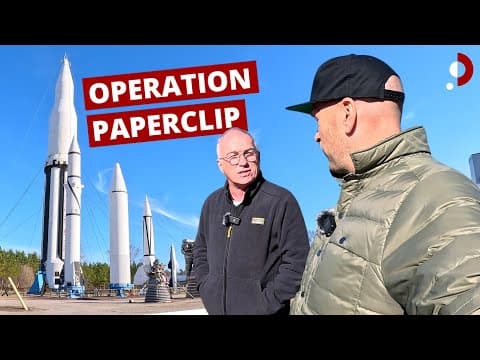
Operation Paperclip secretly brought German scientists to Huntsville, Alabama after WWII, transforming the city into a hub for aerospace and defense. This article explores the history, personal stories, and legacy of these scientists, including their work on the V-2 rocket, the space race, and the cultural impact on Huntsville.
Huntsville, Alabama, is not your typical Deep South city. Once a small, provincial town, it became a pivotal hub for aerospace, technology, and defense, largely due to a secret U.S. government operation after World War II known as Operation Paperclip. This operation brought over 125 German scientists, engineers, and technicians to the United States, many of whom settled in Huntsville and played a crucial role in America’s space and missile programs.
Contrary to some reports of 1600 German scientists, the initial core group numbered 125. These men, including Wernher von Braun, were captured by U.S. forces as the war ended. They had been working on advanced rocket technology for Nazi Germany, including the infamous V-2 rocket, which was the world’s first long-range guided ballistic missile.
The choice for these scientists was stark: surrender to the Americans or the Soviets. Many were captured by the Soviets and contributed to the Soviet space program. However, the U.S. retained their German team members, which was a key factor in winning the space race, culminating in the Apollo moon landings.
The German scientists were initially civilians and engineers before the Nazi regime took power. During the war, they were under strict supervision at the Peenemünde research facility on the North Sea coast, where they developed the V-2 rocket. The work was difficult and dangerous, with many rockets exploding during tests. The scientists were locked in and had little choice but to continue their work under threat of reassignment to manual labor if their rockets failed.
The V-2, or Vergeltungswaffe (Revenge Weapon), was fired at the UK and Belgium during the war. It was a technological marvel for its time but lacked precision guidance, relying on gyroscopes and careful calibration. The Germans were already working on multi-stage intercontinental ballistic missiles (ICBMs) and spacesuit technology during the war, much of which was classified and remains partially secret.
After the war, the German scientists were brought to Huntsville, Alabama, where they worked at Redstone Arsenal. This massive military installation became the nerve center for missile development and later NASA’s Marshall Space Flight Center. The German engineers, led by von Braun, ran the space vehicle development programs until after the successful Apollo moon landing in 1969.
Huntsville grew rapidly, transitioning from a cotton mill town with company stores and scrip payment systems to a bustling city with a strong aerospace and defense industry. The city embraced the German scientists and their families, who lived modestly despite their important work.
The presence of former Nazi scientists in the U.S. government programs was controversial. Many locals were unaware of Operation Paperclip’s full scope, and debates continue about the ethics of employing these men. Some residents appreciate the technological progress they brought, while others question the morality of forgiving their past affiliations.
The German families quickly Americanized, with children attending local schools and learning English. They contributed to the community, including founding the Huntsville Symphony and other cultural institutions.
During the Cold War, the German scientists and their descendants built bomb shelters and prepared for potential Soviet attacks. Huntsville remained a critical center for missile defense and space exploration.
NASA’s role evolved over time, with commercial companies like SpaceX now taking a leading role in space launches. However, the legacy of the German team remains visible at the U.S. Space and Rocket Center, where historic rockets like the V-2 and Saturn V are displayed.
Descendants of the original German scientists preserve documents, books, and artifacts from the era. These include original contracts, slide rules used in rocket design, and rare books such as von Braun’s thesis on Mars exploration.
One poignant story involves von Braun’s verbal admission that the U.S. was being monitored by alien intelligence, a topic still discussed among the descendants.
Today, Huntsville is a melting pot city with a thriving aerospace and defense industry. The downtown area has been revitalized, attracting young professionals and fostering a vibrant community. Despite rapid growth, the city retains its southern hospitality and a strong sense of community.
The city’s history, from its cotton mill roots to its role in the space race, is a testament to transformation and progress, shaped significantly by the secretive yet impactful Operation Paperclip.
Huntsville’s story is a unique chapter in American history, blending science, war, ethics, and community into a narrative that continues to shape the city’s identity and future.



















