
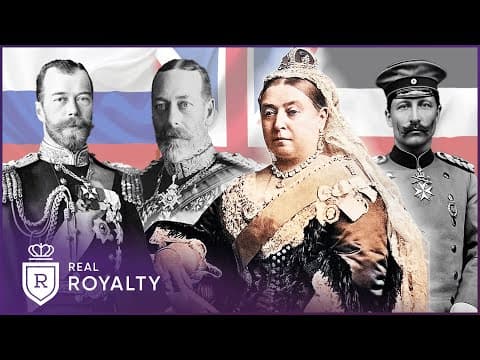
Queen Victoria's attempts to create peace in Europe through royal marriages ultimately failed, leading to World War I. Her matchmaking efforts, intended to unite royal families and prevent conflict, instead sowed the seeds of rivalry and war among her descendants, culminating in a catastrophic global conflict.
The crown has long been a symbol of power, but the nature of royalty is increasingly under threat. In this exploration of Queen Victoria's legacy, we delve into her ambitious plan to create peace in Europe through royal marriages. Despite her intentions, these efforts ultimately contributed to the outbreak of World War I.
Queen Victoria believed that a network of royal families linked by blood would be less likely to engage in warfare. Her dream was to create a peaceful Europe through strategic marriages among her children and grandchildren. However, this vision would soon unravel as tensions escalated among her descendants.
In 1914, war erupted in Europe, drawing in nations across the globe into what was then referred to as the Great War. This conflict was marked by unprecedented violence, with over 30 nations clashing and millions of lives lost. The war was fundamentally a struggle between empires, with the British Empire, Russian Empire, and French Republic on one side, and the German Empire and Austria-Hungary on the other.
Queen Victoria's matchmaking efforts began with her own children, particularly her eldest daughter, Princess Vicki. Vicki married Prince Frederick of Prussia, hoping to foster a peaceful alliance between Britain and Germany. However, their marriage faced challenges, including a traumatic birth that left their son, Prince Wilhelm, with a permanent disability. This incident would have lasting repercussions on the family's dynamics and political relationships.
Wilhelm's upbringing was fraught with difficulties, leading to a troubled relationship with his British relatives. As he grew older, he developed a desire to assert Germany's power, ultimately rejecting his parents' vision of a more democratic state. When he ascended to the throne as Kaiser Wilhelm II, he pursued aggressive policies that would contribute to the tensions leading to World War I.
Queen Victoria also sought to strengthen ties with Russia through her granddaughter, Princess Alexandra, who married Nicholas Romanov, the heir to the Russian throne. Despite Victoria's advice on democratic governance, Nicholas and Alexandra embraced autocracy, leading to further instability in Russia. Their son, Alexei, inherited hemophilia, a genetic disorder believed to have originated from Queen Victoria, which added to the family's troubles.
The assassination of Archduke Franz Ferdinand of Austria in 1914 set off a chain reaction of events that plunged Europe into war. Austria-Hungary sought revenge against Serbia, and Germany quickly aligned with Austria-Hungary, while Russia mobilized to defend Serbia. Queen Victoria's dream of a united royal family was shattered as her descendants found themselves on opposing sides of the conflict.
Despite their familial ties, the royal cousins—George V of Britain, Wilhelm II of Germany, and Nicholas II of Russia—failed to prevent the war. George V was caught between his loyalty to his government and his familial connections, ultimately siding with Russia against Germany. The bonds of blood proved insufficient to avert disaster.
The war resulted in catastrophic loss of life and the downfall of several monarchies. Kaiser Wilhelm II was forced to abdicate, and Nicholas II and his family were executed by revolutionaries. In contrast, George V managed to retain the British crown, largely due to his willingness to embrace democratic reforms and distance himself from the failures of his cousins.
Queen Victoria's romantic matchmaking, intended to foster peace among European royal families, ultimately failed, leading to one of the deadliest conflicts in history. Her legacy serves as a poignant reminder of the complexities of royal diplomacy and the fragility of peace in a world driven by power and ambition. As Europe emerged from the war, the remaining monarchies faced new challenges, including the rise of fascism, as they sought to maintain their relevance in a rapidly changing world.



















