
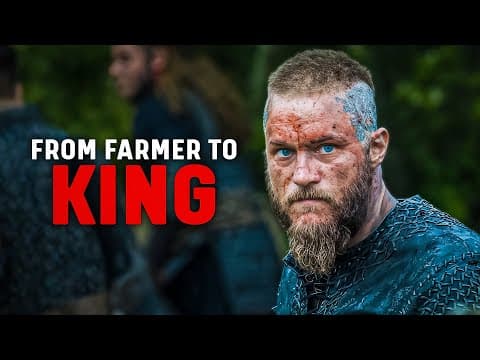
This article explores the life and legacy of Ragnar Lothbrok, a Viking who rose from humble beginnings as a farmer to become a legendary king. It highlights his visionary mindset, strategic preparation, leadership style, adaptability, honor, and the heavy cost of greatness. Ragnar's story teaches lessons on ambition, courage, loyalty, and legacy that remain relevant today.
I am old now. My sword arm is weak, my eyes dim, but my memory is sharp as the day I first saw him: Ragnar Lothbrok. His name is spoken like a saga, a myth carved in stone. But I was there. I sailed with him. I watched a farmer become a king, a dreamer become a conqueror. Tonight, I will share his secrets — the Viking code that turned an ordinary man into a legend.
When I first met Ragnar, he was nobody but a farmer, a husband, a man who tilled the soil like his father before him. Yet, there was something in his eyes — restless, hungry, dangerous. While others raided the same eastern villages year after year, Ragnar looked west, staring at the horizon as if it held secrets only he could see.
The elders mocked him. Earl Haroldson told him to stay in his place, calling him a fool for dreaming of lands across the western sea. But Ragnar did not care. Most men follow tradition because it is safe; they do what their fathers and grandfathers did, staying small because the world tells them to. Ragnar questioned everything.
He asked, "Why do we raid the same poor villages? Why not sail west where riches wait in Christian monasteries?" When laughed at, he did not argue. Instead, he built his own ship in secret, studied the sun compass, and prepared silently. One spring morning, he sailed without permission or approval — just vision and courage.
Lesson One: The world belongs to those who see what others cannot. Most men die where they were born, not for lack of strength but for lack of vision. Ragnar saw England before he touched its shores. He saw wealth, power, and glory, refusing to let fear or tradition stop him.
Ask yourself: What are you not doing because the world says it is impossible? What dream are you burying because others cannot see it? Ragnar would say, "Build the ship anyway. Sail into the unknown. Legends are born from courage, not comfort."
Some think Ragnar was reckless, gambling with his life and getting lucky. They are wrong. He was the most calculated man I ever knew. He took risks, yes, but never blind ones.
Before the first voyage to England, he spent months preparing. He studied the stars with an old wanderer who knew the western route, tested his ship in storms, and chose his crew carefully — not the loudest warriors, but the most loyal.
When we sailed, it was not luck but preparation meeting opportunity that led us to Lindisfarne. After raiding the monastery and returning with silver and gold, Ragnar did not celebrate; he planned the next raid.
Lesson Two: Fortune favors the prepared. Dreaming big is not enough; you must study, train, and build in the shadows. Then, when the moment comes, strike with precision.
I have seen men die because they confused bravery with stupidity, charging without thinking or fighting without strategy. Ragnar was different. Against King Horic, he waited, watched, learned the king's weaknesses, and dismantled him piece by piece. When raiding Paris, he brought siege towers and battering ram plans.
Lesson Three: The difference between a conqueror and a corpse is preparation. Stop charging blindly at your goals. Study the field, build your weapons, choose your moment, and move like a wolf — silent, calculated, lethal.
I have served many kings. Most ruled through fear, shouting orders, taking the best plunder, sitting in warm halls while we bled in the cold. Ragnar was different. He fought beside us, not behind us. His blade met the same steel; his blood mixed with ours.
I remember the raid on Hexom. Surrounded and outnumbered, any other leader would have fled. Ragnar stood at the front, shield to shield with the lowest farmer turned warrior. When the battle ended, we did not just respect him; we would have died for him.
Lesson Four: Men do not follow titles; they follow men they believe in. Ragnar never demanded loyalty; he earned it by showing us we mattered and making us believe we were part of something greater.
Even as king, he did not change. He sat with his warriors, listened, shared the mead and the glory. We saw not a king but a brother. That is why men sailed oceans and stormed castles at his word — not out of fear, but love.
If you want power, learn this: Do not rule through fear. Fear breeds betrayal. Earn respect, inspire belief, and make people want to follow you because they cannot imagine following anyone else.
Ragnar was not just a fighter; he was a student. Every land we raided, every enemy we faced, he studied them. He did not just take their silver; he took their knowledge.
In England, he learned the language, studied their religion, politics, and weaknesses. When King Ecbert offered him baptism, other Vikings laughed, calling him a traitor. But Ragnar was not converting; he was infiltrating, wearing their religion like armor, gaining land and trust. Then, when the time was right, he struck deeper.
This is the Viking way the poets never mention: survival belongs to those who adapt. After Paris repelled us the first time, Ragnar did not rage; he studied their defenses, built better siege weapons, and came back stronger.
When his own people doubted him, he did not force belief; he proved himself again and again.
Lesson Five: The rigid tree breaks in the storm, but the flexible one bends and survives. Be like water — take the shape needed to win. Be a warrior when needed, a diplomat when required, and always a student.
The world is always changing. The man who refuses to adapt will be left behind. Learn from your enemies, study what works, abandon what does not, even if tradition says otherwise. The greatest weapon is not your sword but your ability to become whatever the battle requires.
Ragnar was ruthless. I watched him burn villages, execute traitors, and destroy anyone who stood in his way. But he was never cruel without reason. There is a difference between a warrior and a monster. A warrior kills when he must; a monster kills because he can.
When Yarlborg betrayed him, Ragnar could have tortured him for days. Instead, he gave him the blood eagle — brutal, yes, but Viking justice, not personal sadism.
When King Horic tried to murder his family, Ragnar annihilated him but spared Horic's son because the boy was innocent.
Even in conquest, Ragnar had a code. He respected worthy enemies, honored oaths, and protected his people. This separated him from men like Yarlborg or King Horic, who had ambition but no honor.
Lesson Six: You can be ruthless and still be honorable. Win, but do not become what you hate. Climb, but do not step on those who helped you. Conquer, but keep your soul intact. Power without honor is violence; violence without purpose is destruction.
Ragnar built an empire on principles that made men want to follow him. That is the difference between a king and a tyrant.
Ragnar's glory came with a cost. I watched him lose everything that made him human. His wife, Lagertha, left him. His sons grew distant. His mind, haunted by war and ambition, grew restless.
He had land, wealth, and fame but no peace. That is the curse of greatness. The higher you climb, the lonelier it gets.
I remember one night after conquering Wessex, I found him staring at the stars. "We won?" I asked. He looked at me with hollow eyes. "Did we?" he replied.
Conquest feeds the hunger but never satisfies it. His children became warriors but also rivals. His legacy tore his family apart. Ivar hated him for leaving, Bjorn resented him for never being enough, Ubbe tried to understand but could not.
Greatness is a heavy gift.
Lesson Seven: If you chase glory, you will pay in sleepless nights, broken relationships, and the weight of haunting decisions. Ragnar knew this and chose it anyway. Some men are born to be comfortable; some are born to be legends. You cannot be both.
The last time I saw Ragnar, he was preparing to sail to England alone. We all knew it was suicide. King Ecbert wanted him dead. King Aella wanted revenge. Ragnar did not care.
"Why are you doing this?" I asked.
He smiled — not the wild grin of a young warrior but the calm smile of a man at peace with his fate.
"Because my sons need a reason to become great," he said.
I understood then. Ragnar was not giving up; he was planting a seed. When they threw him into the pit of snakes, his death was not the end but the beginning. His sons invaded England not for land but for revenge, glory, and their father's name.
Ragnar's death made him immortal.
Lesson Eight: Legacy is greater than life. You will die; that is certain. But how you die and how you are remembered is what matters. Ragnar chose his death and turned his end into a beginning. Centuries later, his name still echoes — not because he lived the longest, but because he lived the loudest.
I am old now. My raiding days are over. My sword hangs on the wall, gathering dust. But when young warriors ask me about greatness, glory, and power, I tell them about Ragnar Lothbrok — not the myth, but the man.
The farmer who refused to stay in the dirt. The dreamer who became a king. The legend who chose how his story would end.
His blood soaked English soil, but his name will never die.
The power of living like Ragnar is:
Now I ask you: What will they say about you when you are gone? Will they remember you as someone who played it safe or as someone who dared to sail into the unknown?
Your saga is still being written, warrior. Make it worth telling.
Ragnar Lothbrok started as a farmer but died as a god. The only difference between him and everyone else is that he refused to stay small.
Go write your legend.



















