
This article explores the Roman conquest and administration of Dacia, the process of Romanization through language, urbanization, and military presence, and the spread of Christianity in the region. It highlights the role of Roman veterans, colonists, and religious syncretism in shaping the cultural and spiritual landscape that contributed to the ethnogenesis of the Romanian people.
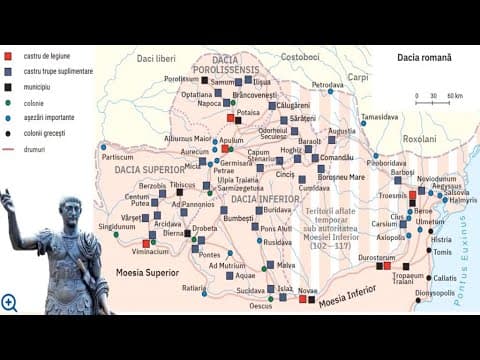
Dacia became a Roman province in the year 106 AD under the rule of Emperor Trajan. The Roman province of Dacia encompassed the regions of Transylvania, Banat, Oltenia, and the western part of present-day Muntenia. It was governed by the emperor through a senatorial governor, who held the title of legatus or propraetor.
The southern part of Moldavia, along with the central and eastern parts of Muntenia, were incorporated into the Roman province. Meanwhile, Moesia, Maramureș, Crișana, and northern Moldavia remained under the control of the free Dacians.
The capital of the province was Ulpia Traiana Sarmizegetusa, located approximately 40 kilometers from the former Dacian capital, Sarmizegetusa Regia.
After Emperor Trajan's death, Dacia was divided into three administrative units:
Romanization began after 106 AD and affected all aspects of life in Dacia. The Latin language was introduced and used by Roman authorities and settlers, and gradually learned by the indigenous population.
Several factors contributed to the Romanization of Dacia:
The Romans brought their urban model to Dacia, organizing urban settlements into colonies (for Roman citizens) and municipia (for both citizens and non-citizens).
Establishing a new province at the empire's border required a strong defense system. Dacia was protected by legions of Roman citizens and auxiliary troops (non-citizens) stationed in military camps called castra.
After completing their 25 years of military service, many soldiers chose to remain in the province they had defended. These veterans played a crucial role in organizing rural settlements and Roman-style farms known as villae rusticae. They also helped spread the Latin language in their areas.
Two significant phenomena facilitated the adoption of Latin in spiritual matters:
The Romans supported schools teaching in Latin, which helped spread Roman culture.
In the 3rd century AD, the Roman Empire faced an internal crisis exacerbated by barbarian migrations. The Dacian frontier became indefensible.
In 271 AD, Emperor Aurelian decided to withdraw the Roman army and administration south of the Danube River. Dobruja remained under Roman control until the 7th century.
Despite the withdrawal, Romanization continued or even intensified through ongoing relations with the free Dacians, who gradually became Romanized as well.
Connections with Rome were not completely severed, allowing the spread of the new monotheistic religion, Christianity.
Christianity spread north of the Danube thanks to soldiers, colonists, and merchants who came to the new province. The policy of Emperor Constantine the Great (306–337 AD) encouraged this spread.
In 313 AD, the Edict of Milan granted Christians freedom of worship. Later, Emperor Theodosius I (379–395 AD) banned pagan cults, organizing the Christian Church in the Danube region.
Christianity spread in Latin, as evidenced by inscriptions and Christian terms preserved in the Romanian language, such as "cruce" (cross), "creștin" (Christian), "botez" (baptism), "biserică" (church), "altă" (altar), and "Dumnezeu" (God).
One of the oldest Christian artifacts found in former Dacia is the Donarium discovered in 1775 at Biertan, Sibiu, dating from the 4th century. The Latin inscription and the monogram of Christ on the disc demonstrate the presence of a Christian community.
The spread of Christianity north of the Danube is also linked to the activity of the Apostle Andrew, who is considered by the Orthodox Church as the protector of Romania and the apostle of the Romanians.
The Roman conquest and administration of Dacia laid the foundation for the ethnogenesis of the Romanian people. Through the process of Romanization, Latin language and culture permeated the region, supported by urban development, military presence, and education.
The spread of Christianity further shaped the spiritual and cultural identity of the population. Despite the Roman withdrawal in the late 3rd century, the legacy of Roman Dacia endured, influencing the development of the Romanian nation and language.



















