Understanding the physics behind packing can help you maximize space in your suitcase. This article explores various packing techniques, including crumpling, folding, and rolling, and their effectiveness based on volume fraction, ultimately guiding you to pack more efficiently for your travels.
It’s a common scenario: you start your trip with a perfectly packed suitcase, but when it’s time to return home, it feels like your clothes have magically expanded. The struggle to close your bag on the way back is not just a matter of packing skills; it’s physics at play. In this article, we delve into the science of packing and explore the best techniques to maximize space in your suitcase.
Packing a suitcase can be likened to building with LEGO bricks. Each folded piece of clothing acts as a brick, fitting together based on its shape. The way you fold your clothes determines how well they fit in your bag, and this can be analyzed using a concept called volume fraction. This is defined as the volume of your shirt divided by the space it occupies after folding or crumpling. A higher volume fraction indicates a more efficient packing method.
To illustrate, consider a flat piece of paper. Its volume fraction is 1, meaning it occupies minimal space relative to its volume. In contrast, crumpling that paper increases its volume without adding material, resulting in a lower volume fraction. The goal when packing is to achieve a volume fraction as close to 1 as possible, indicating optimal use of space.
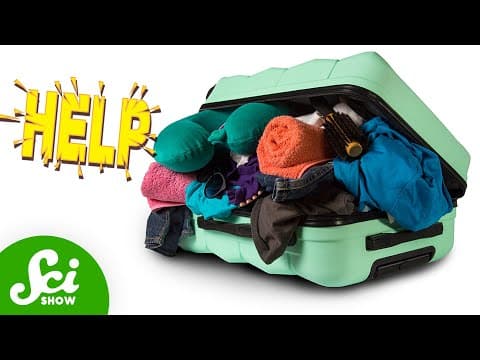
The crumpling method involves throwing clothes into the suitcase and smushing them down. While this technique may save time, it is inefficient. Experiments with crumpled aluminum sheets show that crumpled items have a volume fraction of about one-quarter. This means that even with significant force applied, you are wasting three-quarters of the space in your suitcase. This explains why packing in this manner often leads to difficulties when trying to fit everything back in on the return trip.
In contrast, the neat folder meticulously folds each piece of clothing into uniform dimensions. This method significantly increases the volume fraction because the layers of clothing stack neatly on top of each other, minimizing empty spaces. However, it’s important to note that perfect folding is nearly impossible, as creases will always introduce some empty space. For thicker materials like sweaters or jeans, it’s advisable to fold them only once to avoid excessive empty space.
The rolling technique involves carefully rolling clothes into cylindrical shapes. This method achieves a volume fraction similar to neat folding but offers additional benefits when packing in bags with irregular shapes. Cylindrical shapes can fill curved surfaces and odd corners more effectively than flat shapes. However, the tightness of the roll matters; tightly rolled items can create circular shapes that are difficult to optimize in a rectangular space. Ideally, leaving a bit of slack allows the rolled clothes to compress and fit together more efficiently, potentially achieving a volume fraction of 9/10ths.
Based on the physics of packing, the most effective strategies are either neatly folding or rolling your clothes. Each method has its advantages depending on the type of clothing and the shape of your suitcase. By applying these scientific principles, you can enhance your packing efficiency and ensure that you make the most of the space available in your luggage. Next time you pack for a trip, remember that a little physics can go a long way in helping you travel smarter.