Changi Airport in Singapore, renowned for its architectural marvels like the Jewel, represents a visionary blend of nature and engineering, aiming to transform the airport experience into a destination in itself. This blog post explores the ambitious vision behind Changi Airport, its innovative design, and future expansions.
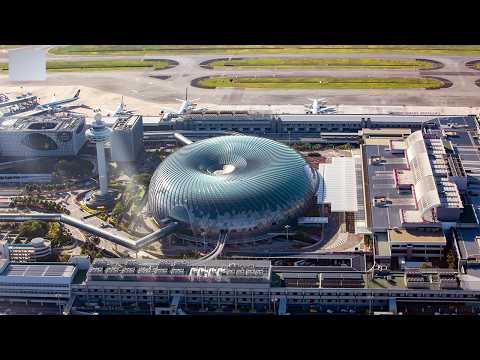
Changi Airport in Singapore is often hailed as one of the most beautiful and efficient airports in the world. At the heart of its allure is the Jewel, a stunning steel and glass structure that weighs 3,500 tonnes and rises 10 stories above the ground. This architectural marvel is not just a terminal; it features the tallest indoor waterfall in the world, pouring 37,000 liters of water every minute, equivalent to an Olympic pool every hour. Inside, visitors can find over 3,000 trees and 60,000 plants from around the globe. This blog post delves into the vision, design, and construction of Changi Airport, showcasing how it has become a destination in its own right.
The story of Changi Airport begins in 1967 when Singapore's first Prime Minister announced his vision for the country as the "Garden City." This vision extended to the airport, emphasizing the need for excellence and innovation. The goal was to create an airport that not only served as a transit point but also as a destination that would attract visitors to Singapore.
To realize this vision, Singapore turned to architect Moshe Safdie, known for his ability to defy gravity in his designs. Safdie's previous works, such as the Marina Bay Sands, had already established him as a leading figure in architecture. His radical idea for Changi Airport was to transform it into a destination, combining a bustling marketplace with a serene garden environment.
The Jewel, which cost approximately $1.3 billion, was designed to be more than just a functional space. Safdie envisioned it as an oasis within the airport, encouraging passengers to explore rather than just transit. However, the construction posed significant challenges, particularly due to existing structures like the Sky Train and control tower.
To accommodate these existing structures, the waterfall was positioned slightly off-center, creating a complex engineering challenge. The Jewel's design features a unique toroidal shape, which required innovative engineering solutions to ensure stability. The structure consists of two phases: a shell phase that forms the dome and a tension phase that creates the waterfall.
High-strength steel and tempered glass were chosen for their durability and ability to withstand environmental stresses. The glass panels were designed to prevent shattering, even in extreme weather conditions. The waterfall system was ingeniously designed to prevent flooding by directing water to the basement, where it is recycled back to the top.
The construction of the Jewel took five years and was completed without disrupting airport operations. Once finished, the interior was filled with lush greenery, creating a vibrant environment for both visitors and plants. To ensure comfort, chilled water pipes were installed in the floors, and air conditioning vents were cleverly hidden.
When the Jewel opened in 2019, it exceeded expectations, attracting over 50 million visitors in its first six months alone. This success solidified Changi Airport's status as a destination, fulfilling the vision of a Garden City and transforming the airport experience.
Changi Airport is not resting on its laurels. Plans for a new Terminal 5 are underway, which will add 1,080 hectares of reclaimed land and accommodate an additional 50 million passengers annually. This ambitious project, costing $10 billion, is set to begin construction in the second half of 2025, further enhancing Singapore's position as a global travel hub.
Changi Airport stands as a testament to Singapore's commitment to innovation and excellence in architecture and design. The Jewel is not just an airport feature; it is a symbol of the country's vision to create a unique travel experience that blends nature with modernity. As Singapore continues to expand its airport facilities, the sky truly is the limit for this remarkable city-state.