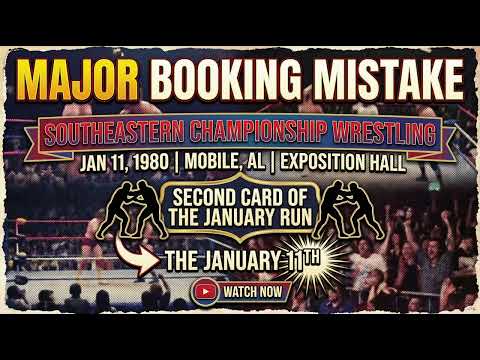
The January 11, 1980 Southeastern Championship Wrestling event in Mobile, Alabama, drew a smaller crowd than the previous week due to the absence of major attractions like mask vs. mask matches and Buddy Fuller's return. While most matches were well-booked and built toward future storylines, the premature unmasking of SuperPro undermined the value of mask matches and hurt long-term business potential.
On Friday, January 11, 1980, Southeastern Championship Wrestling held its second card of the January run at the Mobile, Alabama Exposition Hall. This event, while featuring strong wrestling and purposeful booking, drew a noticeably smaller crowd compared to the previous week's show. Understanding the dynamics of this night provides insight into the booking strategies and challenges faced by the territory during this period.
The January 4th show had been a major draw, featuring a mask versus mask match, the prominent wrestling pro, and the return of Buddy Fuller after years away. These elements were proven attractions that pushed the exposition hall toward a strong turnout.
However, the January 11th card lacked these key ingredients:
As a result, the drawing power was significantly reduced. Robert Fuller, despite his talent and strong mic skills, did not have the same box office pull as his father or Leyon Baxter. Even the revenge storyline involving Robert and Ron Fuller seeking payback for their father’s beating was insufficient to match the previous week's excitement.
Realistically, the crowd was probably cut in half, estimated around 1,500 fans. This was not a reflection on the talent but rather the reality of how the territory drew crowds. Star power and stipulations moved tickets, and this card simply did not have the same punch.
The night opened with a classic Southeastern booking style match. Ron Fuller and possibly Robert Fuller, who was beginning to take more control of booking, likely instructed a simple, clean, and purposeful 15-minute bout. Terry Ordorf secured a solid babyface win with his finisher, with no angles or interference. This match effectively warmed up the crowd and set the tone for the evening.
This match represented a booking misstep. The intention was to elevate Ed Boulder by unmasking SuperPro, giving Boulder a significant boost. However, the timing was problematic.
Just one week earlier, fans had paid to see a mask versus mask match, a major attraction in southern territories. Mask matches were meant to be rare, emotional, and meaningful, with fans paying to see the mystery revealed.
By unmasking SuperPro only seven days later and doing so without a ticket price premium, the promotion undercut the value of the January 4th mask match. Fans realized they could have waited a week to see the reveal for free, which diminished the long-term value of mask matches. This decision also cut short a storyline that could have lasted 10 to 12 weeks, as SuperPro’s mask could have been a slow-burn draw.
While the goal to elevate Ed Boulder was understandable, the execution worked against the territory’s business interests. This moment should have been saved, built up, and monetized more effectively.
This match was booked perfectly. The Mongolians defended the NWA Southeastern tag team titles against Jerry Stubs and Tony Charles, who had both won their matches the previous week. Fans entered the Exposition Hall believing this could be the night the babyfaces took the belts.
Frankie Ka, the great Mesto, likely handled the layout, protecting the Mongolians while giving Stubs and Charles enough momentum to keep the crowd invested. The finish kept the Mongolians strong but set up the next step: Stubs and Charles demanding a rematch, which Mesto would refuse.
This led to the babyfaces raising the stakes with a loser leaves town stipulation for the January 15th event. This was smart, logical, and emotionally charged booking—exactly what Southeastern excelled at.
The main event featured Joe Leuk, Jimmy Golden, and Norvel Austin against Robert Fuller, Ron Fuller, and the Mongolian Stomper. This match was not about a clean finish but about generating heat, violence, and anticipation for the upcoming cage match.
All six men brawled throughout the building, creating the signature chaotic and intense atmosphere Southeastern was known for. This match was designed to send fans home buzzing and eager to buy tickets for the January 15th show.
The psychology was perfect:
Looking at the entire event, almost everything made sense:
The only significant misstep was the unmasking of SuperPro. This decision weakened the previous week’s draw, damaged the long-term value of mask matches, and prematurely ended a storyline that could have carried the territory for months.
Despite this, the event showcased Southeastern Championship Wrestling’s strengths in booking and storytelling, setting the stage for the rest of January 1980.
The January 11, 1980 Southeastern Championship Wrestling card in Mobile was a night of mostly effective booking and storytelling, marred by one critical error that impacted the territory’s business. The absence of major attractions led to a smaller crowd, but the promotion’s ability to build heat and set up future events remained strong. This event serves as a case study in the importance of timing and value in wrestling storylines, especially regarding high-stakes gimmicks like mask matches.