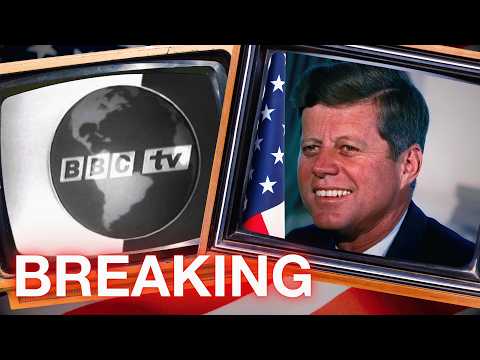
This article explores how the BBC and other broadcasters around the world reported the assassination of President John F. Kennedy on November 22, 1963. It details the timeline of events, the challenges of broadcasting breaking news in the 1960s, and the impact of this historic moment on television news coverage in the UK and the US.
John Fitzgerald Kennedy, elected as the 35th President of the United States in 1960 at the age of 43, was one of the youngest and most popular leaders in American history. His charisma and forward-thinking vision, especially his leadership during the space race and the Cuban missile crisis, earned him admiration not only in the US but also across the Atlantic in Britain.
However, his presidency was tragically cut short during a visit to Dallas, Texas, on November 22, 1963. This article examines how the news of JFK's assassination was broadcast, focusing particularly on the BBC's coverage and the broader context of television news in the 1960s.
On November 22, 1963, President Kennedy was riding in a motorcade through downtown Dallas, waving to supporters. Around 12:30 PM local time, shots were fired, striking the president and Texas Governor John Connally. Kennedy was rushed to Parkland Hospital, but he was pronounced dead at 1:00 PM Central Standard Time.
The assassination was unprecedented in its shock and impact. In 1963, without the internet, television was the primary medium for disseminating breaking news.
Within minutes of the shooting, the three major American networks—ABC, NBC, and CBS—interrupted their programming to deliver news bulletins. CBS's coverage, anchored by Walter Cronkite, became one of the most memorable broadcasts in television history. Cronkite, visibly shaken, relayed the news of the shooting, the president's condition, and eventually confirmed his death.
Vice President Lyndon Johnson was reported to have left the hospital and was expected to take the oath of office shortly thereafter.
At the time of the shooting, it was approximately 6:30 PM in the UK. Viewers were watching either BBC Television or ITV, the commercial competitor.
Just under an hour after the shooting, around 7 PM, ITV's Granada franchise, serving Yorkshire and Northwest England, broadcast a news flash informing viewers that President Kennedy had been shot. Due to ITV's regional structure, this news initially reached only viewers in those northern regions.
At 7 PM, the BBC Light program on the radio broke the news to listeners nationwide, reporting the shooting and the president's collapse.
Five minutes later, at 7:05 PM, the BBC interrupted its television programming to deliver a news flash announcing the shooting. The newsreader was John Roberts, a New Zealander on a short-term contract with the BBC, who was relatively unknown to the public. Many of the BBC's prominent news figures were attending the Guild of Television Producers and Directors awards, a precursor to the BAFTA TV awards.
Unfortunately, the initial news flash and many broadcasts from that night were not recorded, as home video recorders were not yet common.
Around 7:27 PM, during the broadcast, John Roberts received a phone call live on air. Upon answering, he solemnly announced, "We regret to announce that President Kennedy is dead." This moment shocked millions of British viewers.
Following this, normal programming did not resume. Instead, the BBC displayed its channel ident—a spinning globe—accompanied by somber music. Periodic news updates continued, with Roberts providing information as it became available.
One update confirmed that President Kennedy died at 6:25 PM UK time, and that Vice President Lyndon Johnson had been sworn in as the 36th President of the United States.
Unlike modern expectations where scheduled programming would be suspended for continuous news coverage or tribute programs, the BBC in 1963 surprisingly returned to its scheduled lineup after the initial interruption. This included shows like comedian Harry Worth's program and the drama "Dr. Finley's Casebook."
ITV initially followed a similar approach with its medical drama "Emergency Ward 10," but soon pulled the program to provide more coverage of the assassination.
As senior BBC figures returned from the awards ceremony, the schedule became erratic, with uncertainty about which programs would air.
By 11 PM, near the end of the broadcasting day, the BBC coordinated a special program featuring tributes from high-profile figures, including the Prime Minister and the Leader of the Opposition, both delivered live.
The final news update of the day came at 11:30 PM, again delivered by John Roberts, cementing his place in television history for his role in delivering one of the first major global breaking news stories of the postwar era.
On Saturday, November 23, 1963, the UK was still processing the news of Kennedy's death. Television programming remained heavily focused on the event.
One notable broadcast was an episode of "That Was the Week That Was," a satirical show known for critiquing current events and public figures. This episode was a serious and sincere tribute to President Kennedy, often cited as the most impactful episode of the show's tenure.
The assassination marked a turning point in television news, demonstrating the medium's power to deliver fast-moving, global breaking news. Despite the technological limitations of the era, the BBC and ITV managed to broadcast news of the tragedy within half an hour of the event.
The shock of Kennedy's assassination was profound. As one commentator noted, the news was "the most unexpected piece of news one could possibly imagine." Assassinations were no longer believed to be a part of the civilized world, making the event all the more devastating.
For viewers in 1963, the experience of having their evening programming interrupted by such a tragic and unexpected announcement was unprecedented.
The assassination of President John F. Kennedy was not only a pivotal moment in history but also a landmark event in the evolution of television news broadcasting. The BBC's coverage, despite the challenges of the time, played a crucial role in informing the British public and demonstrated the growing importance of television as a medium for breaking news.
This event set a precedent for how broadcasters worldwide would handle major breaking news stories in the future.
If you found this exploration of the BBC's coverage of JFK's assassination interesting, you might also be intrigued by how the BBC broke the news of Princess Diana's death in 1997.
Thank you for reading.