
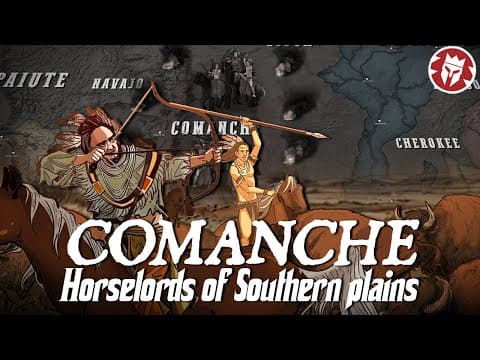
The Comanches, originally an offshoot of the Shoshone people, became the most powerful Native American tribe on the southern plains through mastery of horseback warfare, strategic trade, and brutal raids. Their empire dominated the 18th and early 19th centuries, resisting Spanish, Mexican, and American expansion until disease, starvation, and military pressure led to their decline by the late 19th century.
In the common narrative of the colonization of the Americas, Native American peoples are often portrayed solely as victims struggling against the tide of European civilization. However, history reveals a more complex picture. Among the Native American tribes, the Comanches stand out as a people who consistently and decisively resisted colonial advances, becoming one of the most formidable powers on the American continent.
The Comanches were not originally native to the southern plains of Texas where they eventually established their empire. They descended from the northern Shoshone people, known from the era of Sakagawea, and originally inhabited the foothills of the Rocky Mountains around present-day Wyoming and Utah. Before the arrival of Europeans, the Shoshone were pedestrian hunter-gatherers, relying on deer and salmon for sustenance.
During the 17th century, the Little Ice Age—a period of global cooling—forced many Shoshone to migrate south and east to warmer, flatter regions. By the mid-1600s, a branch of the eastern Shoshone had settled in the northern Great Plains between the Platte and Missouri rivers. Here, they adapted to hunting vast herds of buffalo on foot, using dog-pulled travois to carry their belongings.
The arrival of the Spanish in the Americas introduced many changes, including horses, which had been absent from North America for over 10,000 years. The horse revolutionized life for Plains peoples such as the Lakota, Cheyenne, Blackfoot, and Shoshone. Horses could carry much more weight than dogs and cover greater distances, enabling hunters to pursue buffalo more effectively and to engage in mounted warfare.
A subgroup of the Shoshone migrated further south into what is now Texas, closer to the Spanish colony of New Mexico, the center of the American horse trade. Recognizing the power horses conferred, these migrants quickly became dominant in the region, subjugating local tribes and controlling the horse trade. Within two generations, they transformed from a footbound people into a fully mounted society, adopting a new identity as the Comanche, a name derived from a Ute word meaning "enemy."
When the Comanches arrived in the early 1700s, the southern plains were already inhabited by various tribes and contested by European powers. The Spanish had settlements along the Rio Grande, the French were in Louisiana and the Mississippi Valley, and other mounted tribes roamed the grasslands.
The Comanches quickly asserted their supremacy, first defeating the Plains Apaches by 1740, killing, enslaving, or driving them south. Other tribes either suffered similar fates or became junior partners in the Comanche alliance.
The Comanches also waged war against Spanish colonial settlements in Texas and New Mexico, conducting raids that captured thousands of cattle, horses, and slaves. Spanish reinforcements were repeatedly defeated by the Comanches, who used superior horsemanship, guerrilla tactics, and faster mobility to outmatch their foes. By 1780, only the capital of Santa Fe remained untouched, overwhelmed by refugees fleeing Comanche raids.
The Comanches were unique among Native American tribes for being a society of full-time warriors, much like the ancient Spartans. They did not engage in agriculture or crafts but focused entirely on hunting buffalo and warfare. Every military-aged male was a trained and deadly soldier.
Their fighting style resembled that of the Mongol horse archers. Armed with short bows capable of firing multiple arrows rapidly, long lances, and buffalo-hide shields reputed to deflect bullets, Comanche warriors were highly mobile and lethal. Their raids were brutal, involving scalping, mutilation, enslavement, and torture, instilling fear that often led victims to surrender without a fight.
Despite their fearsome reputation, the Comanche empire was also a sophisticated trade network. They controlled vast trading routes across the continent and formed alliances with tribes such as the Kiowa, Ute, and Wichita. These alliances facilitated trade with European powers including the French, English, and Spanish.
Trade was essential for acquiring foodstuffs like vegetables and grains to supplement their bison-heavy diet, as well as firearms, which enhanced their military capabilities. The Comanches traded bison meat, furs, and especially horses, which they dominated as a commodity.
They were also active participants in the regional slave trade, capturing and trading indigenous peoples, mestizos, blacks, and whites. Captives were either sold in Spanish markets or assimilated into Comanche society.
The Comanche were not politically unified but consisted of up to 13 different bands roaming the southern plains. Their empire resembled the nomadic confederations of Eurasia rather than a centralized state. Bands often fought among themselves but united against common enemies.
Each band had a peace chief and a war chief, chosen by merit and subject to removal if they lost the confidence of their people. Women in Comanche society enjoyed more freedom and autonomy than in European colonial societies. The Comanches had no racial stratification and welcomed outsiders, including European outcasts and escaped slaves, into their nation.
By the early 19th century, the Comanche empire was at its peak, but the geopolitical landscape was shifting. The Spanish colonial empires were replaced by revolutionary states like Mexico and the United States.
During the Mexican Revolution starting in 1810, Comanche raids intensified, hastening the collapse of Spanish power in the region. Mexico initially allied with the Comanches as a buffer against American expansion but failed to uphold trade agreements, leading to renewed Comanche raids that devastated northern Mexico.
In 1824, Mexico invited Anglo-American settlers into Texas, which backfired when these settlers revolted, leading to the creation of the Republic of Texas in 1836. Conflict between Texans and Comanches escalated, including the famous 1836 raid on Fort Parker, where Cynthia Ann Parker was captured and assimilated into Comanche society.
The Texas Rangers, a mounted militia armed with the revolutionary Colt revolver, emerged as a formidable force against Comanche raids. The phrase "God created men, but Samuel Colt made them equal" reflects the impact of this new firearm.
Texas joined the United States in 1845, leading to the Mexican-American War (1846-1848), which resulted in U.S. control over vast territories. The Comanches continued to resist American expansion but faced increasingly advanced weaponry.
The completion of the transcontinental railroad in 1869 accelerated white settlement in the southern plains. A devastating smallpox epidemic in 1862 reduced the Comanche population drastically from around 40,000 to 5,000.
The final blow came from the systematic destruction of the buffalo herds, the Comanches' primary food source. White hunters killed millions of buffalo, leaving the species near extinction and starving the Comanche people.
In 1874, Chief Quanah Parker led the last free Comanche band in a final war against the U.S. government. Defeated, he surrendered in 1875, marking the end of Comancheria and the transformation of the plains into American farms and ranches.
Today, the Comanche people continue to exist as a federally recognized tribe with over 17,000 members, primarily in Oklahoma. While their empire no longer exists, their traditions, identity, and history endure, preserving the memory of the great horse lords of the southern plains.
The story of the Comanches is a testament to the resilience, adaptability, and martial prowess of Native American peoples in the face of overwhelming change and adversity.



















