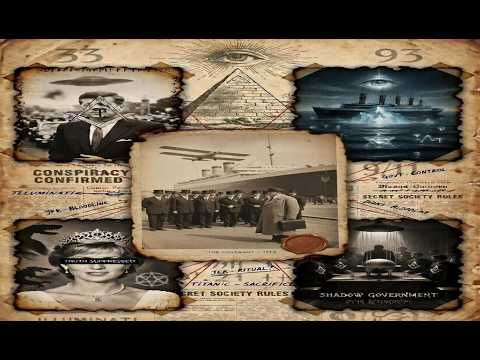
John Hamer, a historian and author, discusses how Princess Diana's death in 1997 led him to question mainstream narratives and explore various controversial topics including the Titanic conspiracy, flat earth theory, and 9/11 false flag claims. He emphasizes the manipulation by elites and the importance of critical thinking while managing fear.
In a revealing conversation with Michael, historian and author John Hamer shares his journey into uncovering what he believes are hidden truths behind major historical and contemporary events. His path began in 1997 with the death of Princess Diana, an event that challenged the official narrative and led him down a rabbit hole of research and skepticism.
John Hamer has spent nearly 30 years researching and analyzing historical events. His work focuses on questioning mainstream accounts and exploring alternative perspectives. He is an author of ten books, including his recent novels "60 Degrees South" and its sequel "100 Degrees South," which delve into mysteries surrounding Antarctica and the Antarctic Treaty.
The death of Princess Diana in 1997 was the pivotal moment that set John on his investigative path. Friends who were in Paris that night reported seeing Diana walking into the ambulance, contradicting official reports that she never regained consciousness. This discrepancy sparked John's curiosity and skepticism about the official story.
He believes the British royal family had motives to silence Diana, who was seen as a threat due to her growing independence, her anti-landmine campaign, and her influence over public opinion. The royal family's declining popularity and Diana's potential to disrupt the status quo were factors John cites as reasons for a possible orchestrated operation rather than an accident.
John's research expanded beyond Diana's death to other significant events and theories often dismissed by mainstream discourse.
John admits to being "a little bit kind of" a flat-earther, having initially investigated the theory to debunk it but finding compelling elements that challenge the globe earth model. He also considers the possibility that the Earth might be much larger than commonly believed, which could explain the perceived flatness.
He references a peculiar map in the United Nations lobby that depicts Antarctica as an ice wall surrounding the Earth, with numerous other continents beyond it, suggesting hidden knowledge or a double bluff by global powers.
John presents a detailed alternative history of the Titanic disaster. He explains that the RMS Olympic, Titanic's sister ship, was severely damaged and declared a wreck. To recover financially, the owners allegedly swapped the identities of the Olympic and Titanic, sinking the damaged Olympic disguised as the Titanic to claim insurance money.
He supports this theory with evidence such as differences in porthole designs and other ship features visible in underwater footage. John also connects the sinking to the formation of the Federal Reserve, suggesting the deaths of key opponents aboard the ship cleared the way for its establishment.
John describes the events of September 11, 2001, as a false flag operation, highlighting inconsistencies such as the immediate blaming of Osama bin Laden, who was reportedly in a hospital in Beirut at the time. He points out the suspicious deaths of all members of Seal Team Six shortly after the alleged raid on bin Laden's compound.
He also shares the story of Beverly, a woman who lost her husband in the Twin Towers collapse and publicly questioned the official narrative, only to experience a tragic plane crash under suspicious circumstances.
John emphasizes that the global elite, whom he refers to as "men with the tiny hats," control media narratives and use divide-and-conquer strategies to keep the public fragmented and distracted. He notes the infighting within the truth movement itself, with factions vehemently opposing each other's views, which benefits those in power.
He advises skepticism towards mainstream media and encourages looking at events retrospectively to better understand the broader context.
Acknowledging the emotional toll of uncovering such controversial information, John recommends compartmentalizing these truths to maintain mental health. He suggests focusing on living a normal life, loving family and friends, and only engaging with these topics when necessary.
He warns against living in fear, as fear is a tool used by those in power to control the masses.
John Hamer's work challenges conventional historical narratives and encourages critical thinking about the information presented by authorities and media. His journey from questioning Princess Diana's death to exploring broader conspiracies highlights the complexity of discerning truth in a world rife with misinformation and manipulation.
For those interested in exploring his research further, John maintains a website with articles, podcasts, and information about his books.
Website: falsificationofhistory.co.uk
Books: Available on Amazon worldwide under John Hamer's author page.
This conversation invites us to question who controls our history, who creates crises, and who defines reality, urging a deeper examination of the narratives we accept.