
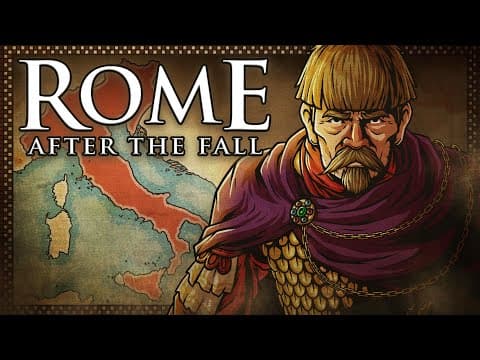
The fall of the Western Roman Empire in 476 AD marked a significant transition as Odoacer, a Germanic foederati commander, deposed the last emperor and established a new kingdom in Italy. Despite the political upheaval, Roman administrative structures, law, and military organization largely persisted under Odoacer's rule, blending Roman and Germanic elements while navigating religious differences and external threats.
By the fifth century, the Roman Empire was split into two halves: the prosperous Eastern Empire ruled from Constantinople, and the exhausted Western Empire struggling to defend its borders from its new capital in Ravenna. The Western Empire had been weakened by decades of internal conflict, shrinking revenues, and repeated invasions.
The city of Rome itself had lost its status as the center of power, declining in population and prestige. However, it retained enormous symbolic importance due to its ancient monuments, Senate, and Christian bishops who continued to influence the Empire. Despite this, waves of newcomers from distant lands brought new rulers and ruling classes, challenging the old order.
Among the Germanic tribes serving as foederati (allied troops) within the Roman military was Odoacer, a commander who capitalized on the chaotic period to stage a revolt. On September 4th, 476 AD, Odoacer captured Ravenna and deposed the young emperor Romulus Augustus. This event is often seen as the fall of the Western Roman Empire.
Unlike previous barbarian invasions, Odoacer's revolt included not only Germanic mercenaries but also disgruntled Roman troops. His coalition consisted of tribes such as the Herulians, Skirians, and Rugians, who had served under Roman law but had not received promised payments or land due to the empire's collapsing finances.
After taking power, Odoacer was proclaimed king by his forces, a risky title in Roman culture but safer than claiming the imperial title. He sought to legitimize his rule by acknowledging the Eastern Roman Emperor Zeno, sending the imperial regalia of the West to Constantinople and declaring that Italy no longer needed a separate emperor.
Emperor Zeno accepted this arrangement, recognizing Odoacer as king of Italy and elevating him to the rank of Patrician. This recognition allowed Odoacer to govern Italy in the emperor's name, dismissing his status as a rebel.
Odoacer maintained much of the Roman administrative system. He ruled from Ravenna but kept the Senate in Rome functioning, appointing senators to high offices and even issuing new copper coins stamped by the Senate for the first time since the mid-third century.
Taxation continued through traditional Roman methods, including land taxes, levies on trades and professions, sales taxes, and tolls. The army was provisioned by the state, and non-Roman troops were granted land to settle, securing their allegiance.
Roman courts continued to apply standard law codes and imperial edicts. Efforts were made to maintain infrastructure, such as the restoration of the Coliseum in Rome.
Despite the political continuity, Roman cities like Rome, Ravenna, and Milan were shadows of their former selves. Decades of war and corruption had left public works crumbling and long-distance trade diminished due to the empire's collapse outside Italy.
Roman Christians in Italy found themselves ruled by a king and a Germanic elite who followed Arian Christianity, a sect considered heretical by the Roman Church because it denied the equality of Jesus with God the Father. Despite theological differences, Odoacer showed respect for the Roman Church, granting tax remissions and favoring bishops such as Epiphanius.
Both Roman and Arian Christians coexisted during this period, reflecting a pragmatic approach to religious diversity.
The Roman military structure was not abolished under Odoacer. Offices like the Magister Militum and regional commands continued, and soldiers remained active in garrison duties, internal security, and frontier defense.
Odoacer's forces suppressed internal rebellions and guarded Alpine passes. He also sought to expand his territory by challenging other successors of the Western Empire.
One rival was Julius Nepos, who ruled from Salona in Dalmatia and was recognized by Emperor Zeno as the legitimate Western Emperor. Nepos denounced Romulus Augustus as a usurper and maintained a small army until his assassination in 480 AD.
Nepos' death marked the true end of the Western Emperor title. Odoacer used this event as a pretext to invade Dalmatia, ending the last imperial rump state.
In northern Gaul, another Roman holdout existed under Syagrius, son of the late Magister Militum Aegidius. Syagrius maintained Roman civil administration and order until 486, when he was defeated and executed by the Franks under Clovis the First.
The fall of the Western Roman Empire did not mean the immediate collapse of Roman institutions in Italy. Under Odoacer's rule, many Roman administrative, military, and legal structures persisted, blending with the new Germanic leadership. This period marked a complex transition from Roman imperial rule to the early medieval kingdoms, setting the stage for the future of Italy and Europe.
This comprehensive overview highlights the nuanced transformation of Rome and Italy after the fall of the Western Roman Empire, emphasizing continuity amid change and the interplay of Roman and Germanic cultures.



















