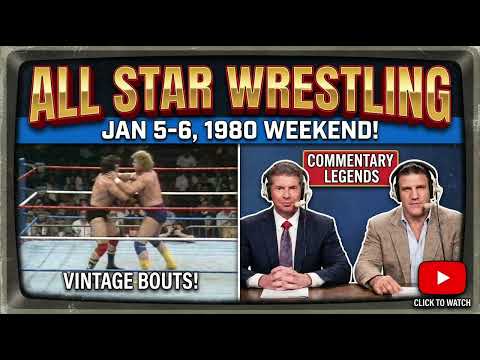
The January 5th and 6th, 1980 episode of All Star Wrestling, featuring commentary by Vince McMahon Jr. and Bruno Sammartino, showcased a mix of solid wrestling and chaotic moments. The show focused on establishing wrestler personalities and setting the tone for 1980, rather than delivering high-impact moments, highlighting the era's approach to wrestling storytelling.
All Star Wrestling's weekend episode from January 5th and 6th, 1980, offers a fascinating glimpse into the wrestling world at the dawn of a new decade. With Vince McMahon Jr. and Bruno Sammartino on commentary and Gary Michael Capetta as the ring announcer, the show presented a lineup that ranged from solid technical wrestling to moments of chaotic energy.
The show opened with Tito Santana facing off against the formidable Hussein Arab, who was managed by the notorious Freddy Blassie. The match began with a dramatic moment as Hussein attacked Tito while he was signing autographs for children, immediately setting a tone of villainy. Unable to secure a clean victory, Hussein resorted to using a chair, which led to his disqualification. Although the match itself was not particularly memorable, it effectively established the classic wrestling trope of the manager's men cheating first and wrestling second.
The show gained momentum with Ken Patera's match. Managed by the Grand Wizard, Patera's entrance was theatrical, with the manager engaging the crowd while helping Patera prepare. Once the bell rang, Patera showcased his athleticism and confidence, running circles around his opponent, Burger. His performance was marked by believable wrestling, a strong presence, and compelling interviews. Patera finished the match with a swinging full nelson and delivered one of the era's best heel interviews, boldly telling Vince McMahon Jr., "If I could get away with it, I'd knock you out of your shoes. That's authenticity you can't fake."
Next up was Hulk Hogan in a handicap match that was rough around the edges. Hogan appeared to no-sell most attacks and threw some of the loosest forearms seen, making the match look somewhat disorganized. Despite this, Hogan secured the win with a Canadian backbreaker that barely came together. The post-match interview was the highlight, with Blassie defending Hogan's lack of technical wrestling moves and Hogan proclaiming himself the new king of professional wrestling. This moment captured Hogan's early bravado and set the stage for his future stardom.
One of the standout matches was Larry Zbyszko versus Johnny Rhodes. Rhodes played the face, while Zbyszko heated up the crowd with a series of counters, slams, and near falls that felt like genuine competition. The match concluded with Zbyszko hitting the ropes and delivering a flying chest block that knocked Rhodes down for the three-count. Despite a few awkward moments, the match was solid and engaging.
The show closed with Bobby Duncan, managed by Captain Lou Albano, facing an opponent while the crowd still buzzed about Pat Patterson following his split with Albano. Duncan delivered a quick and believable beatdown, utilizing a front headlock, corner control, and finishing with a running bulldog for the win. The simplicity and effectiveness of this match underscored the straightforward storytelling approach of the era.
Reflecting on the episode, it’s clear that the show was not designed to dazzle viewers with spectacular moments every week. Instead, All Star Wrestling in early 1980 focused on preparing the audience for the year ahead by introducing talent and establishing personalities. Unlike modern wrestling, where every match aims to be an award-winning angle and every segment a must-see moment, this era embraced a simpler philosophy.
The goal was to get the wrestler over, get the finish over, and get the character over. This episode accomplished that by showcasing Tito Santana's fire, Ken Patera's arrogance and credibility, Hulk Hogan's raw power and confidence, Larry Zbyszko's technique, and Bobby Duncan's toughness. These were not lightweight performers pretending to be wrestlers; they were grown men with presence, size, and identities that fans could instantly understand.
The January 5th and 6th, 1980 episode of All Star Wrestling was not about selling tickets for the next day’s live event. Instead, it was about setting the table for 1980, laying the groundwork for storylines and characters that would define the year. In that sense, the show fulfilled its purpose perfectly, offering a snapshot of wrestling’s evolving landscape and the foundational elements that would shape its future.