
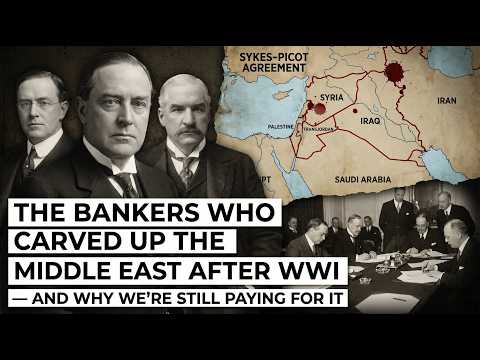
The modern Middle East's borders and conflicts trace back to secret agreements during World War I, where British and French imperial powers divided Ottoman lands without consulting local populations. Financial interests, especially in oil, heavily influenced these decisions. Promises made to Arabs, Jews, and France conflicted, leading to lasting political instability, displacement, and economic control by Western powers, effects still felt today.
Every border dispute, war, refugee crisis, and religious conflict in today's Middle East can often be traced back to a pivotal moment in history: the secret agreements made by European imperial powers during World War I. These decisions, made in closed rooms far from the region, drew arbitrary lines on maps without consulting the people living there. Over a century later, the consequences of these actions continue to reverberate across the region.
In 1916, the world was engulfed in the most catastrophic war it had ever seen. The Ottoman Empire, which had controlled vast territories including modern-day Iraq, Syria, Lebanon, and Palestine for six centuries, was weakening due to internal corruption, military defeats, and economic stagnation. European powers like Britain, France, Russia, Italy, and Germany were circling the Ottoman territories, each with ambitions to expand their influence.
Oil, known in the Middle East for centuries but only recently recognized for its strategic value, became a critical factor. In 1908, a major oil discovery in Persia led to the formation of the Anglo-Persian Oil Company. The British Navy, under Winston Churchill's leadership, realized that oil-powered ships would outperform coal-powered ones, making control over oil supplies a national security priority.
Britain purchased a controlling stake in the Anglo-Persian Oil Company in 1913, signaling its intent to secure oil resources. Reports indicated vast oil reserves in Ottoman provinces like Mosul, Baghdad, and Basra, making Mesopotamia a key prize.
Behind the scenes, banking dynasties and financiers played crucial roles. Armenian oil broker Kalusta Gulbenian helped form the Turkish Petroleum Company, a consortium of British, Dutch, and German interests aiming to develop Mesopotamian oil.
The Rothschild family, a dominant financial network in Europe, had deep ties to Palestine. Baron Edmund James de Rothschild invested millions over decades to establish Jewish settlements and infrastructure in Ottoman Palestine, laying the groundwork for future developments.
As the war progressed, Britain made several conflicting promises to different groups:
To the Arabs: Through correspondence between Sir Henry McMahon and Hussein bin Ali, Sharif of Mecca, Britain promised Arab independence over a vast territory in exchange for an Arab revolt against the Ottomans.
To France: The secret Sykes-Picot Agreement of 1916 divided Ottoman lands between Britain and France, assigning Syria and Lebanon to France and Iraq and Palestine to Britain.
To the Jewish Community: The 1917 Balfour Declaration expressed British support for establishing a national home for the Jewish people in Palestine.
These promises were made simultaneously and secretly, with Britain planning to maintain strategic and economic dominance regardless of the conflicting commitments.
The Bolshevik Revolution in Russia exposed the secret Sykes-Picot Agreement in 1917, revealing Britain's duplicity to the Arab leaders who had fought alongside them.
Post-war settlements formalized these divisions:
France took control of Syria and Lebanon, suppressing Arab nationalist movements.
Britain established mandates over Palestine and Iraq, installing leaders like Prince Faisal in Iraq to maintain influence.
The Kurds, promised autonomy, were left stateless.
The borders drawn ignored ethnic, religious, and cultural realities, institutionalizing divisions and conflicts.
Jewish immigration to Palestine increased under British administration, backed by Rothschild-funded organizations, while the Arab population, comprising 90% of Palestine in 1917, was excluded from negotiations.
The 1948 creation of Israel and the ensuing Arab-Israeli war led to the displacement of approximately 700,000 Palestinian Arabs, an event known as the Nakba, which continues to shape Palestinian identity and the regional conflict.
The oil concession arrangements made in the 1920s enriched Western companies and governments. The Iraq Petroleum Company, involving British, French, Dutch, and later American interests, controlled oil development, suppressing production to maintain prices and limiting royalties to local populations.
The Rothschild family held significant stakes in these companies, linking financial interests directly to territorial mandates.
The borders and political structures established during this period have become entrenched, shaping states, economies, and identities. The conflicts and grievances stemming from broken promises and imposed boundaries continue to fuel instability.
The financial networks and imperial strategies that orchestrated these outcomes remain largely invisible but are fundamental to understanding the region's history.
The story of the Middle East's modern borders and conflicts is not one of ancient, immutable hatreds but of calculated decisions by imperial powers driven by financial and strategic interests. The promises made to Arabs, Jews, and European allies were part of a complex web of diplomacy and finance that prioritized control over resources and strategic routes.
Understanding this history is crucial to comprehending the present-day realities of the Middle East and the ongoing struggles of its peoples. The legacy of 1916 and the years that followed is a testament to how financial capital and imperial ambition can shape the fate of millions for generations.
If this account changes how you view current events in the Middle East, consider sharing it to spread awareness of these pivotal historical truths.



















