
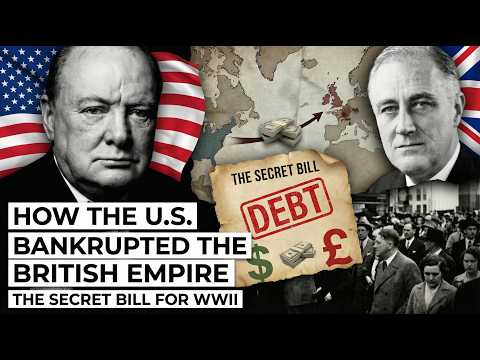
During World War II, Britain faced severe financial strain and relied heavily on American aid through loans and the Lend-Lease program. The U.S. used financial mechanisms, including the Bretton Woods Conference and strict loan conditions, to dismantle Britain's imperial economic system, leading to the decline of the British Empire and the rise of American global financial dominance.
In September 1939, as Britain declared war on Nazi Germany, a secret and massive transfer of Britain's gold reserves began across the Atlantic to Canada. This covert operation, known as Operation Fish, was a desperate measure by a financially strained Britain that foresaw bankruptcy in the war effort. While the public focused on the military fight against Hitler, the United States was quietly orchestrating a financial strategy that would dismantle the British Empire and reshape global power.
At the war's start, Britain was at its territorial peak, controlling nearly a quarter of the world's land and population. However, the empire was economically weakened by the Great Depression, industrial decline, and the abandonment of the gold standard in 1931. The pound sterling, once the dominant global currency, had become vulnerable and was rapidly losing value. In September 1939 alone, the pound plummeted from $4.61 to $3.99.
Britain needed American dollars to purchase weapons and supplies due to strict U.S. neutrality laws that required cash payments upfront for military goods. To obtain these dollars, Britain secretly shipped over 280 tons of gold bullion and billions in securities to Canada. This gold was stored securely in Montreal, enabling Britain to pay for American arms and supplies under the "cash and carry" policy.
By early 1941, Britain's reserves were nearly depleted. Winston Churchill appealed to President Roosevelt for help. Roosevelt responded with the Lend-Lease program, which allowed the U.S. to supply Britain with $31.4 billion worth of war materials (equivalent to about $690 billion today) without immediate payment. Roosevelt framed this as a neighborly loan of a garden hose to put out a fire, but in reality, the aid came with significant strings attached.
Lend-Lease included Article 7, which required Britain to eliminate discriminatory trade practices that had sustained its empire. This meant dismantling imperial trade preferences and opening British markets to American goods. Despite the aid, Britain still faced a catastrophic trade deficit, with 55% of its GDP devoted to military production by 1944 and exports collapsing.
In August 1945, President Truman abruptly ended Lend-Lease, forcing Britain to purchase remaining American supplies at a discounted rate. However, Britain lacked the dollars to pay even this reduced price, pushing the country toward economic crisis.
In July 1944, representatives from 44 allied nations met in Bretton Woods, New Hampshire, to design the post-war financial system. British economist John Maynard Keynes proposed the Bankor, a neutral international currency managed by a world central bank. The U.S., represented by Harry Dexter White, rejected this and instead established the U.S. dollar as the global reserve currency, pegged to gold at $35 per ounce.
This system made the U.S. the world's central bank, subordinating the British pound and dismantling Britain's financial dominance. The conference also created the International Monetary Fund (IMF) and the World Bank, institutions headquartered in Washington and dominated by American influence.
In 1946, Britain negotiated a $3.75 billion loan from the U.S. and $1.2 billion from Canada at 2% interest, repayable over 50 years. The loan required sterling convertibility, allowing countries holding pounds to exchange them for dollars freely. This exposed Britain to massive demands for dollars from its colonies and dominions, draining its scarce reserves.
One year after the loan agreement, Britain made the pound convertible. Within 37 days, countries rushed to convert their sterling balances to dollars, depleting $600 million of the American loan. Britain suspended convertibility, but the damage was done. The pound lost its credibility as an international currency, and the dollar emerged as the dominant global currency.
The financial strain accelerated the dismantling of the British Empire. India gained independence on August 15, 1947, just days before sterling convertibility was suspended. The independence negotiations included contentious discussions over India's wartime sterling balances, which Britain controlled to maintain influence.
Other colonies followed suit: Burma and Ceylon in 1948, Ghana in 1957, and over 20 territories by 1967. The empire that took centuries to build disintegrated in about two decades, driven largely by Britain's financial incapacity to maintain it.
The 1956 Suez Crisis highlighted Britain's diminished power. When Britain and France invaded Egypt to regain control of the Suez Canal, the U.S. opposed the action economically, refusing to support the pound. This forced Britain to withdraw, signaling the end of its ability to project military power independently.
By 1968, Britain announced the withdrawal of all military forces east of Suez, marking the end of its imperial era.
Britain continued repaying the 1945 loan until 2006, paying approximately $130 billion in today's money. The pound was devalued multiple times, including a significant 30% devaluation in 1949, which further eroded its purchasing power and reserve currency status.
By the 1970s, Britain faced stagflation, economic decline, and financial crises, eventually requiring IMF bailouts. The empire that once financed the world became dependent on international aid.
This financial dismantling was not a conspiracy but a calculated strategy by American policymakers. They recognized that breaking down Britain's imperial economic system would open vast markets to American businesses and establish the U.S. dollar as the global currency.
There was also an ideological component: American leaders, including Roosevelt, viewed colonialism as outdated and morally wrong, aligning economic interests with a vision of a new world order.
The Bretton Woods system, though modified over time, still underpins the global financial order. The dollar remains the world's reserve currency, international trade is primarily conducted in dollars, and institutions like the IMF and World Bank continue to be dominated by the U.S.
This system grants the United States extraordinary economic power, including the ability to run persistent trade deficits and impose impactful economic sanctions.
While America helped Britain win World War II, the financial cost was the dismantling of the British Empire and the transfer of global financial dominance to the United States. The "special relationship" between the two nations was, in reality, a creditor-debtor dynamic that reshaped the world order.
The greatest transfer of power in modern history was achieved not through military might but through financial mechanisms, loans, and economic policies crafted in negotiation rooms far from the battlefield.
Understanding this hidden history reveals the profound impact of financial power on geopolitics and the enduring legacy of World War II on the global economic system.



















