
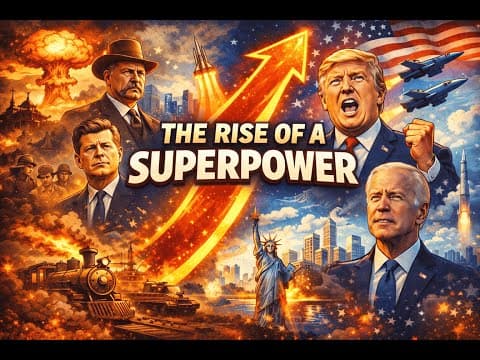
This article traces the United States' journey from an overlooked continent to the richest and most powerful country in history. It covers early European discoveries, colonial struggles, territorial expansions, key wars including the Revolutionary and Civil Wars, and strategic acquisitions like Alaska, Hawaii, and the Panama Canal that established the U.S. as a major global power by the early 20th century.
The United States today stands as the richest and most powerful country in history. However, its rise to global dominance was far from inevitable. For over a century after Europeans discovered the continent, North America was largely overlooked. This article explores the key events and developments that transformed the United States from an overlooked landmass into a global superpower.
Before Christopher Columbus sailed westward in 1492, European maps showed almost nothing across the Atlantic Ocean. Although the Vikings had reached parts of North America centuries earlier, Europe did not recognize it as a continent. Columbus aimed to reach Asia by sailing west but instead arrived in the Caribbean. Believing he was near India, he reported his findings to Spain, which soon began building an empire in the Americas.
Around the same time, Portugal discovered a sea route to Asia around Africa. To avoid conflict, Spain and Portugal divided the non-Christian world between them through a boundary line. Portugal focused on Asia, while Spain turned its attention to the Americas, especially the wealthy regions of Central and South America. These areas were rich in gold, silver, and dense populations, supporting a vast Spanish empire.
North America, lacking obvious precious metals, received little attention from Spain.
England explored North America early but waited almost a century before establishing permanent colonies. The first English attempts struggled; Roanoke failed, but Jamestown succeeded. Soon after, the Pilgrims established Plymouth, and more settlers arrived. Over time, the entire east coast filled with British colonies.
Meanwhile, France claimed the center of North America and established New France.
By 1754, competition between Britain and France erupted into the French and Indian War. France had about 60,000 settlers and relied on native allies, while Britain's colonies had more than a million settlers and also fought alongside native groups. Britain won the war, and France surrendered Canada and all remaining lands east of the Mississippi River.
This victory dramatically expanded British territory but also produced massive war debt. To pay down these expenses, Britain imposed new taxes on the colonies, which led to rising political tensions.
The colonists rejected taxation without representation, leading to protests that escalated into armed conflict. In 1776, the colonies declared independence. The Revolutionary War lasted five years before America secured its freedom.
After independence, the new government under the Articles of Confederation proved ineffective. The states acted as separate countries with little unity. This failure led to the creation of the U.S. Constitution and a new federal government. In 1789, George Washington was inaugurated as the first president.
When the U.S. attempted to purchase New Orleans, Napoleon offered to sell the entire Louisiana territory. The United States bought it for $15 million in 1803, doubling its size overnight.
In 1819, the U.S. acquired Florida from Spain. Mexico later gained independence and encouraged American settlement in Texas. However, conflicts led to the U.S.-Mexico War. Mexico was defeated, and the U.S. gained what would become California, Nevada, Utah, Arizona, New Mexico, and parts of Colorado and Wyoming.
The Oregon border was peacefully settled with Britain.
As the nation expanded, tensions between free and slave states intensified. Abraham Lincoln's election in 1860 led southern states to secede, and the Civil War erupted. The Union prevailed, slavery was abolished, and the country was reunified.
The U.S. purchased Alaska in 1867 and later annexed Hawaii. Both would eventually become states.
After conflict in Cuba, the U.S. declared war on Spain and quickly defeated it, gaining control of Cuba, Puerto Rico, Guam, and the Philippines.
The U.S. supported Panama's independence and built the Panama Canal, completed in 1914. This strategic waterway strengthened American global mobility.
By the early 20th century, the United States had become a major global power.
This timeline illustrates how an initially overlooked continent transformed into the most powerful nation in the world through exploration, conflict, expansion, and strategic development.



















