
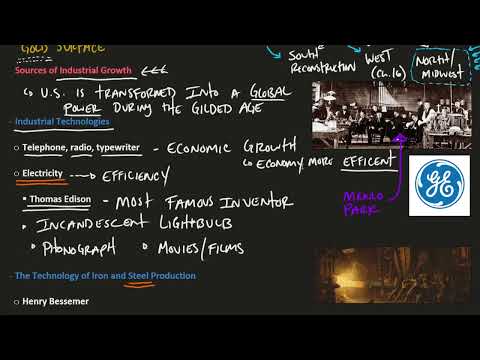
Chapter 17 of Alan Brinkley's "The Unfinished Nation" explores the transformative period of the Gilded Age in American history, highlighting the significant industrial growth, technological advancements, and the socio-economic challenges faced by workers. It discusses key figures like Thomas Edison, Andrew Carnegie, and John D. Rockefeller, as well as the rise of labor unions and the conflicts between business and labor during this era.
In Chapter 17 of Alan Brinkley's "The Unfinished Nation," titled "Industrial Supremacy," the author delves into the transformative period known as the Gilded Age, which followed the Civil War. This era, spanning roughly from 1865 to 1914, marked a significant shift in the United States as it evolved from a relatively insignificant nation into a global economic powerhouse.
The term "Gilded Age" was coined by Mark Twain, referring to the superficial glitter of wealth and prosperity that masked deeper societal issues. While the United States appeared to be thriving economically, beneath the surface lay significant social and economic challenges. The Gilded Age is characterized by rapid industrial growth, technological advancements, and stark contrasts between wealth and poverty.
Following the Civil War, the U.S. economy underwent unprecedented industrial growth. By the time World War I began in 1914, the United States had surpassed Britain and Germany in industrial output. This transformation was fueled by several factors, including:
The Gilded Age saw the emergence of powerful industrialists, often referred to as "robber barons." Figures like Andrew Carnegie and John D. Rockefeller epitomized this era of wealth accumulation. Carnegie's steel empire and Rockefeller's Standard Oil Company dominated their respective industries, often employing strategies of vertical and horizontal integration to eliminate competition and establish monopolies.
As industries flourished, workers faced harsh realities, including long hours, unsafe conditions, and low wages. The rise of unskilled labor, exacerbated by mass immigration, led to increased competition for jobs and a decline in workers' bargaining power.
The Gilded Age marked the peak of immigration to the United States, with millions arriving from Eastern and Southern Europe, as well as Asia. This influx of labor contributed to a more expendable workforce, making it difficult for workers to demand better conditions or wages.
In response to these challenges, workers began to organize into unions. Notable labor organizations included:
The Gilded Age was marked by significant labor conflicts, including:
The Gilded Age was a complex period of American history characterized by remarkable industrial growth and significant social upheaval. While the era produced technological advancements and economic prosperity, it also exposed deep societal divides and challenges for workers. The conflicts between labor and business during this time laid the groundwork for future labor movements and reforms, shaping the trajectory of American society in the years to come.



















