
This article explores President Trump's claims of genocide against white South African farmers, examining the experiences of farmers, crime statistics, land ownership, and the South African government's stance. While farm attacks are real and tragic, experts and locals dispute the genocide narrative, highlighting crime as a broader issue affecting all farmers and the complexities of land reform in South Africa.
In November, President Trump announced a "permanent pause" on migration from all third world countries to the US following a violent incident involving an Afghan refugee. However, in contrast, his administration expedited the resettlement of white South African refugees, mostly Afrikaners, descendants of Dutch settlers. Trump claimed that white South African farmers are victims of genocide, a claim disputed by the South African government. To understand the situation better, we visited South Africa to see the reality firsthand.
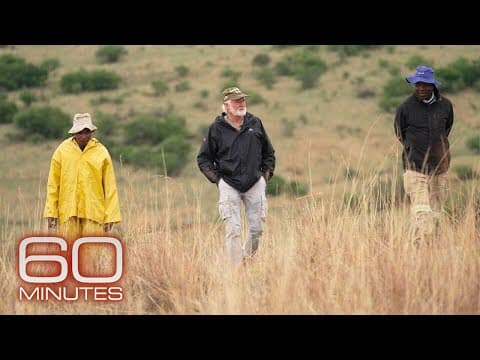
In the rolling hills of KwaZulu Natal Province in southeast South Africa, we met Daryl Brown, a seventh-generation rancher and farmer. Farming was always in his blood, a calling he embraced despite the risks. Ten years ago, his 82-year-old father was brutally attacked on their farm by robbers seeking guns and money. In 2020, Brown's friends Glenn and Vita Raferty were murdered during a robbery on a nearby farm.
When asked if he lives in fear, Brown responded that he lives carefully, aware of his surroundings and avoiding unnecessary risks.
President Trump, in May, described the murders of South African farmers as a genocide, emphasizing that the victims happen to be white. Nine days later, South Africa's President Cyril Ramaphosa visited the White House, accompanied by Elon Musk, who has also made claims of genocide. During the meeting, Trump showed videos purportedly proving violence targeting white farmers, including images of crosses marking burial sites of over a thousand white farmers.
However, the crosses were not burial sites but a memorial planted by Brown and others to honor commercial farmers who lost their lives. Brown keeps these crosses locked in a shed and brought them out again in 2024 for the funeral of his best friend, Toli Nell, who was also murdered on his farm.
Toli's wife, Renee, still lives on the farm. Her husband was killed in front of her while trying to fight off burglars; their son was tied up during the robbery. No arrests have been made. Renee's life has changed drastically, and she has little to look forward to. Their son now runs the farm, carrying a weapon almost all the time and employing private security, electric fences, and cameras to protect their property. Many South Africans feel they cannot rely on the police, who are often ineffective and overwhelmed.
When asked about the term "genocide," Renee said she thought Trump was using the wrong word. She sees the attacks as opportunistic crimes motivated by the presence of money and firearms rather than racially motivated genocide.
White South Africans make up about 7% of the population but own 72% of all privately held agricultural land and many large commercial farms. However, according to Wandeli Salobo, a leading agricultural economist, the majority of farmers and farm workers are black.
Crime on farms affects both black and white farmers, as well as largely black farm workers. Nlala Lazuma, a black farmer who worked a 9-acre plot for 20 years, experienced theft and a violent attack in 2024 where men shot at him and broke into his house. He believed they intended to kill him and subsequently decided to sell his farm. Lazuma highlighted that many black farmers are attacked, but their stories often go unheard.
South Africa is one of the most dangerous countries globally, with a murder rate seven times that of the United States. In 2024, over 25,000 people were murdered, with an estimated 37 killed on farms. Johan Kotze, an Afrikaner and head of South Africa's largest agricultural organization, emphasized that the violence is about criminality affecting farms and cities alike, not white genocide.
Police data from early 2025 showed six farm homicides, five of whom were black. Poverty remains the biggest driver of crime in South Africa, where 44% of black South Africans live in poverty compared to 1% of whites.
South Africa's 2.7 million Afrikaners descend from Dutch settlers who arrived 400 years ago. The country has a complex history of racial segregation and land dispossession. Millions of black South Africans were forcibly evicted from their land by law in 1913. Afrikaners took power in 1948 and instituted apartheid, a brutal system of racial segregation and discrimination that severely restricted black South Africans' rights.
In 1994, apartheid ended, and Nelson Mandela was elected, ushering in progress, a growing black middle class, and poverty reduction. However, efforts to redress inequalities through land reform have been controversial and plagued by corruption.
White supremacists in the US and elsewhere have long portrayed Afrikaners as victims of discrimination and genocide. These claims gained mainstream attention in 2018 when Fox News host Tucker Carlson alleged that Afrikaner farmers were being killed and having their land seized. President Trump echoed these claims, tweeting about large-scale killings and land seizures.
Max du Preez, a prominent South African journalist, refuted the claims of genocide and land seizures, stating that he has never experienced discrimination and that South Africa's constitution outlaws discrimination and protects property rights and due process.
In January 2024, South Africa's Parliament approved a land expropriation act allowing the government to take land without compensation in some cases to redress past discriminatory laws. This act is being challenged in court and is not yet in effect.
Khali Creel, CEO of the Afrikaner rights group AfriForum, who has lobbied in Washington, acknowledges threats to property rights and farmers' lives but denies the use of the term "white genocide." He points to violent rhetoric, such as the song "Kill the Boer, Kill the Farmer," sung by opposition politician Julius Malema, who advocates for land seizure.
President Trump cited the Expropriation Act in his executive order cutting off aid to South Africa and allowing the resettlement of Afrikaner refugees. The first group of 59 Afrikaner refugees arrived in May, with nearly 2,000 now in the US.
Despite the political rhetoric, many Afrikaners like Daryl Brown do not plan to leave South Africa. Brown identifies as African and remains positive about his country's future, stating, "I'm an African. I've been burnt by the African sun and I'm not going anywhere."
The preferential treatment of Afrikaner refugees in the US has been criticized as absurd and discriminatory, implying that white lives are valued more than others.
The situation of white South African farmers is complex. While farm attacks and murders are real and tragic, the narrative of a targeted genocide is disputed by many experts, locals, and the South African government. Crime affects all farmers regardless of race, and poverty is a significant driver. Land reform remains a contentious issue, with legal and political battles ongoing. The experiences of farmers like Daryl Brown and others highlight the challenges faced but also the resilience and hope for South Africa's future.



















