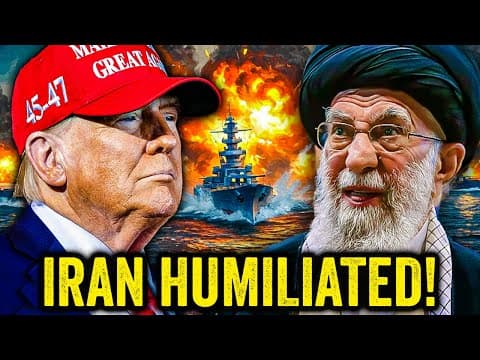
Iran is undergoing its most severe crisis since 1979, with widespread protests, economic collapse, and US military pressure in the Strait of Hormuz. The Iranian regime's supreme leader reportedly has an escape plan to Moscow amid fears of internal collapse. US naval forces, including an aircraft carrier strike group, are deployed, escalating tensions. Iran signals willingness for negotiations, marking a potential shift in strategy amid ongoing unrest.
The Iranian regime is currently experiencing its most severe crisis since the Islamic Republic was established in 1979. A combination of widespread protests, economic collapse, and increasing military pressure from the United States has brought the foundations of the regime to the brink of collapse. This article explores the unfolding events, the regime's internal struggles, and the escalating tensions in the strategic Strait of Hormuz.
Protests have erupted across Iran, fueled by economic hardship and a population increasingly emboldened to challenge the government despite the feared security apparatus. The Iranian currency is in freefall, exacerbating the economic crisis. Meanwhile, the regime's supreme leader, Ayatollah Ali Khamenei, is reportedly in hiding, with intelligence revealing a detailed escape plan to Moscow for himself and approximately 20 members of his inner circle, including family, top aides, and his designated heir. This plan includes the transfer of an estimated $95 billion empire hidden in semi-state foundations and front companies.
This revelation shatters the long-held mythology of the supreme leader's unwavering commitment to die on Iranian soil rather than back down, portraying him instead as a cleptocrat seeking an exit strategy.
The Strait of Hormuz, a critical global energy artery through which about 20% of the world's oil trade passes daily, has become a flashpoint. Iranian gunboats armed with heavy machine guns recently swarmed a US-linked tanker, ordering it to stop for boarding. The tanker’s captain ignored the orders and accelerated, prompting a nearby American warship to escort the vessel to safety. The six Iranian boats retreated immediately upon the arrival of the US destroyer.
President Trump has responded by deploying a formidable US naval armada to the region, including the nuclear-powered aircraft carrier USS Abraham Lincoln, carrying over 65 aircraft and nearly 6,000 personnel, supported by guided missile destroyers, cruisers, submarines armed with Tomahawk missiles, and support ships.
Further escalating tensions, a US fighter jet shot down an Iranian drone approaching an American aircraft carrier in the Arabian Sea, signaling a clear message of American resolve.
Despite initial bluster and threats to close the Strait of Hormuz or sink American ships, Iran's tone has shifted under the weight of overwhelming US military presence. Live-fire drills have been scaled back, and threats have softened to claims of defensive responses only.
Behind the scenes, Iranian officials have begun whispering about frameworks for negotiations. Iranian President Masoud Pezeshkian announced instructions for the foreign minister to pursue "fair and equitable negotiations" with the United States. This marks the first clear international indication of Tehran's willingness to engage in dialogue amid massive internal unrest.
This development aligns with President Trump's strategy of a two-front squeeze: applying external military pressure while supporting internal protest movements to destabilize the regime from within.
Within Iran, the regime faces deep contradictions. State media continues to proclaim the Islamic Republic as eternal and unbeatable, yet leaked psychological profiles describe Supreme Leader Khamenei as mentally and physically weakened, paranoid about defections within the Islamic Revolutionary Guard Corps (IRGC).
The existence of an escape plan for Khamenei undermines the morale of regime loyalists. If the supreme leader is prepared to flee, commanders may question the value of continuing violent crackdowns on protesters, fearing abandonment and potential trials.
The protests across Iranian cities have intensified, reflecting widespread dissatisfaction and desperation. The regime's weakening grip has emboldened citizens to overcome fear and demand change.
In the midst of this turmoil, everyday challenges persist. For example, the dangers of exposure during nighttime protests or emergencies are real, especially in harsh weather conditions. Innovative solutions like compact, heat-reflective emergency sleeping bags that fit in the palm of a hand have become invaluable for those caught in difficult situations, providing warmth and protection down to Arctic temperatures.
Iran stands at a critical crossroads. The combination of internal unrest, economic collapse, and overwhelming US military pressure has exposed the regime's vulnerabilities. The supreme leader's escape plan and the signals of willingness to negotiate suggest cracks in the regime's once formidable facade.
The coming weeks will be decisive in determining whether the Islamic Republic can withstand these pressures or if a new chapter in Iranian history is about to unfold.
The world watches closely as the situation develops, with the potential for significant geopolitical ramifications.
This comprehensive overview captures the complex dynamics currently shaping Iran's political and military landscape, providing insight into the challenges facing the regime and the broader implications for regional and global stability.