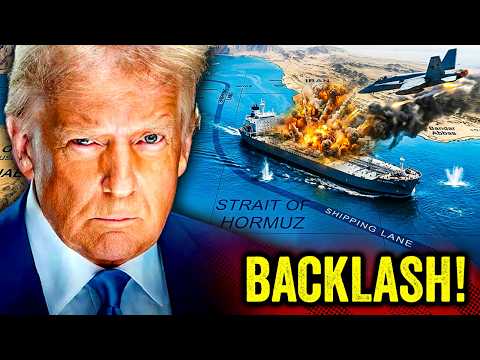
Iran attacked three commercial ships in the Strait of Hormuz, declaring the waterway closed and threatening destruction of unauthorized vessels. The U.S. responded by destroying Iranian mine-laying boats and intensifying military strikes. Discussions are underway about seizing Karb Island, a critical oil export hub for Iran, which could cripple Iran's economy and reshape regional power dynamics.
The Strait of Hormuz has become a volatile war zone following Iran's recent attacks on three commercial vessels. This escalation has not only intensified military confrontations but also brought to light the strategic significance of Karb Island, a critical hub for Iran's oil exports.
On a recent day, Iran struck three commercial ships in and near the Strait of Hormuz:
The Islamic Revolutionary Guard Corps (IRGC) claimed immediate responsibility for these attacks. Their naval commander declared that all ships must obtain permission from Iran before transiting the Strait, effectively closing the waterway. To enforce this, Iran reportedly began laying mines, with several dozen possibly already deployed.
The response from the United States was swift and forceful. Former President Donald Trump posted on social media that the consequences of Iran's actions would be unprecedented. The U.S. Strategic Command (Sentcom) destroyed 16 Iranian mine-laying boats, many before they could leave harbor, effectively neutralizing the mine threat.
This marked the most intense day of strikes since the beginning of Operation Epic Fury, with over 5,500 targets destroyed to date. More than 60 major Iranian warships have been sunk, including the complete elimination of the Solommani class corvette, Iran's most advanced catamaran warship.
Amid these military developments, attention has turned to Karb Island, a small limestone island about 16 miles off Iran's southern coast in the northern Persian Gulf. Though only one-third the size of Manhattan, Karb Island handles 90% of Iran's crude oil exports, with an annual flow of approximately 950 million barrels.
Most of this oil is exported to China, accounting for about 90% of the island's shipments. The island's loading capacity peaks at an astonishing 7 million barrels per day. In 2024, Iran earned roughly $78 billion from energy exports, the vast majority of which passes through Karb Island.
Control of Karb Island equates to control over Iran's economy. This has led to active discussions between U.S. and Israeli officials about seizing the island. Sources close to the U.S. administration suggest that the seizure is not a question of if, but when.
Interestingly, the idea of seizing Karb Island is not new. In 1988, a young Donald Trump mentioned in an interview that he would take decisive action, including seizing Karb Island and its oil, if American personnel or vessels were attacked.
Michael Rubin of the American Enterprise Institute described seizing Karb Island as a "no-brainer." Unlike destroying the island's infrastructure, seizing it would preserve the oil terminals for future use by a new Iranian government aligned with American interests. This strategy mirrors the approach taken in Venezuela, where control over the oil sector was used to influence regime change.
The IRGC faces a difficult choice. If they fire ballistic missiles at Karb Island to prevent its seizure, they risk destroying their own oil terminal, effectively crippling Iran's ability to export oil for months. This would be economic suicide, leaving them trapped between military and economic imperatives.
The conflict over Karb Island is not just a military or economic issue; it represents a civilizational objective. The pattern observed in recent months includes:
This strategy reflects what is termed "civilizational gravity," where the center of a civilization reasserts itself, demonstrating the will to act and the power to enforce, causing satellite nations to realign.
The Abraham Accords have already realigned Gulf states with Israeli and Arab alliances. Iran, as the last major holdout, is being pulled into this new geopolitical orbit.
Seizing Karb Island represents the convergence of military and civilizational strategy:
Achieving these steps would allow control over the terms of Iran's future government, ensuring it is not funded by China, armed by Russia, or running proxy wars across the region. Instead, Iran would enter the American-led civilizational order as a nation aligned with U.S. interests.
The recent attacks in the Strait of Hormuz and the subsequent military responses have escalated tensions dramatically. The strategic focus on Karb Island underscores the importance of energy control in shaping geopolitical outcomes. As the situation develops, the control of this small but vital island may determine the future of Iran and the broader Middle East.
What are your thoughts on the potential seizure of Karb Island and its implications for regional stability? Share your views in the comments below.
Stay tuned for more breaking news and in-depth analysis.