
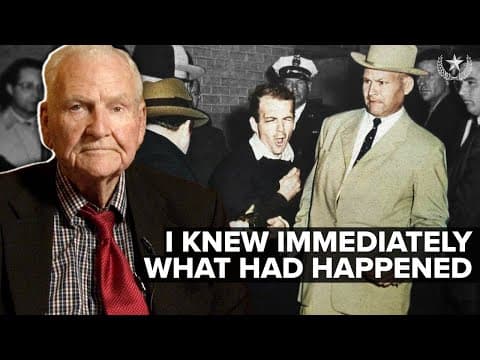
James Leavelle, a Dallas police detective, shares his firsthand account of being handcuffed to Lee Harvey Oswald when Jack Ruby shot Oswald. Leavelle also reflects on his Navy service during World War II, the Pearl Harbor attack, and his police career, including the events surrounding the assassination of President John F. Kennedy and the subsequent shooting of Oswald.
James Leavelle, a Dallas police detective, provides a detailed and personal account of the moments surrounding the assassination of President John F. Kennedy, the arrest of Lee Harvey Oswald, and the shocking shooting of Oswald by Jack Ruby. Leavelle also shares insights into his early life, military service during World War II, and his career in law enforcement.
Leavelle was born in Red River County, southeast of Dallas, and spent his early years there before moving around West Texas during his teens. In 1937-38, at age 17, he joined the Civilian Conservation Corps, a program started by President Roosevelt, and spent a year in New Mexico. After completing his schooling, he enlisted in the U.S. Navy in 1939.
He was assigned to a destroyer that escorted aircraft carriers, which practiced landing and takeoff drills. Leavelle's role included being ready to rescue pilots who might fall into the water during these exercises. He never fired a shot during the attack on Pearl Harbor, as his gun was designed for ship-to-ship combat rather than anti-aircraft defense.
On the morning of December 7, 1941, Leavelle was aboard his ship when the Japanese attack began just before 8 a.m. It was a Sunday, and many sailors were preparing to go ashore after payday. Fortunately, the attack occurred just before the shore boats left, allowing the crew to man their battle stations promptly. Leavelle was a loader on a four-inch gun, which was ineffective against planes flying half a mile up, so he did not fire during the attack.
After his military service, Leavelle worked as a federal government auditor before joining the Dallas Police Department in 1950. He excelled in the police examination and was assigned to the homicide division.
In 1963, when President Kennedy visited Dallas, Leavelle was involved in the investigation following the assassination. Lee Harvey Oswald was stopped by Officer JD Tippett in Oak Cliff shortly after the shooting. Tippett questioned Oswald based on a general description provided by witnesses. Oswald was walking quickly and was stopped for questioning, a routine police procedure.
Witnesses described the encounter where Oswald pulled a pistol and fired four shots at Tippett, hitting him in the belt area and temple. Contrary to conspiracy theories suggesting Oswald casually walked around a car to shoot Tippett, Leavelle clarifies that Oswald fired from a steady stance without moving his gun up or down.
Oswald then fled, discarding his tan jacket to avoid identification. He entered a shoe store pretending to look at shoes but was actually listening to police radio. Suspicious, police followed him to the Texas Theater, where he was arrested after attempting to enter without buying a ticket.
Leavelle was assigned as Oswald's custodian and brought him to the police station. He initially questioned Oswald about the shooting of Tippett but was unaware of Oswald's connection to the president's assassination at that time. Captain Fritz took over the interrogation after confirming Oswald's employment at the Texas School Book Depository.
During the transfer of Oswald from the city jail to the county jail, Leavelle was handcuffed to Oswald. As they walked through the basement, Jack Ruby suddenly stepped forward and shot Oswald. Leavelle describes how he instinctively jerked Oswald's body, causing the bullet to hit Oswald off-center, about four inches to the left of the navel.
The bullet passed through Oswald's stomach, liver, and shattered a rib before lodging under the skin. Leavelle immediately called for an ambulance, and Oswald was rushed to the hospital where surgeons removed the bullet.
Leavelle had the nurse mark her initials on the bullet to ensure its authenticity for future testimony. He later filed a case report on Oswald's shooting and testified multiple times during Jack Ruby's trial.
Jack Ruby was convicted and sentenced to death, but the conviction was overturned on appeal due to concerns about the trial judge's impartiality. Ruby died in jail in early 1967 from cancer before a retrial could occur.
Leavelle reflects on the missed opportunity by police officers who failed to notice Ruby carrying a pistol before the shooting. He believes that had they been more vigilant, they could have prevented the shooting and become heroes.
James Leavelle's account provides a unique and detailed perspective on some of the most significant events in American history. From his service during World War II to his role in the aftermath of President Kennedy's assassination, Leavelle's experiences offer valuable insights into the complexities and human elements behind these historic moments.



















