
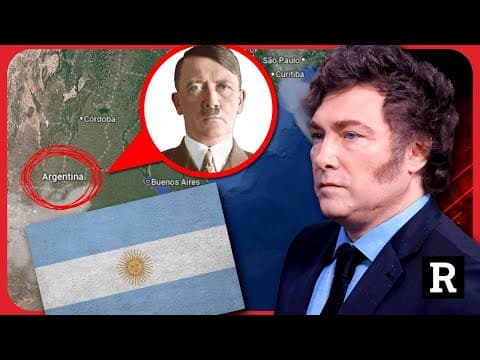
Argentinian President Javier Milei has ordered the release of documents revealing the escape of Adolf Hitler and other Nazis to Argentina after World War II. This post explores the historical context, evidence supporting Hitler's survival, and the implications of these revelations.
In a surprising move, Argentinian President Javier Milei has ordered the release of all remaining documents related to the escape of Adolf Hitler and other Nazis to Argentina following World War II. This revelation has reignited discussions about the widely held belief that Hitler did not die in his Berlin bunker but instead fled to South America.
Most historians and those familiar with the subject agree that the story of Adolf Hitler's suicide in a Berlin bunker as the Red Army closed in is a fabricated narrative. Evidence suggests that Hitler escaped Germany weeks before the fall of Berlin, utilizing a network of underground tunnels that led to an airstrip. From there, he was flown out of Germany, with submarines transporting him to Argentina.
It is believed that Hitler lived in Argentina for nearly two decades after the war, with many accounts suggesting he resided in Bariloche until his death in the mid-1960s. This theory is supported by various intelligence documents, including those from the CIA and FBI, which detail sightings of Hitler in Argentina. The existence of these documents raises questions about the extent of knowledge held by the United States and its allies regarding Hitler's fate.
The influx of Nazis into Argentina was not merely a coincidence. After World War II, many members of the Third Reich established a significant base of operations in Argentina, effectively creating a second stronghold outside of Germany. This migration was facilitated by Operation Paperclip, a secret program that allowed the U.S. to recruit former Nazis, including scientists and intelligence operatives, to work for American interests.
One of the most contentious pieces of evidence regarding Hitler's death is the skull fragment held by Russian authorities, which was claimed to be Hitler's. However, DNA testing revealed that the fragment belonged to a female, further casting doubt on the official narrative of Hitler's demise in Berlin.
Milei's decision to release these documents is seen as a step towards transparency in Argentina. Historians and researchers are eager to uncover the details of how many Nazis settled in Argentina and the extent of their influence. There are speculations that the documents may reveal information about Hitler's descendants, as it is rumored that he fathered two daughters during his time in Argentina.
The historical context surrounding the Nazi escape routes, often referred to as "rat lines," is crucial for understanding the post-war dynamics. Many Nazis, including scientists who contributed to nuclear research, found refuge in Argentina. The CIA's involvement in facilitating their escape and subsequent recruitment into American intelligence raises ethical questions about the lengths to which the U.S. government went to secure expertise in the Cold War era.
As the world awaits the release of these documents, the implications of Milei's actions could reshape our understanding of post-war history. The narrative that Hitler died in Berlin is increasingly challenged by emerging evidence, and the potential revelations from Argentina may provide further insights into the connections between former Nazis and American intelligence. This ongoing story highlights the complexities of historical narratives and the importance of transparency in uncovering the truth about one of history's most notorious figures.



















