
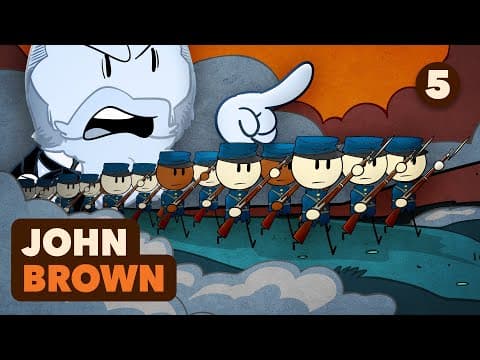
John Brown's 1859 raid on Harper's Ferry was a pivotal event in American history that intensified the national debate over slavery. Though his raid failed and he was executed, Brown's actions and trial galvanized abolitionist sentiment in the North and heightened Southern fears, contributing to the political divisions that led to the Civil War. His legacy inspired the famous song "John Brown's Body" and remains a symbol of radical abolitionism.
On October 16th, 1859, John Brown found himself holed up in the engine house at Harper's Ferry, Virginia, surrounded by a company of U.S. Marines. Negotiations with one of their officers, Jeb Stuart, had broken down. Stuart signaled their commander, Robert E. Lee, and the Marines rushed the door. Despite some wounded, they used sledgehammers and a ladder as a battering ram to break through.
Inside, Brown instructed the hostages to stand against one wall to avoid crossfire. As the Marines forced entry, Brown knelt by his wounded sons—one alive, one dead—and urged his men to sell their lives dearly. A Marine lieutenant attacked Brown with his sword repeatedly, but the sword was a dull parade sword, not a lethal weapon, so Brown survived the assault.
The Marines then dragged the wounded and dead out of the engine house. Among Brown's sons, Oliver had died during the night, and Watson, who was shot under a flag of truce, died later that day. The raiders were buried in an unmarked grave, except for Watson, whose skeleton was kept as a medical curiosity by a Southern doctor.
Brown, badly wounded and unable to stand, was taken to jail for questioning. Reporters were present during his interrogation, as both Brown and the authorities believed that spreading his message could sway public opinion.
John Brown proved to be articulate, sincere, and witty during his trial. He defended his actions using both scripture and the Constitution, arguing for liberation and racial equality. His eloquence and ideology terrified slaveholders and made him a compelling figure in the eyes of many.
While awaiting trial, Brown wrote letters defending his raid, which newspapers across the country reprinted. Meanwhile, his enemies debated who would have the honor of executing him.
Virginia Governor Henry Wise was furious that Brown had survived to stand trial and wanted to execute him to make a point. The state of Virginia's clear bias made the trial appear partisan, but this also allowed people across the country to pick sides.
Brown's defense argued that he could not commit treason against Virginia since he was not a resident, but this argument failed. His lawyers also attempted an insanity plea, which Brown rejected, finding it offensive to suggest his beliefs in racial equality were signs of mental illness.
Despite his wounds, Brown stood to give testimony. He stated that if he had acted on behalf of the rich and powerful, he would have been rewarded, but he acted for the poor and enslaved, as directed by the Bible. He declared:
"I believe that to have interfered as I have done, on behalf of God's despised poor, was not wrong, but right."
He accepted the possibility of death for the cause of justice and liberation.
Brown's speech stirred sympathy among Northern abolitionists but did not lead to widespread endorsement of his violent methods. His financial backers, known as the Secret Six, distanced themselves; some fled, one suffered a breakdown, and only Thomas Higgins faced a congressional inquiry. Higgins claimed no knowledge of the raid but later admitted that radical action was necessary to end slavery.
On December 2nd, 1859, John Brown was executed by hanging in Charlestown, Virginia. He refused spiritual counsel from a slave preacher and faced the gallows surrounded by soldiers to prevent rescue attempts. The crowd included notable figures such as Thomas "Stonewall" Jackson, Governor Wise, and Robert E. Lee, all of whom would later take part in the Confederacy but were never executed.
As Brown was hanged, an officer proclaimed, "So perish all the enemies of Virginia! All such enemies of the Union! All such foes of the human race!" Brown's final written statement predicted that the crimes of the nation would only be purged with blood, acknowledging that he had hoped for a less violent resolution.
His captured raiders were also executed. In the North, church bells tolled in his memory, honoring his pure motives if not his methods.
Brown's raid intensified Southern fears of Northern-sponsored slave rebellions. Southern propaganda used the event to center slavery in the national debate, causing divisions within the Democratic Party. This split helped Abraham Lincoln, a moderate abolitionist, win the 1860 presidential election with less than 40% of the popular vote.
Following Lincoln's election, Southern states began to secede, moving the nation closer to civil war. Brown's reputation improved in the North as many came to see him as a martyr who had been right about the impossibility of peacefully ending slavery.
Brown became a folk saint, inspiring heroic paintings and stories. However, not all portrayals were respectful. When a Union regiment enlisted a sergeant named John Brown, soldiers joked about him being dead, leading to the creation of the song "John Brown's Body." The song combined black humor with the idea that Brown's soul was marching on.
On the eve of the Civil War, Union troops sang this song while marching out of Washington, D.C., which scandalized a minister who overheard it. He suggested to abolitionist writer Julia Ward Howe that she write proper lyrics. Howe's words transformed the tune into a powerful anthem describing divine retribution and the sacrifice of Union soldiers, further cementing Brown's symbolic role in the fight against slavery.
John Brown's raid on Harper's Ferry remains a defining moment in American history. His willingness to use violence for abolition, his articulate defense, and his martyrdom helped polarize the nation and set the stage for the Civil War. His legacy lives on in American culture and history as a symbol of radical commitment to justice and equality.



















