
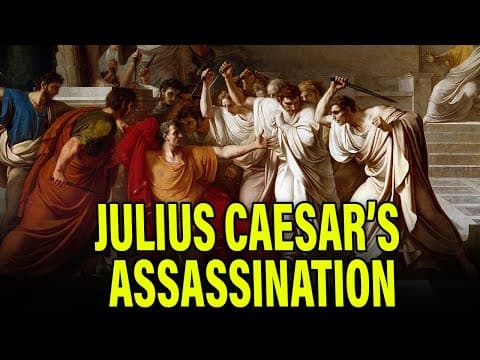
The assassination of Julius Caesar on the Ides of March in 44 BCE raises questions about betrayal versus necessity. While conspirators viewed it as a defense of the Roman Republic against tyranny, supporters saw it as a treacherous act against a leader who championed the people. This blog explores both perspectives and the broader implications of Caesar's death on Roman history.
Julius Caesar, a name that resonates through history as both a brilliant military leader and a figure of immense controversy, was assassinated on the Ides of March in 44 BCE. This event marked one of the most dramatic moments in Roman history, and the question of whether it was a betrayal has lingered ever since. Was the assassination of Caesar truly an act of treachery, or was it a necessary step to preserve the Roman Republic? In this post, we will explore both sides of the argument, dissecting the motivations behind the conspiracy that led to his death and examining the broader historical context that made his murder seem inevitable.
To understand the question of betrayal, we first need to grasp who Julius Caesar was, why he was so powerful, and what his death represented. Born into the prestigious Julian family, Caesar's rise to power was anything but typical. His military genius, especially in his conquest of Gaul, and his strategic political alliances, including his famous relationship with Pompey and Crassus in the First Triumvirate, allowed him to amass significant influence.
By 49 BCE, Caesar's power was undeniable. His decision to cross the Rubicon and march on Rome effectively marked the end of the Roman Republic as it had been known. This act of defiance against the Roman Senate set in motion a series of events that would ultimately lead to Caesar becoming the dictator of Rome. While he never officially declared himself king, his actions suggested that he was positioning himself as the sole ruler of Rome, a notion that many feared would lead to the complete collapse of the Republic.
The people who conspired to kill Caesar, including well-known figures like Brutus and Cassius, saw themselves as protectors of the Roman Republic. For them, Caesar's increasing concentration of power was a direct threat to the traditional Republican values that Rome had been founded upon. The Roman Republic was built on the principle that power should not be concentrated in the hands of a single individual; it was meant to be shared by elected officials in the Senate and other bodies with a system of checks and balances.
Caesar's declaration as dictator perpetuo (dictator for life) in 44 BCE was viewed as a direct assault on the Roman tradition of elected magistracies. The conspirators believed that Caesar was not just seeking political power; he was undermining the very foundations of Rome's political system. They feared that his ambition would eventually lead to the establishment of a hereditary monarchy, which would end the Republic once and for all. Thus, the assassination was seen as a necessary act of self-defense for the Republic. In their eyes, it was not a betrayal of Caesar but a betrayal of his intentions to destroy the system that had allowed Rome to flourish.
On the other hand, those who supported Caesar, including many of his soldiers, allies, and even members of the Roman populace, viewed his assassination as an unforgivable betrayal. To them, Caesar was the champion of the people. He had implemented a series of reforms aimed at improving the lives of the lower classes, particularly through land redistribution and debt relief. His victories in Gaul had brought wealth and glory to Rome, and many saw him as the key to Rome's continued greatness.
From this perspective, the conspirators were not defenders of the Republic but rather reactionary elites who feared losing their own power and privilege. These elites, many of whom had served as magistrates or held other important positions in Roman society, had been increasingly sidelined by Caesar's growing influence. His reforms had taken power away from the traditional aristocracy and given it to the common people, which naturally made him unpopular among the Senate and the old Roman elite.
Supporters of Caesar perceived the conspiracy as an act of envy and self-preservation on the part of the Senate, a body that had long been dominated by aristocratic families. The murder was seen as a betrayal of a leader who had brought prosperity to Rome and had given the common people a voice in government. In their eyes, the senators who conspired against Caesar were motivated not by a desire to preserve the Republic but by a desire to maintain the status quo and their own positions of power.
To fully understand whether Caesar's assassination was a betrayal, we must also consider the political climate of Rome at the time. The Roman Republic was in turmoil, with a power struggle between the Senate and various military leaders intensifying for years. The Republic was suffering from internal conflict, corruption, and political gridlock. The Senate had become increasingly ineffective at managing the affairs of the state, and military leaders like Caesar had begun to take matters into their own hands.
Caesar's rise to power was a direct result of this dysfunction, and his concentration of power was, in part, a response to the Senate's failure to govern effectively. While often portrayed as a tyrant by his opponents, it is important to note that he also enacted several reforms aimed at fixing the broken political system. He reduced the power of the Senate, reformed the calendar, and implemented policies to address Rome's growing economic problems.
In this context, the conspiracy to assassinate Caesar can be seen as an act of resistance against a system that was no longer functioning. The conspirators may have viewed Caesar's rise as the inevitable result of the political decay of the Republic. In their eyes, killing him was the last desperate attempt to restore order and prevent the complete collapse of the Roman political system.
Regardless of whether the assassination was a betrayal or a patriotic act, the outcome was clear: the death of Julius Caesar did not restore the Roman Republic. Instead, it led to a period of further instability and conflict. Caesar's assassination created a power vacuum that was quickly filled by his supporters, including his grandnephew and adopted son, Octavian, later known as Augustus, who would go on to become the first emperor of Rome.
The civil war that followed Caesar's death culminated in the rise of the Roman Empire, effectively ending the Republic that the conspirators had sought to preserve. In many ways, the assassination of Caesar can be seen as a tragic and futile attempt to prevent the inevitable transformation of Rome from a republic to an empire. The conspirators' failure to grasp the larger political forces at play—the decline of the Roman Republic and the rise of autocratic rule—meant that their actions did not achieve the desired result. Instead of preserving the Republic, they paved the way for a new form of government, one that would see the power of the emperor eclipsing the power of the Senate and the people.
So, was Julius Caesar's assassination truly a betrayal? The answer depends on one's perspective. For the conspirators, it was not a betrayal but a necessary act to protect the Republic from what they saw as Caesar's growing tyranny. They believed they were saving Rome from a future of autocracy. However, for Caesar's supporters, his assassination was undoubtedly a betrayal—a betrayal of a leader who had brought prosperity and stability to Rome and who had the support of the people.
In the end, the assassination of Julius Caesar was not just a political act; it symbolized the death of the Roman Republic and the birth of the Roman Empire. Whether or not it was a betrayal, the consequences of Caesar's death were far-reaching and irreversible, shaping the future of Rome for centuries to come.



















