
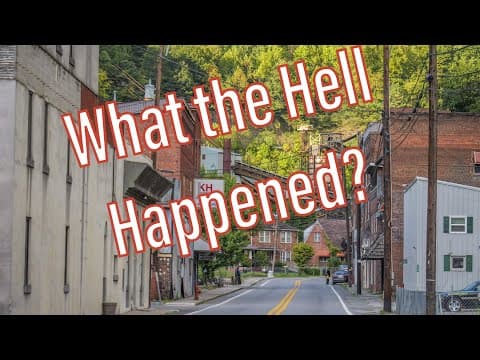
Keystone, West Virginia, known as the Sodom and Gomorrah of Appalachia, has a notorious history marked by a red light district, corruption, and a major banking scandal. This blog explores the town's dark past, the role of illegal businesses, and the impact of a banking collapse that devastated the community.
Keystone, West Virginia, a small town nestled in McDow County, is not just another dot on the map; it carries an infamous reputation that has reached far beyond its borders. Often referred to as the Sodom and Gomorrah of Appalachia, Keystone's history is steeped in tales of vice, corruption, and scandal. In this blog post, we will explore the dark past of Keystone, focusing on its notorious red light district, the role of illegal businesses, and a significant banking scandal that rocked the community.
In the early 20th century, a section of Keystone known as Cinder Bottom became infamous for its vibrant yet seedy atmosphere. This area was a hub of brothels, saloons, and all manner of debauchery, attracting coal miners from far and wide. The railroads even arranged special routes to transport miners directly to this den of iniquity, allowing them to indulge in a weekend of sin.
Cinder Bottom was not just a local curiosity; it gained national and even international notoriety. Soldiers stationed in France during World War I exchanged stories about their escapades in Cinder Bottom, treating their experiences as twisted badges of honor. The area was so well-known that it even made a chilling appearance in the film Matewan.
The operations in Cinder Bottom were not run by a single villainous figure but rather a complex web of illegal businesses. Prostitution flourished openly, often protected by corrupt law enforcement. Former State Attorney General Howard Lee recounted a visit to Keystone in 1909, where he witnessed the chief of police physically assaulting a madam for not paying her bribe on time. This was not an isolated incident but rather a reflection of the systemic corruption that allowed such activities to thrive.
Residents of Keystone viewed the brothels as part of the town's fabric, with many recalling them with a sense of nostalgia. The police were not there to enforce the law but to maintain the status quo, ensuring that the flow of money from gambling, alcohol, and prostitution continued uninterrupted.
Contrary to the common perception of prostitutes as victims, the women running the brothels in Cinder Bottom were savvy businesswomen. They navigated legal loopholes and political realities with skill, often moving from town to town to evade law enforcement. Historian accounts describe these women as hard-headed entrepreneurs who could have thrived in legitimate industries under different circumstances.
The madams of Cinder Bottom understood the importance of mobility and adaptability. They rarely stayed in one place for long, which made it difficult for authorities to pin them down. For instance, records show that women like Blanch Miller and Marie Marshall frequently changed their locations to avoid legal repercussions. This strategy allowed them to maintain control over their businesses while minimizing risks.
Ownership of a brothel provided not just profit from prostitution but also from rent, allowing these women to build small empires in the shadows of Appalachia. Cinder Bottom was more than just a location; it represented a gritty underworld where survival depended on cunning and discretion.
As if Keystone's reputation for vice wasn't enough, the town was also the epicenter of a significant banking scandal in the 1990s. This scandal was so outrageous that it seemed straight out of a crime novel, yet it was all too real.
In the weeks leading up to the bank's collapse, residents witnessed boxes of bank records being buried on the property of Terry Church, the bank's head. This was not a mere cover-up attempt; it was a desperate effort to hide a mix of corruption, theft, and incompetence that drained millions from the bank's coffers.
When the FBI unearthed these records, it triggered a series of criminal and civil cases that thrust Keystone back into the national spotlight, but this time for financial ruin rather than its red light district. At its peak, Keystone Bank was considered one of the top-performing institutions in the country, but beneath the surface lay a staggering $500 million discrepancy between reported assets and actual funds.
The fallout from the scandal was devastating. The FDIC estimated that the mess would cost taxpayers between $750 and $850 million, making it one of the most expensive bank failures in U.S. history. Knox McConnell, the mastermind behind the fraudulent scheme, promised high returns to depositors, only for the bank to collapse and lives to be ruined.
Today, Keystone is a shadow of its former self. The population has dwindled, buildings are in disrepair, and the town struggles with basic needs like a reliable water supply. While some locals are working to clean up the town, opinions are divided. Some see it as a step forward, while others mourn the loss of a dark yet significant part of their history.
Keystone, West Virginia, is a town where fortunes were made, lives were lost, and history was written in scandal and sin. From its notorious red light district to the catastrophic banking scandal, the echoes of its past continue to resonate. As the town grapples with its legacy, the phantoms of its history walk its streets, reminding us of the complexities of human nature and the shadows that linger in the heart of Appalachia.



















