On the Iraq-Iran border, Kurdish fighters are poised to potentially invade Iran, driven by their quest for greater autonomy. While US support remains uncertain, the Kurds may act independently. This situation places Iraq in a precarious position, caught between Iranian attacks and US-Israeli strikes on Iran-aligned groups, escalating regional instability.
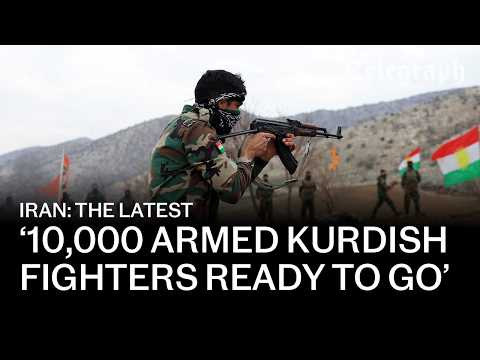
Standing just miles from the Iraq-Iran border, the geopolitical tension is palpable. The mountainous ridge line behind marks the boundary between the two countries, a critical frontline where Kurdish fighters are reportedly ready to launch a ground invasion into Iran. This potential conflict is layered with complex motivations, shifting international support, and significant regional implications.
The Kurdish fighters, among the world's largest stateless ethnic groups, are divided across four countries: Iran, Iraq, Syria, and Turkey. Their primary aim is to secure greater freedoms and autonomy. Historically, Kurds have faced discrimination and repression under both the Islamic Republic of Iran and the monarchy that preceded it.
This current moment is seen by the Kurds as an opportunity to advance their cause for self-determination. Reports indicate a newly formed coalition of approximately 10,000 armed Kurdish fighters ready to act, potentially even without US support. While they welcome assistance, particularly air support to clear obstacles posed by Iranian security forces, their resolve appears strong.
US policy, particularly under former President Trump, has been inconsistent. Initially, there was speculation about US backing, possibly through air cover or weapons. However, Trump has recently stated he would not consider such support. The US and Israel prefer to avoid deploying their own ground troops, instead potentially using the Kurds as a proxy force.
There is a notable divergence between Kurdish objectives and US interests. While the Kurds see regime change in Iran as essential for their freedom, Trump's stance on regime change has fluctuated, adding to the uncertainty.
Experts suggest that for a Kurdish offensive to succeed, several conditions must be met:
Iran's population of 90 million is ethnically diverse with strong nationalist sentiments. Any Kurdish action perceived as threatening Iran's territorial integrity may not garner widespread domestic support.
Iraq finds itself in a precarious position amid these tensions. Northern Iraq hosts Iranian Kurdish separatist groups, sharing ethnic ties with the Kurds. Iraq has tolerated their presence, but the escalating conflict has thrown the country into turmoil.
Iran and its aligned groups have launched preemptive attacks against Kurdish forces in Iraq. These attacks have targeted a broad range of sites, including US embassies, consulates, oil fields, and hotels frequented by foreigners. Concurrently, US and Israeli forces have conducted bombings against Iran-aligned paramilitary groups within Iraq.
This multifaceted conflict has severely compromised Iraq's internal security and placed it at the center of a broader geopolitical struggle involving Iran, the US, Israel, and Kurdish forces.
The situation on the Iraq-Iran border is a microcosm of larger regional dynamics. Kurdish fighters are motivated by a long-standing desire for autonomy and may act independently of fluctuating US support. Iraq's role as host to these groups and the site of ongoing attacks underscores the complexity and volatility of the region. The outcome of this tense standoff will have significant implications for the future of Kurdish self-determination, Iranian stability, and regional security.
Understanding these intertwined factors is crucial as the world watches this evolving conflict unfold along one of the Middle East's most sensitive borders.