
This blog post explores the impact of Nazi rule on occupied Europe from 1939 to 1945, focusing on the contrasting experiences in Eastern and Western Europe, the Holocaust, and the varied responses of collaboration, accommodation, and resistance among the occupied populations.
The Nazi occupation of Europe during World War II from 1939 to 1945 had profound implications for the people living in the affected regions. This blog post delves into the nature of Nazi rule, examining the contrasting experiences in Eastern and Western Europe, the Holocaust, and the responses of the occupied populations, including collaboration, accommodation, and resistance.
The Channel Islands, including Jersey, Guernsey, Alderney, and Sark, were occupied by the Nazis in June 1940 and remained under German control until May 1945. Following the invasion, major decisions were made by the German commandant, but local politicians were allowed to assist with the occupation. Resistance and sabotage were challenging, leading some to collaborate with the Nazis while others engaged in underground activities, such as printing anti-Nazi newspapers.
In October 1941, Hitler declared the Channel Islands an impregnable fortress as part of the Atlantic Wall. Most locals refused to build fortifications, resulting in the use of slave labor from concentration camps, where approximately 16,000 prisoners of war were held, with 700 dying in captivity.
Poland, which regained its independence in 1918, faced brutal occupation by the Nazis after their invasion in 1939. The Nazis aimed to eradicate Polish culture and people, leading to the establishment of the General Government, which included Warsaw. Heinrich Himmler’s General Plan for the East sought to replace Slavic populations with Germans, resulting in the expulsion of Polish citizens and the settlement of ethnic Germans in their homes.
The Nazis viewed Polish people as racially inferior, leading to widespread murder and forced labor. Historians estimate that 1.9 million non-Jewish Poles were killed, while approximately 3 million Polish Jews were murdered during the Holocaust. The Polish resistance movement became one of the largest in occupied Europe, culminating in the Warsaw Uprising of August 1944, which was brutally suppressed, resulting in the destruction of the city and the deaths of around 200,000 people.
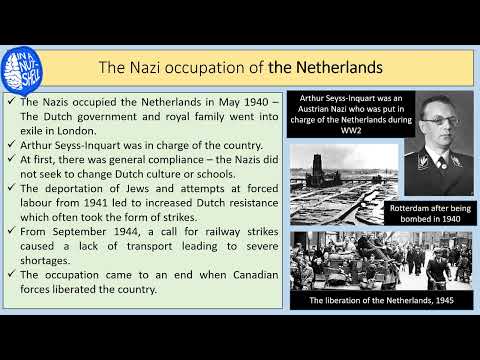
In contrast, the Netherlands was invaded by Germany on May 10, 1940, and surrendered shortly thereafter. Initially, the Dutch were treated differently due to their ethnic similarities to Germans. Civil servants continued their work, and education remained largely unchanged. However, as Nazi policies intensified around 1941-42, the situation deteriorated.
The first Jewish deportations began in 1941, leading to strikes and resistance among the Dutch population. By 1944, food shortages and forced labor led to increased resistance efforts, with many men going into hiding and illegal printing presses producing anti-Nazi materials. The Dutch resistance was significant, with 20,000 members arrested and many executed.
The Netherlands was liberated on May 5, 1945, after five years of occupation, but not before suffering severe losses, including the starvation of 20,000 people during the winter of 1944-45.
The Holocaust represents one of the darkest chapters in human history, with approximately 11 million individuals, including six million Jews, murdered by the Nazis. The Nazi approach to the Jewish population evolved over time, beginning with forced immigration and leading to the establishment of ghettos, such as the infamous Warsaw Ghetto.
As the Nazis invaded the Soviet Union in 1941, mass shootings of Jews began, often carried out by Einsatzgruppen, mobile killing units. The final solution was formalized at the Wannsee Conference in January 1942, leading to the establishment of extermination camps like Auschwitz, where millions were systematically murdered.
The responses to Nazi occupation varied widely across Europe, categorized into collaboration, accommodation, and resistance.
Collaborators actively assisted the Nazis in their occupation. In Belgium, the Lag movement sought closer ties with Nazi Germany, while in Latvia, the SS created auxiliary security forces to purge Jews and Communists. In Yugoslavia, the Chetniks collaborated with Nazi forces.
Many individuals chose to accommodate the Nazis, complying with their demands without actively collaborating. In the Netherlands, initial compliance shifted to resistance as the treatment of Jews worsened. The Danish government maintained favorable relations with Germany while rejecting anti-Semitic laws.
Resistance movements emerged across occupied Europe, with notable examples including the Polish Delegatura and the French Resistance. These groups engaged in sabotage, intelligence gathering, and efforts to protect Jews from deportation. In France, individuals like André Trocmé risked their lives to save thousands of Jews from persecution.
The Nazi occupation of Europe from 1939 to 1945 resulted in diverse experiences for the populations of occupied countries. While some collaborated with the regime, others resisted in various forms, and the Holocaust remains a stark reminder of the atrocities committed during this period. Understanding these complexities is crucial for comprehending the full impact of Nazi rule on European society during World War II.



















